
Species guide · Hymenopus coronatus
Orchid Mantis (Hymenopus coronatus): The Flower That Hunts
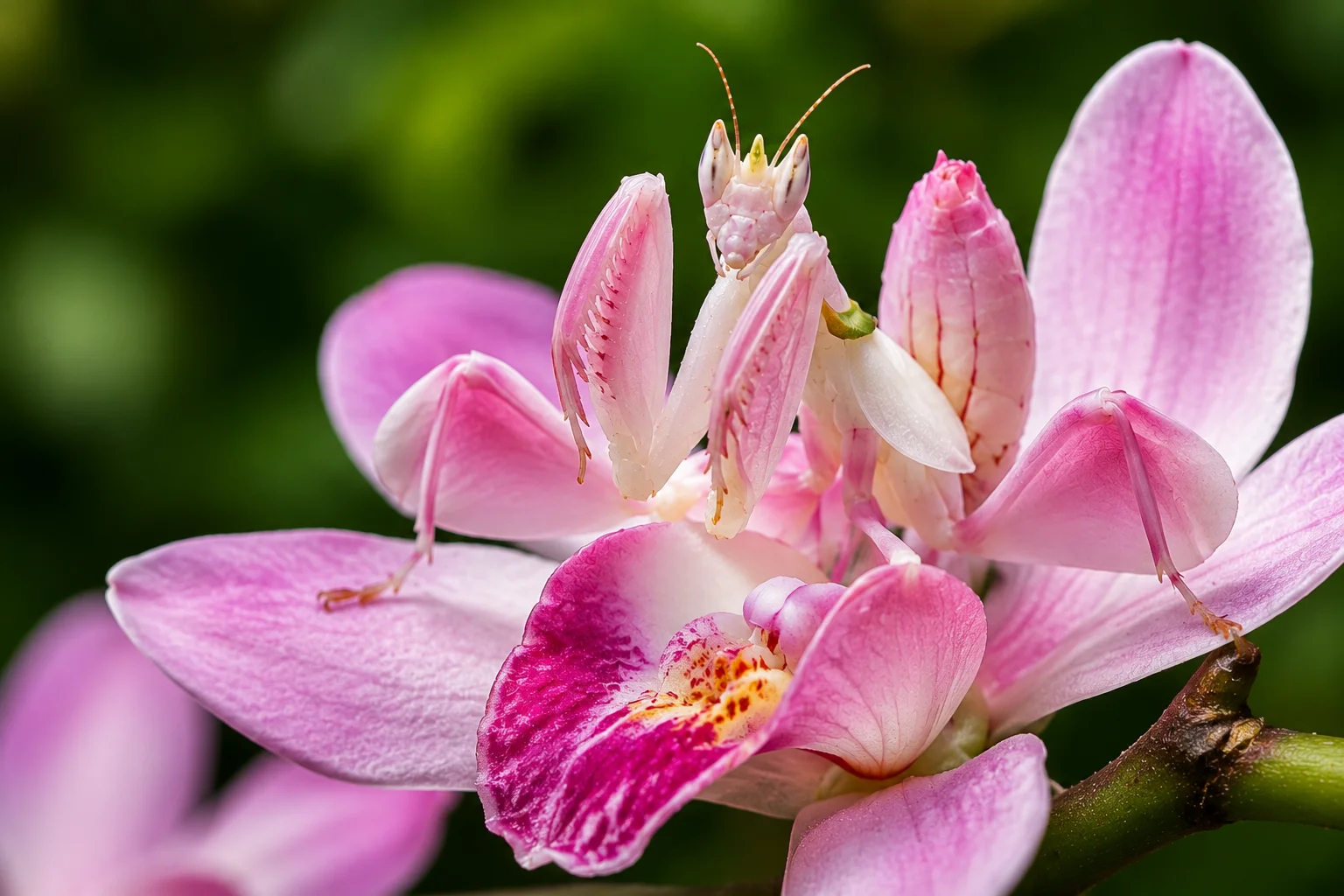
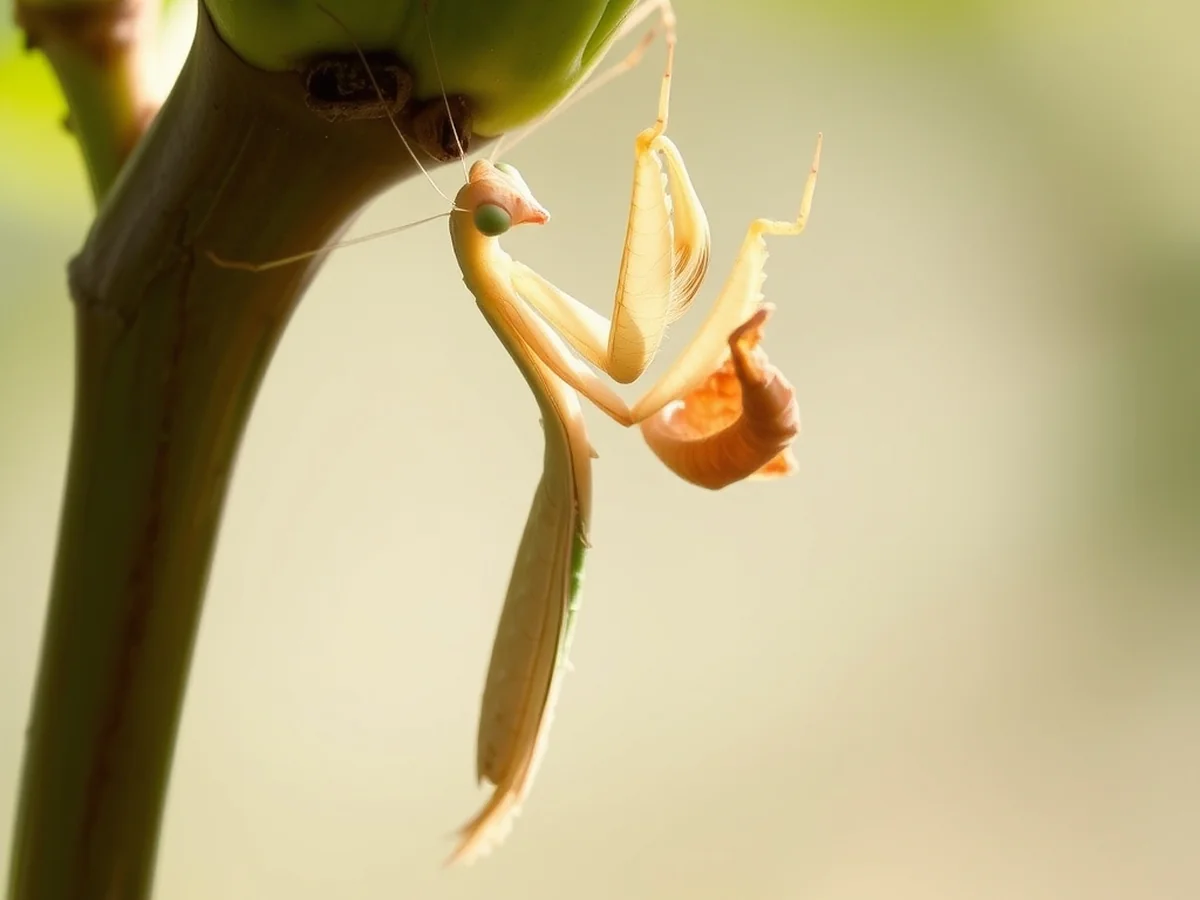
The orchid mantis is a praying mantis from the rainforests of Southeast Asia, known for looking more like a flower than an insect. Its white and pink body, petal-shaped legs and slow, swaying walk make it easy to mistake for a bloom until it moves.
That disguise is not just for hiding. Field research has shown that the orchid mantis actively draws pollinating insects toward it and then eats them, a hunting strategy scientists had suspected for more than a century before anyone could prove it.
This page brings the key orchid mantis facts together in one place: how to identify one, where it lives, how its flower mimicry works, the surprising differences between males and females, its lifespan, and a complete care guide if you are thinking about keeping one as a pet.
On this page
- Orchid Mantis Facts at a Glance
- What Is an Orchid Mantis?
- How to Identify an Orchid Mantis
- Where Do Orchid Mantises Live?
- Flower Mimicry: How the Orchid Mantis Hunts
- Male vs Female Orchid Mantis
- Orchid Mantis Life Cycle and Lifespan
- Orchid Mantis Care Guide
- Breeding and Ootheca Care
- Orchid Mantis Price in the US
- Is It Legal to Own an Orchid Mantis in the US?
- Is an Orchid Mantis the Right Pet for You?
- Orchid Mantis Guides
- Frequently Asked Questions
Orchid Mantis Facts at a Glance
| Trait | Details |
|---|---|
| Scientific name | Hymenopus coronatus |
| Other common names | Walking flower mantis, orchid-blossom mantis, pink orchid mantis, “kung fu mantis” (hobby nickname) |
| Family | Hymenopodidae (flower mantises) |
| Native range | Tropical rainforests of Southeast Asia, including Malaysia, Indonesia and Thailand |
| Adult female size | About 2.4 to 2.8 inches (6 to 7 cm) |
| Adult male size | About 1 inch (2.5 cm) |
| Color | White to pink, varying between individuals |
| Diet | Live insects, mainly flying pollinators |
| Lifespan | Roughly 8 to 9 months for females, 5 to 6 months for males |
| Pet care level | Intermediate |
What Is an Orchid Mantis?
The orchid mantis, often called the walking flower mantis, belongs to the order Mantodea, the same group as every other praying mantis. Within that order, it sits in the family Hymenopodidae, known as flower mantises because many of its members use floral colors and shapes to hunt.
Hymenopus coronatus is the best known of these flower mantises and one of the most requested species in the exotic pet hobby. Keepers prize it for its looks, but it is also an important species for science. Research on the orchid mantis has changed how biologists think about mimicry and about why males and females of one species can end up looking completely different.
How to Identify an Orchid Mantis
Once you know what to look for, an adult orchid mantis is hard to confuse with anything else.
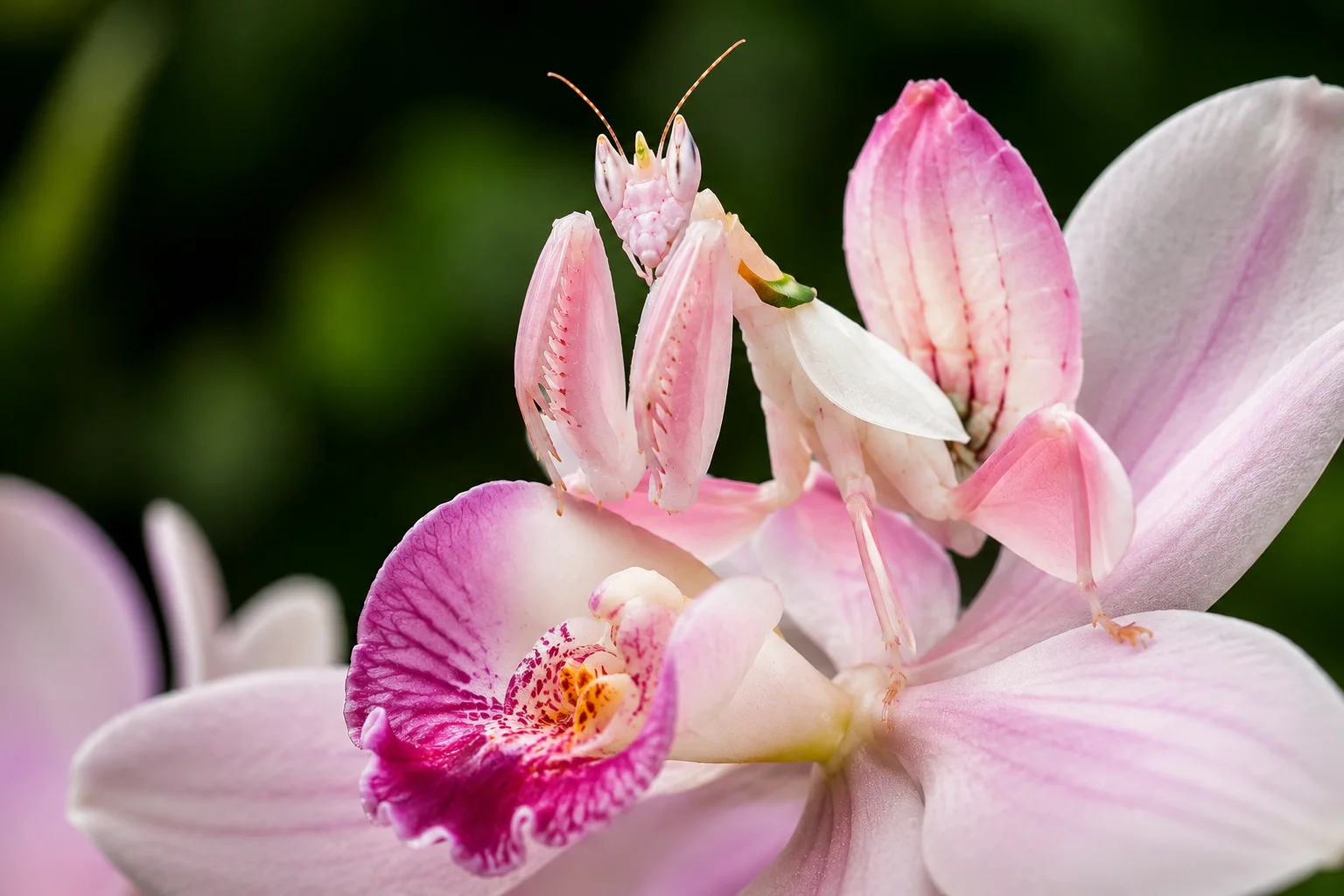
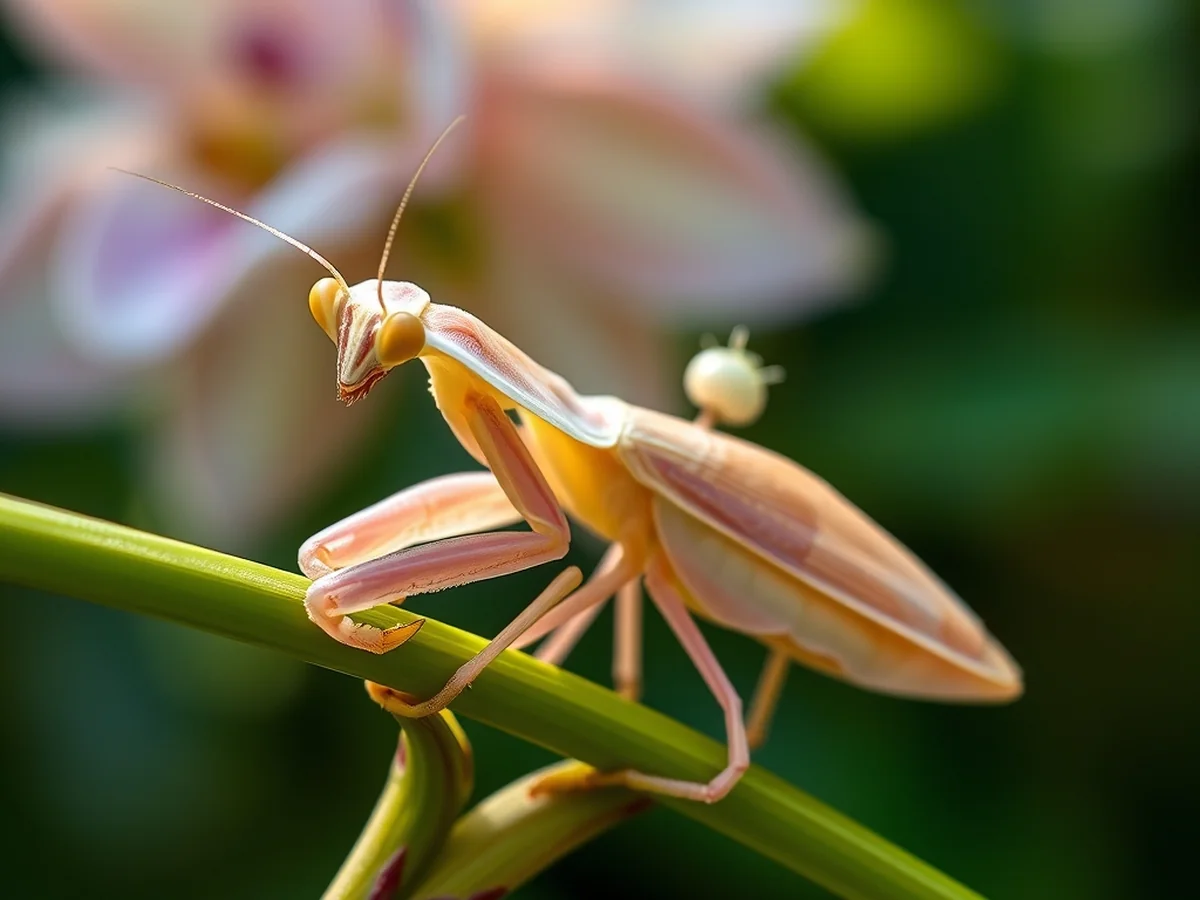
- Petal-shaped legs: The four walking legs have wide, rounded lobes that look like flower petals.
- Flower colors: The body ranges from almost pure white to soft or strong pink.
- Pointed head: A small cone-like projection sits on top of the head, between the large eyes.
- Spiked front legs: Like all mantises, it has folded raptorial forelegs lined with spines for gripping prey.
- Flower-like posture: It often sits still on a stem or leaf with its body raised, and may sway gently when it moves.
Color Variation and the “Rainbow Orchid Mantis” Myth
Real orchid mantises come in shades between white and pink. The exact tone differs from one individual to the next and can shift as the mantis grows through its molts. Our orchid mantis color morphs guide explains these changes in more detail.
Photos of blue, purple or multicolored “rainbow” orchid mantises are commonly digitally altered. The species’ natural range runs from white to pink, so a seller advertising a blue or rainbow orchid mantis should be treated as a red flag.
Where Do Orchid Mantises Live?
In the wild, the orchid mantis lives in the warm, humid rainforests of Southeast Asia. It is most often reported from Malaysia, Indonesia (including Sumatra and Borneo) and Thailand.
Rather than hiding inside orchid blooms, it usually perches on flowering shrubs and leaves where pollinating insects pass by. It has been recorded hunting flies on Melastoma shrubs, a common flowering plant in its range.
Despite how often it appears in photos, the orchid mantis is considered rare and hard to find in its natural habitat. That rarity is one reason it took so long for scientists to study its behavior in the field.
Flower Mimicry: How the Orchid Mantis Hunts
The orchid mantis is a classic case of aggressive mimicry, where a predator imitates something harmless or attractive so its prey comes close. The idea that this species imitates a flower to attract prey goes back to the 1800s, when naturalist Alfred Russel Wallace suggested it. For a long time, though, nobody had tested it.
That changed in 2014, when researchers from Macquarie University published a study in The American Naturalist (PubMed record). Their main findings were:
- To the eyes of bees and other pollinators, the color of the orchid mantis could not be told apart from the color of flowers growing in the same area.
- In field experiments, orchid mantises placed on their own attracted wild pollinators at a higher rate than real flowers did.
- The mantises caught and ate those pollinators.
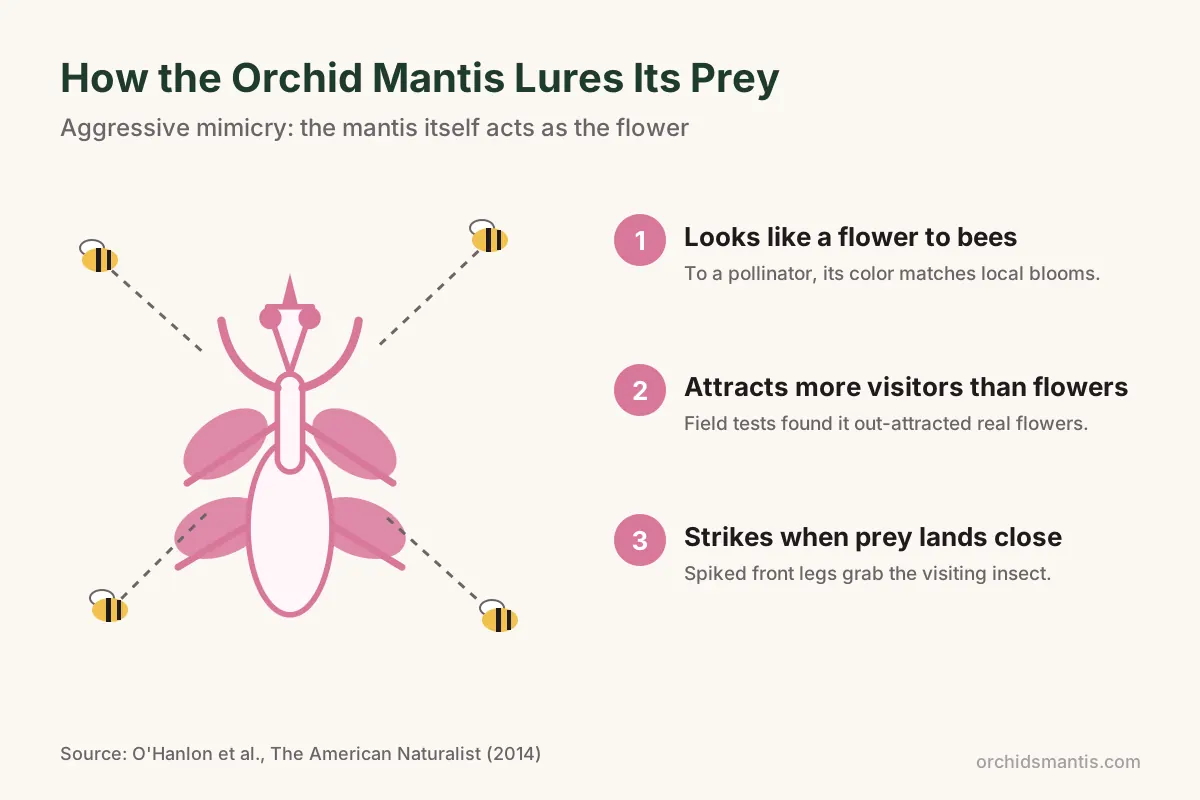
The researchers described this as the first experimental evidence of pollinator deception in the orchid mantis and a predatory strategy not documented in any other animal. The mantis is not just camouflaged among flowers. It acts as the lure itself, which means it can sit on a plain leaf and still pull in prey.
It Does Not Copy a Specific Orchid
The name suggests the mantis imitates orchids, but follow-up research by the same team did not find any single flower species that it closely matches. The current view is that it resembles a general “flower-like” signal, which works on pollinators visiting many different white and pink blooms.
This also answers a common claim on pet and fact sites: there is no good evidence that an orchid mantis changes color to match the exact orchid it is sitting on.
Young Mantises Use Chemistry Too
A separate 2014 study published in Zoological Science (DOI link) found that juvenile orchid mantises attract Oriental honeybees using both visual and chemical cues. So even before they reach their full flower-like form, young orchid mantises have their own way of luring prey.
What Orchid Mantises Eat in the Wild
The orchid mantis is an ambush predator. It waits motionless until prey comes within reach, then grabs it with its spiked front legs. Its wild diet is mostly insects that visit flowers, such as:
- Flies and hoverflies
- Bees and small wasps
- Butterflies and moths
- Crickets and beetles
Male vs Female Orchid Mantis
Males and females of this species are so different that you could mistake them for two separate insects.
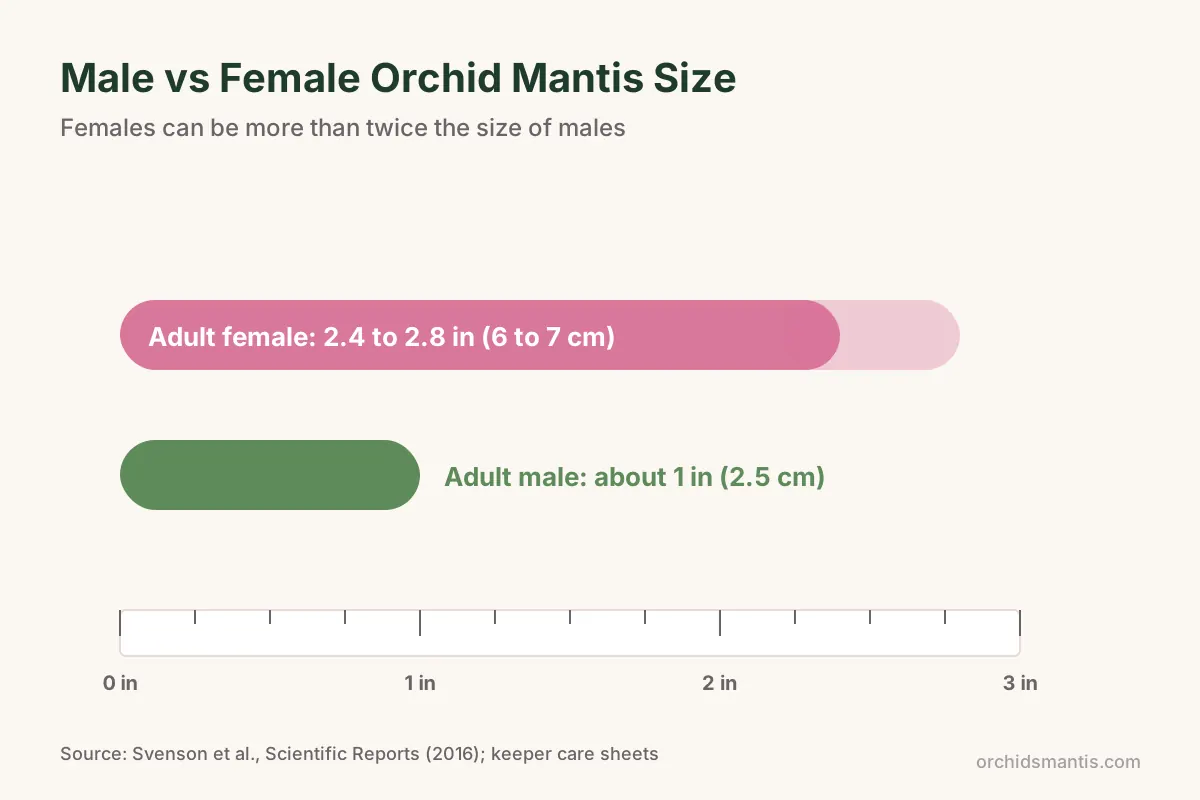
A 2016 study in Scientific Reports led by Gavin Svenson of the Cleveland Museum of Natural History (full study) found that orchid mantis females can be more than twice the size of males. The authors noted they knew of no other praying mantis species with that degree of size difference.
Usually, bigger females in insects are explained by the need to produce more eggs. The Svenson team concluded something different here: the large, colorful females evolved that way because it made them better at catching big pollinators like bees. Males stayed small, dull and camouflaged, which helps them avoid predators and travel to find mates.
| Feature | Female | Male |
|---|---|---|
| Adult size | About 2.4 to 2.8 in (6 to 7 cm) | About 1 in (2.5 cm) |
| Color | White to pink, flower-like | Duller, often greenish brown with less floral coloring |
| Behavior | Calm, slow-moving, sits and waits | Active, skittish, flies readily as an adult |
| Molts to adulthood | Around 7 to 8 | Around 5 to 6 |
| Typical lifespan | About 8 to 9 months | About 5 to 6 months |
| Abdominal segments (useful for sexing nymphs) | 6 | 8 |
Because males mature so much faster, breeders have to plan carefully to have an adult male available when a female is ready to mate. For step-by-step sexing tips, see our guide on how to tell a male from a female orchid mantis.
Orchid Mantis Life Cycle and Lifespan
Like all mantises, the orchid mantis goes through three stages: egg, nymph and adult. There is no pupa stage.
- Ootheca (egg case): After mating, the female lays her eggs inside a foamy case that hardens on a twig or surface.
- Nymph: Newly hatched nymphs look nothing like adults. They are red-orange and black, and they gain their white and pink colors after their early molts. Each stage between molts is called an instar (L1, L2, L3 and so on).
- Adult: After the final molt, the mantis has full wings and is sexually mature. It does not molt again.
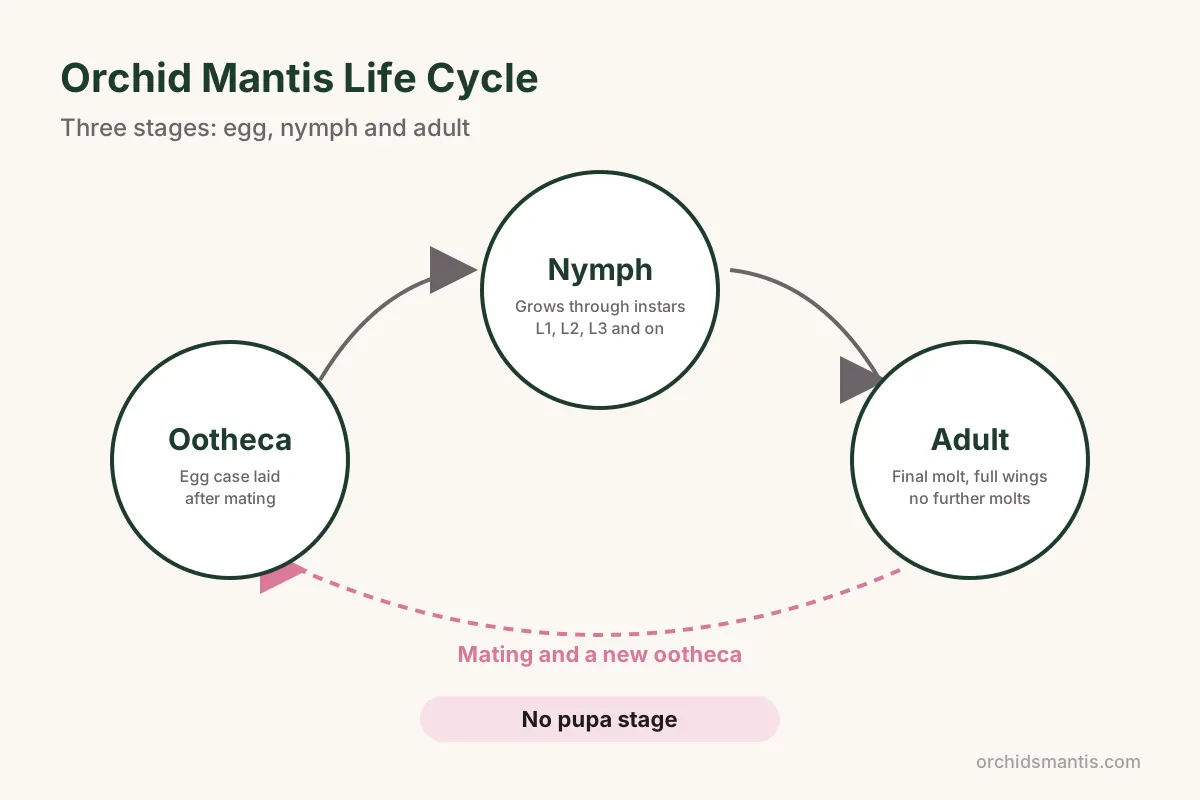
Most keeper sources put the total lifespan at roughly 8 to 9 months for females and 5 to 6 months for males, with males reaching adulthood much sooner. The Cincinnati Zoo lists the species’ lifespan as about one year. Our orchid mantis lifespan guide covers what shortens or extends it, and the molting and instar stages guide walks through each instar with a timeline.
Orchid Mantis Care Guide
Good orchid mantis care comes down to steady humidity, safe molting space and the right live food. These mantises are less forgiving than hardy beginner species like the ghost mantis, and small mistakes with humidity or ventilation can cause serious problems, especially in young nymphs. With the right setup, though, they are manageable for a keeper willing to pay attention.
The figures below come from experienced keepers’ and breeders’ care sheets rather than a single official standard. Treat them as a reliable starting range and adjust based on how your mantis behaves. For a deeper walkthrough, read our full orchid mantis care guide.
Care at a Glance
| Requirement | Recommendation |
|---|---|
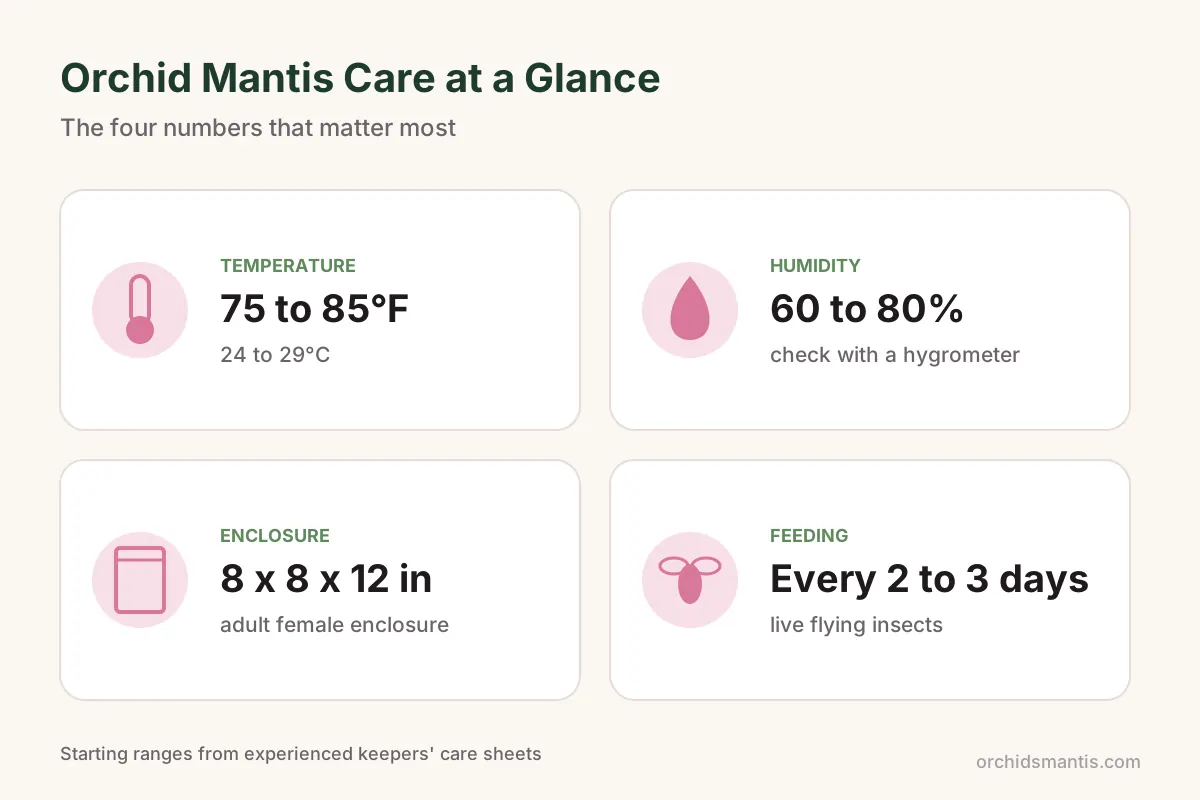
| Enclosure size (adult female) | Around 8 x 8 x 12 inches (20 x 20 x 30 cm) |
| Enclosure size (nymphs, adult males) | A ventilated 32 oz deli cup works well |
| Height rule | At least 3 times the mantis’s body length |
| Temperature | About 75 to 85°F (24 to 29°C) |
| Humidity | About 60 to 80% |
| Food | Live flying insects, no longer than about half the mantis’s body length |
| Feeding schedule | Every 2 to 3 days for most stages |
| Housing | One mantis per enclosure |
Enclosure Setup
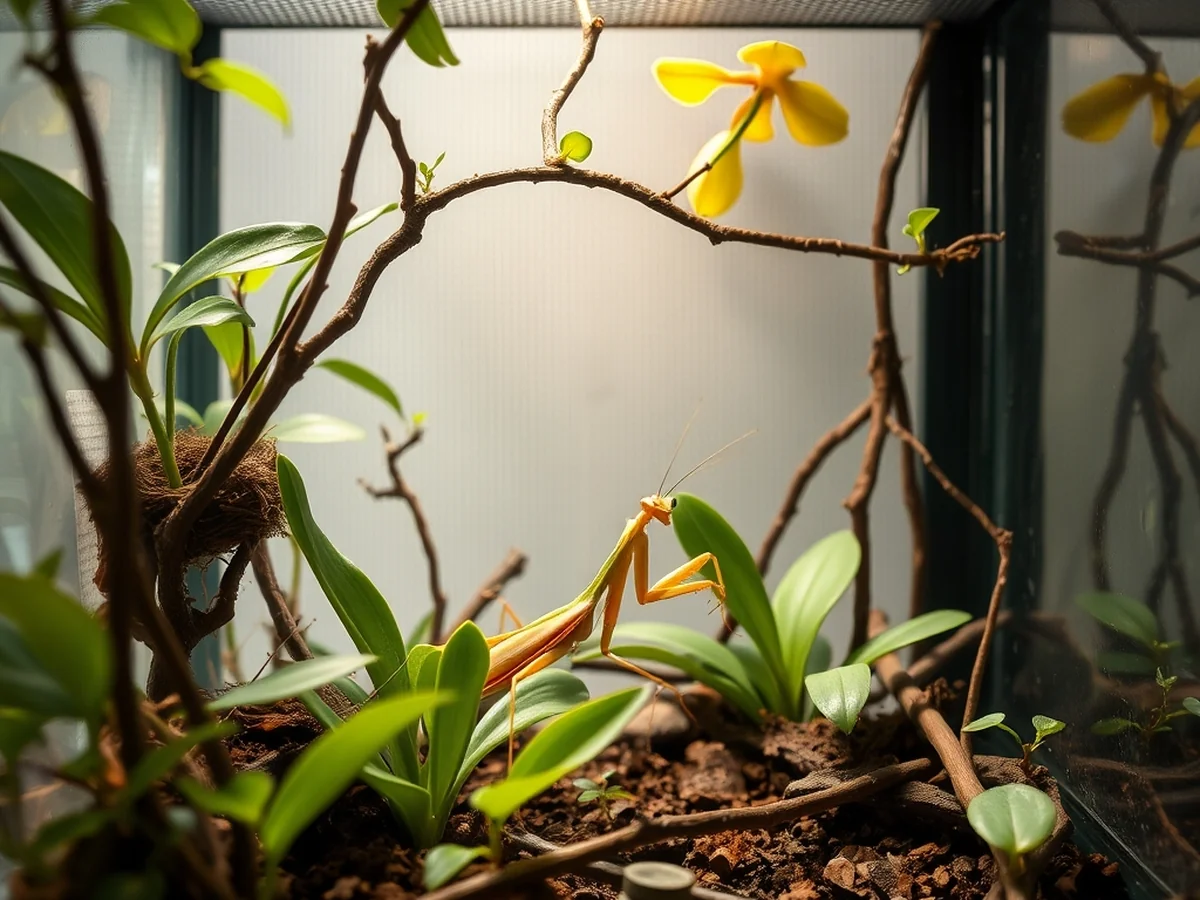
Height matters more than floor space. A mantis molts by hanging upside down and pulling itself out of its old skin, so it needs clear vertical room below it. A common guideline is an enclosure at least three times as tall as the mantis and about twice as wide.
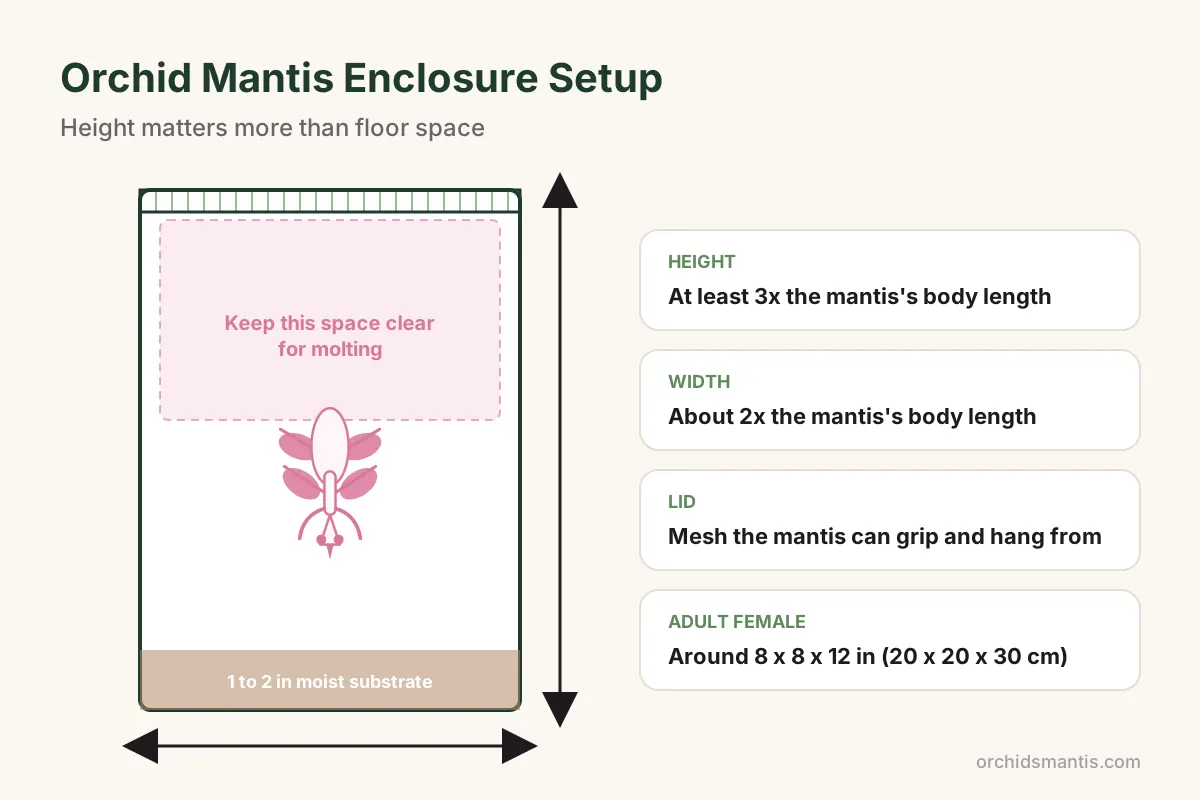
Good setups usually include:
- A mesh or ventilated lid the mantis can grip for hanging and molting.
- Climbing branches, artificial flowers or plants for perching and a sense of security.
- An open area near the top with nothing in the way, so molts are not blocked.
- Moisture-holding substrate such as coco soil, about 1 to 2 inches deep, to help keep humidity steady.
Keep orchid mantises alone. They will eat each other, and females are known to eat males.
Temperature and Humidity
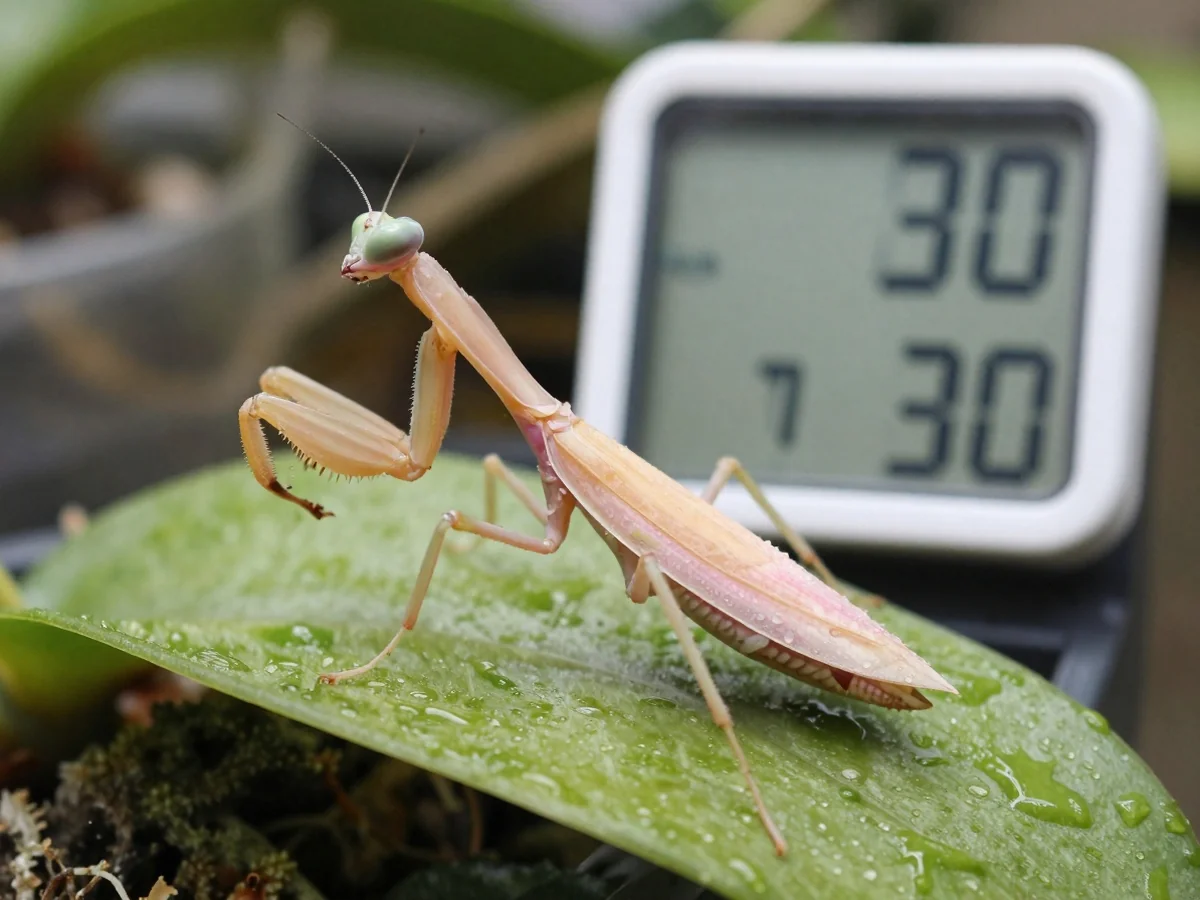
Most care guides place the ideal range around 75 to 85°F (24 to 29°C), which is warm room temperature for many homes. Use a digital thermometer so you are not guessing.
Humidity should sit around 60 to 80%, checked with a hygrometer. The tricky part is balancing humidity with airflow:
- Too little ventilation leads to stale, damp air and mold.
- Too much ventilation dries the enclosure out quickly.
- Nymphs are sensitive and should be kept slightly drier than adults, with lighter misting.
- Adults may need misting once a day depending on your setup.
Orchid mantises drink water droplets from surfaces, so misting also serves as their water source.
Feeding
Orchid mantises prefer flying prey, which matches their wild diet. A good rule is to offer insects no longer than about half the mantis’s body length.
| Stage | Suitable feeders |
|---|---|
| Young nymphs (L1 to L3 instars) | Small fruit flies (Drosophila), with larger D. hydei as they grow |
| Larger nymphs | House flies, small blue bottle flies |
| Adult females | House flies, blue bottle flies, other appropriately sized flying insects |
| Adult males | Fruit flies and small house flies |
Feed every two to three days and remove uneaten prey, since crickets and similar insects can bother or injure a molting mantis.
Molting
Molting is the most dangerous time in an orchid mantis’s life, and it happens at the end of every instar. Signs that a molt is coming include a loss of appetite and long periods hanging still from the lid.
During this time:
- Do not feed it or leave live prey in the enclosure.
- Do not touch or move the mantis.
- Keep humidity in the recommended range, since low humidity is a common cause of a mantis getting stuck in its old skin.
- Wait until the new exoskeleton has hardened before feeding, as it is soft right after a molt.
Handling
Orchid mantises have no venom and are harmless to people. Many females are calm enough to walk onto a hand. Still, they are fragile insects, so handling should be brief and gentle, and never during or right after a molt. Males are much jumpier and more likely to fly off.
Common Care Problems
| Problem | Likely cause | What to do |
|---|---|---|
| Mantis stuck in old skin | Humidity too low or not enough vertical space | Raise humidity, check enclosure height and lid grip |
| Not eating | Upcoming molt, prey too large, or temperature too low | Check for molt signs, offer smaller flying prey, check temperature |
| Mold in enclosure | Too damp with poor airflow | Improve ventilation, remove leftover food and dead insects |
| Shriveled or weak mantis | Dehydration | Mist more consistently and check humidity readings |
| Bent limbs after molting | Disturbed molt or blocked space | Keep the top area clear and avoid handling around molts |
If you are dealing with one of these right now, our guide to common orchid mantis problems like mismolts and dehydration goes through each one in detail.
Breeding and Ootheca Care
Breeding orchid mantises is possible but challenging, mostly because males mature months earlier than females and the female may attack the male.
A few practical points keepers follow:
- Plan the timing. Because males mature much sooner, keepers stagger their nymphs so an adult male is available when the female matures.
- Feed the female well first. A well-fed female is less likely to treat the male as food.
- Supervise the pairing and separate them afterward.
- Incubate the ootheca in a ventilated container, attached to a twig, with warm temperatures and steady humidity.
- Be ready for hatchlings. Newly hatched nymphs need tiny fruit flies right away and regular misting. Separate them as they grow to prevent cannibalism.
Orchid Mantis Price in the US
The orchid mantis is one of the more expensive pet mantises. At the time of writing, captive-bred nymphs from US breeders commonly sell for around $40 to $100, depending on the seller and the nymph’s age. Older, sexed sub-adults and adults often cost more, sometimes well over $100. Our orchid mantis price guide breaks these costs down further.
A few reasons for the higher price:
- They grow slowly and need tighter humidity control than hardy species.
- Young nymphs have higher losses, so breeders raise more to sell fewer.
- Most sellers require overnight shipping, which adds to the total cost.
Prices change often with supply, so compare a few reputable breeders and factor in shipping and setup costs (enclosure, thermometer, hygrometer and a fruit fly culture). Before ordering, read our checklist on where to buy an orchid mantis safely.
Is It Legal to Own an Orchid Mantis in the US?
The orchid mantis is not native to the United States. The USDA’s Animal and Plant Health Inspection Service (APHIS) regulates the importation of live insects, and importing them from abroad requires permits. Smuggled mantids and egg cases have been seized at US ports of entry.
Rules for simply owning non-native mantises are less clear-cut, and requirements can differ for places like Hawaii, Alaska and US territories. The safest approach is to:
- Buy only captive-bred animals from a US breeder.
- Never order live mantises or egg cases from overseas sellers.
- Check current requirements with USDA APHIS and your state agriculture department if you are unsure.
Is an Orchid Mantis the Right Pet for You?
Reasons people love them
- One of the most beautiful insects you can keep
- Females are calm and often easy to observe up close
- Small space requirements
- Fascinating hunting behavior to watch
Things to consider first
- Short lifespan, usually under a year
- Sensitive to humidity and ventilation mistakes
- Need a steady supply of live flying insects
- Higher cost than most pet mantises
- Must be housed alone
If you are brand new to mantises, starting with a hardier species and moving to an orchid mantis later is a sensible path.
Explore Our Orchid Mantis Guides
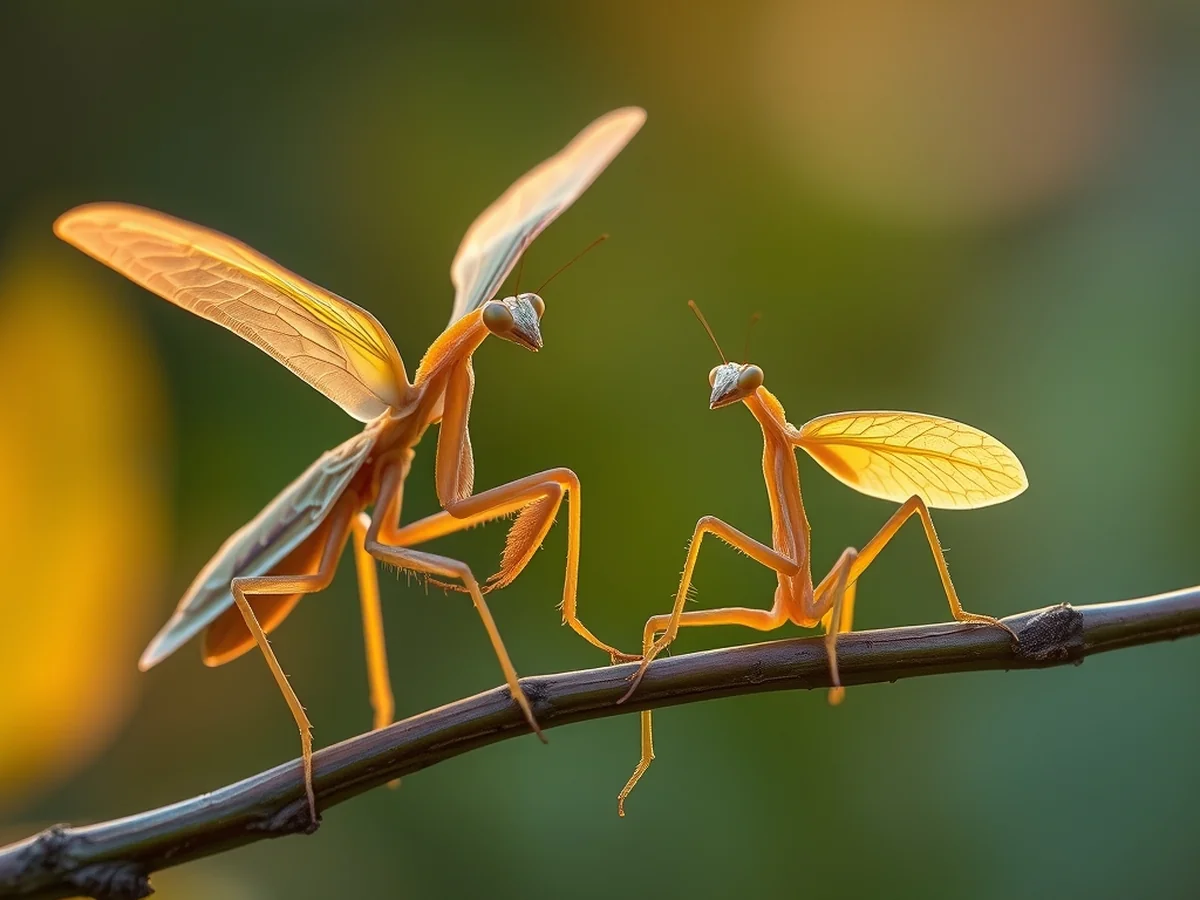
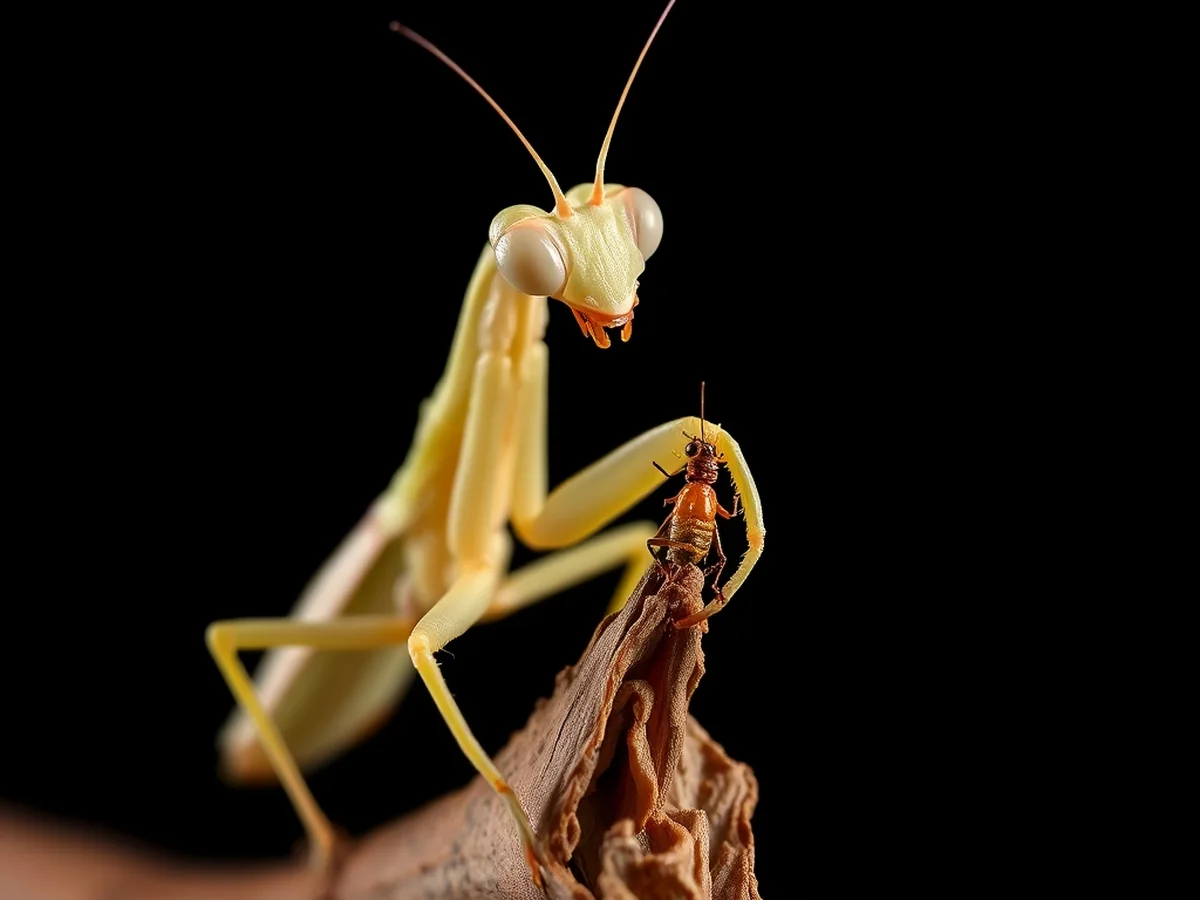
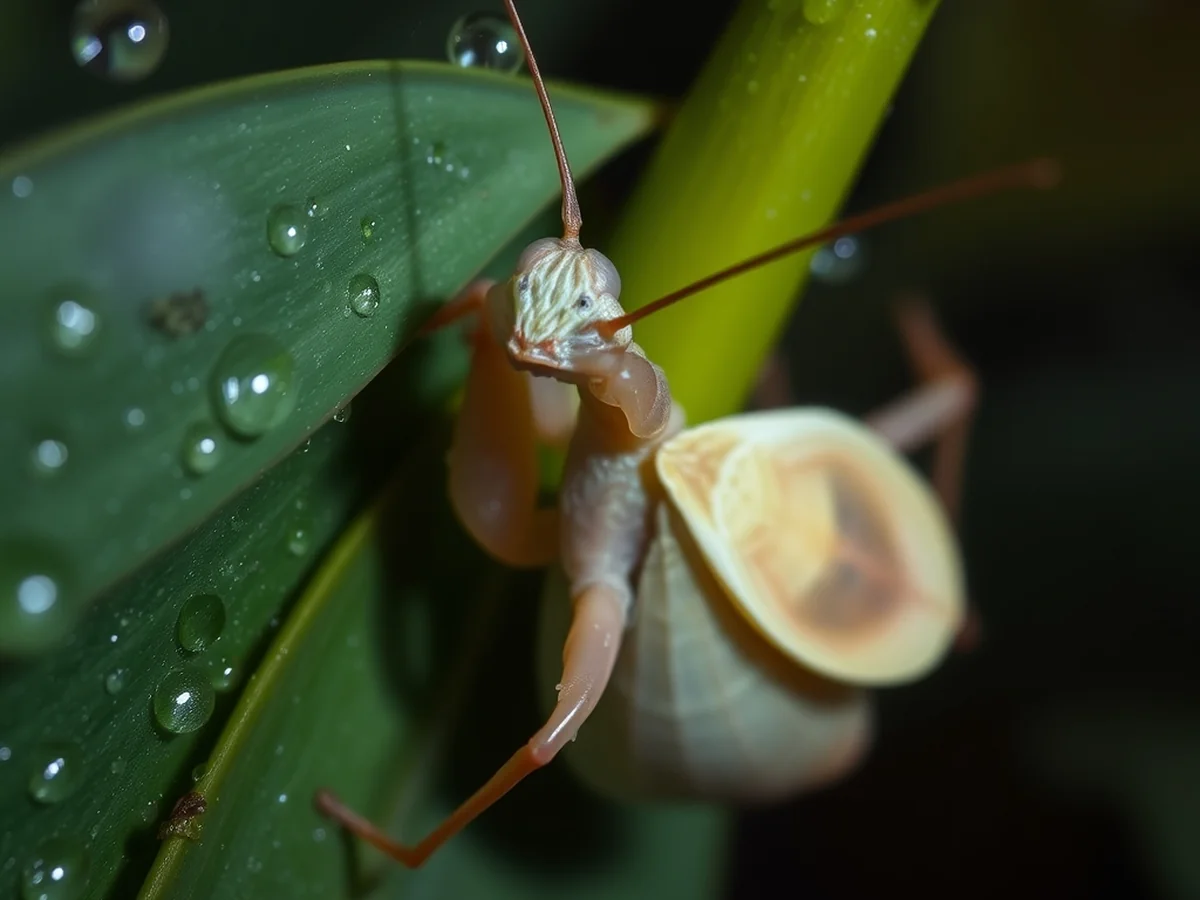
Each guide below goes deeper into one part of orchid mantis care and biology.
Frequently Asked Questions
Is the orchid mantis dangerous to humans?
No. Orchid mantises have no venom and cannot harm people. A large female might grip a finger with her front legs, but this is harmless.
How big does an orchid mantis get?
Adult females usually reach about 2.4 to 2.8 inches (6 to 7 cm). Males are much smaller, at around 1 inch (2.5 cm).
How long do orchid mantises live?
Females typically live about 8 to 9 months and males about 5 to 6 months. Good humidity and safe molts make the biggest difference to how long a pet orchid mantis lives.
Do orchid mantises change color to match flowers?
Their color varies from white to pink and can shift between molts, but research has not shown that they match the exact flower they sit on. Studies suggest they resemble a general flower signal instead.
What do orchid mantises eat?
They eat live insects, especially flying ones. In captivity, fruit flies suit young nymphs, while house flies and blue bottle flies work well for larger mantises.
Can two orchid mantises live together?
No. They are cannibalistic, so each mantis needs its own enclosure.
Why are orchid mantises so expensive?
They grow slowly, need careful humidity control, and young nymphs have higher losses than hardier species. Overnight shipping also adds to the cost.
Are orchid mantises rare?
They are considered rare in the wild, which made them difficult for scientists to study. In the pet trade, captive-bred nymphs are available from US breeders, though stock often sells out.
References
- O’Hanlon, J.C., Holwell, G.I. and Herberstein, M.E. (2014). Pollinator deception in the orchid mantis. The American Naturalist, 183(1), 126 to 132. PubMed
- O’Hanlon, J.C., Holwell, G.I. and Herberstein, M.E. (2014). Predatory pollinator deception: Does the orchid mantis resemble a model species? Current Zoology, 60(1), 90 to 103.
- Svenson, G.J. et al. (2016). Selection for predation, not female fecundity, explains sexual size dimorphism in the orchid mantises. Scientific Reports, 6, 37753. Full text
- “Double-trick” visual and chemical mimicry by the juvenile orchid mantis used in predation of the Oriental honeybee. Zoological Science (2014). DOI
- Cincinnati Zoo and Botanical Garden: Orchid Mantis
- USDA Animal and Plant Health Inspection Service: aphis.usda.gov