Cherry Blossom Praying Mantis, Celestial Mantis and Rose Mantis: Which Are Real?
Search for a cherry blossom praying mantis and you will find dreamy images of a pink insect folded like a sakura flower. Search for the celestial mantis and you will see a glowing creature landing on a hand in front of snowy peaks. Both have been shared millions of times. Neither, as far as we can find, is a real species.
Some of the other names in this trend are more complicated. “Rose mantis” is a real common name for a real insect, even though a viral “sleeping rose mantis” is fake. “Pink emperor mantis” appears to be a mix-up with a real pink mantis from the Mediterranean. This guide goes through each name, tells you what the evidence shows, and points you to the real insects behind the myths.
Quick Verdicts
| Name you searched | Real or fake? | What we found |
|---|---|---|
| Cherry blossom praying mantis / cherry blossom mantis | No species found | No described species by this name; images match the AI “flower insect” trend |
| Sakura mantis / sakura praying mantis | No species found | Same as above; the name is also used for LEGO-style builds and art |
| The celestial mantis | Fake | Viral AI clip from 2025, also shared as the lotus mantis |
| Sleeping rose mantis | Fake | Debunked by Lead Stories in April 2025 |
| Rose mantis / Indian rose mantis | Real (different insect) | A common name for Gongylus gongylodes, the wandering violin mantis |
| Pink emperor mantis | No species found | Likely confused with the pink form of Empusa pennata, sometimes called the pink Empusa mantis |
| Butterfly mantis, lily mantis | No species found | Not recognized names for any species we could verify |
The Celestial Mantis
The celestial mantis is the most famous of these names, and the easiest to check.
According to Sportskeeda’s investigation, the clip started as a post by the Instagram user @oleg.pars on March 7, 2025, describing a “lotus mantis” said to live high in the mountains. The original post carried hashtags including #ai, #vfx, #digitalart and #midjourneygallery. On April 1, 2025, another account reposted the video with the caption “The Celestial Mantis just landed on his hand. Only 3 sightings in the last 150 years,” and the name stuck.
Sportskeeda points out that the gloved hand in the video appears to have six fingers, a typical error in AI-generated imagery. There is no scientific record of a celestial mantis, and no entomologist has described it. Our lotus mantis page covers this clip and its timeline in detail.
Is the celestial mantis real? No. It is AI-generated art.
The Cherry Blossom Praying Mantis
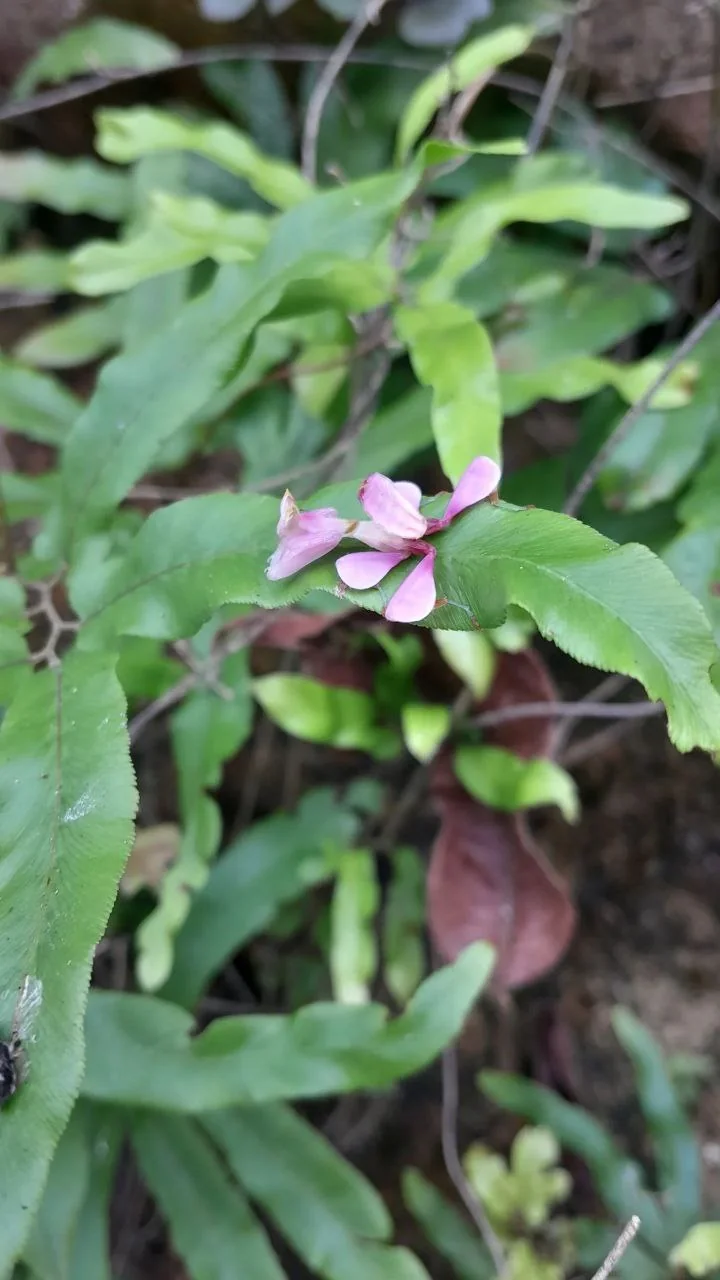
Images labeled “cherry blossom mantis” or “sakura mantis” usually show a pink insect with petals arranged like a cherry blossom, often on a branch in full bloom. We searched for any species with this common name and found none. The name does not appear as a species in the scientific and fact-check sources we reviewed, and real mantises do not grow petal-shaped structures from their backs.
The name “Sakura Mantis” also shows up as the title of LEGO creations and digital art. That is a legitimate use, but it adds to the confusion when those images are reshared without context.
Many of these images come from the same wave of AI “flower insect” content that produced the lotus mantis and the sleeping rose mantis. Hoax trackers such as MalwareTips have documented several similar creatures, including a “Mantiflora aurantia” that has no record in the Global Biodiversity Information Facility.
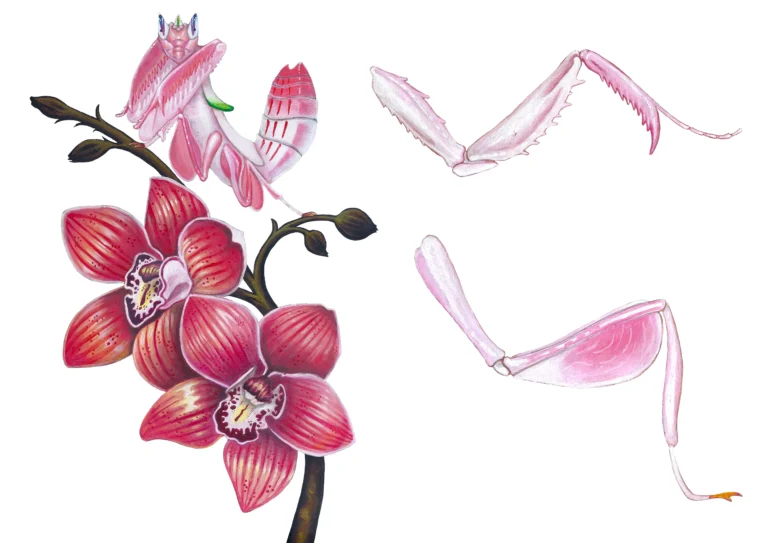
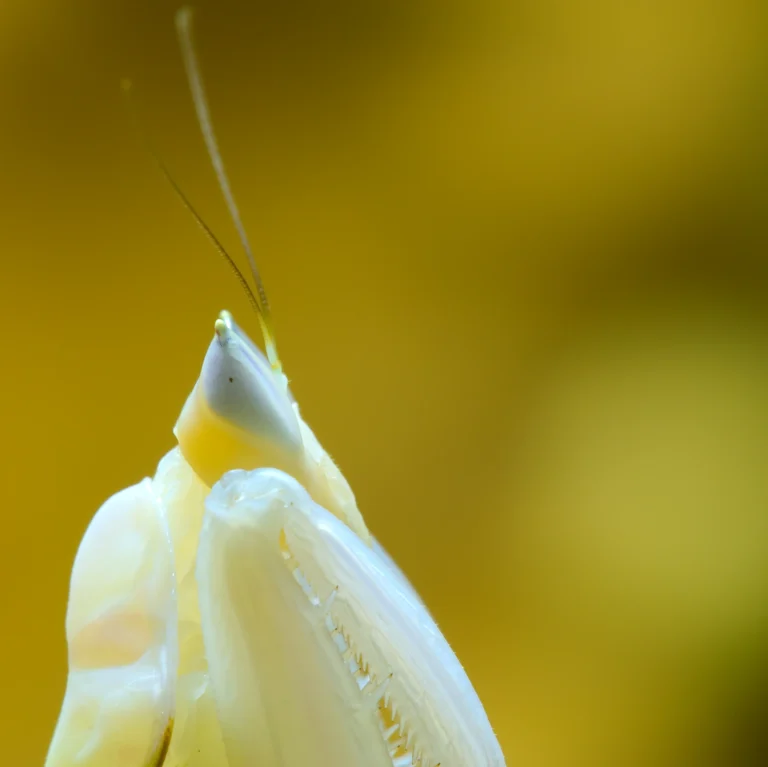
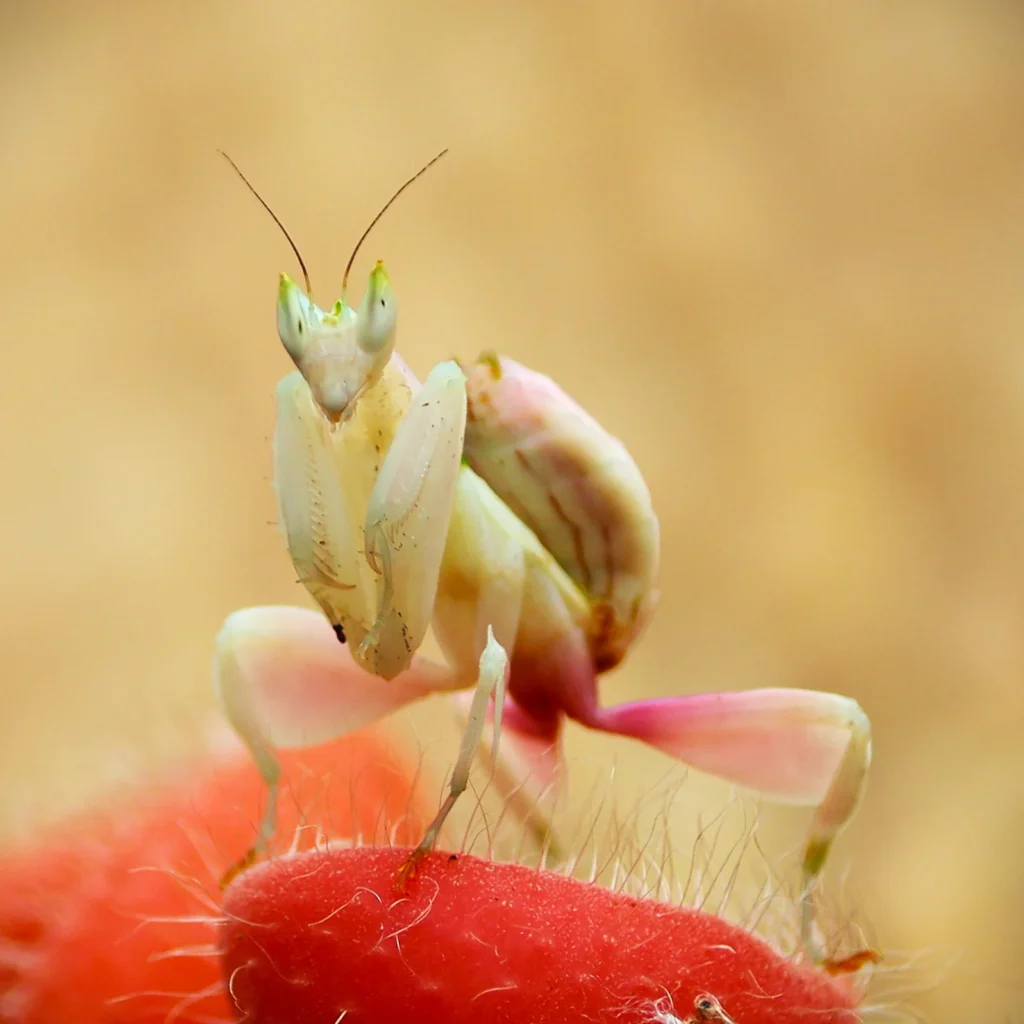
If you want to see a real insect that looks like a pink blossom, look at the orchid mantis. Its white to pink body and petal-shaped legs are the real-life version of what the cherry blossom images imagine. See our pink praying mantis guide.
Real mantises on real cherry blossoms
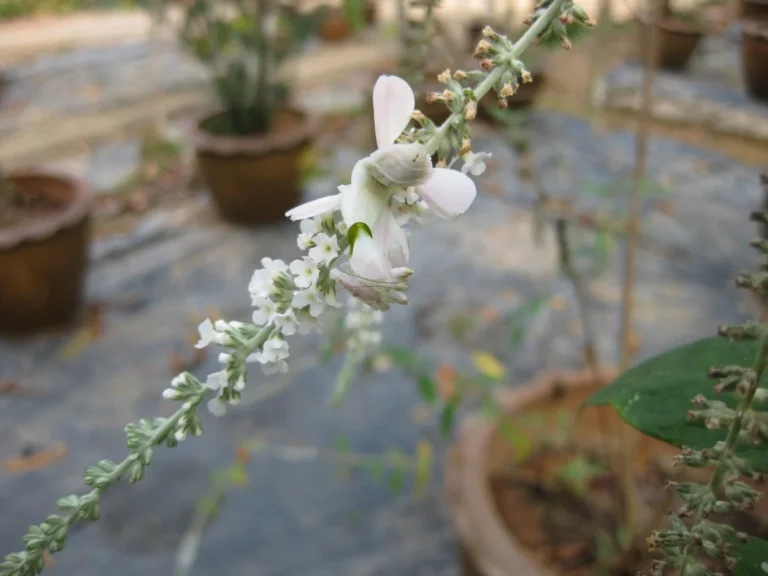
A real praying mantis sitting on a cherry blossom is perfectly possible, and photos of one are not suspicious on their own. Mantises of many species hunt on flowers because flowers bring prey to them. The University of California’s Bug Squad blog, for example, has photographed a native Stagmomantis mantis waiting beside verbena blossoms for butterflies.
There is a small seasonal twist, though. In Japan, where cherry blossom imagery is strongest, the praying mantis is traditionally a symbol of autumn, according to US Mantis’s write-up of mantis folklore. Cherry blossoms bloom in spring, when most temperate mantises are still tiny nymphs or unhatched eggs. A large adult mantis posed in full sakura bloom is not impossible in warmer regions, but in Japan it would be out of season. That mismatch is one more small reason to look twice at the most polished “sakura mantis” images.
The useful test is simple: is the mantis sitting on the blossom, or is it supposed to be the blossom? The first can be real. The second is not.
The Rose Mantis: One Real, One Fake
“Rose mantis” is where you need to be careful, because two different things share the name.
The sleeping rose mantis (fake)
In late April 2025, posts on X shared a nine-second video of a so-called sleeping rose mantis, said to be native to the Himalayas. The insect appeared to unfold from a rose. Lead Stories published a fact check on April 30, 2025, finding that the clip came from an Instagram account that posts “unbelievable creatures” and that, when it uploaded the video on March 18, 2025, it credited generative AI tools including Flux, Midjourney and Kling. Lead Stories also searched Google Scholar, JSTOR and other databases and found no scientific mention of the insect.
Is the sleeping rose mantis real? No.
The Indian rose mantis (real)
Separately, “Indian rose mantis” is a genuine common name for Gongylus gongylodes, a mantis also called the wandering violin mantis or ornate mantis. It belongs to the family Empusidae and lives in southern India and Sri Lanka, with records from Java, Myanmar and Thailand.
It looks nothing like a rose blossom. It is extremely slender, with leaf-like flaps on its legs and a wide plate on its thorax, and Wikipedia notes it can reach about 11 cm. It sways back and forth to imitate a twig moving in the wind and feeds mainly on flying insects. Hobbyists keep it as a pet, and it is unusual among mantises in tolerating group living without much cannibalism.
So when someone says “rose mantis,” ask which one they mean. A rose praying mantis video is almost certainly the AI clip. A “rose mantis” in a breeder’s price list is probably Gongylus.
The Pink Emperor Mantis
We could not find any species called the pink emperor mantis. The closest real match is the pink form of Empusa pennata, a Mediterranean species also known as the conehead mantis. A-Z Animals profiles it as the “pink Empusa mantis,” describing a long, spiky, horn-headed mantis that can take on a pale pink color in spring that helps it blend in with blossoms and new growth.
Its photos are so striking that people often assume they are AI. The science blog Why Evolution Is True made exactly that point in May 2025, sharing a real Wikipedia photo of Empusa pennata under the title “Not an AI photo!” It is a useful reminder that some unbelievable mantises are real, which is why checking matters more than guessing.
Butterfly Mantis, Lily Mantis and Other Names
“Butterfly mantis,” “lily mantis,” “walking rose insect” and similar names circulate with images of mantises that have wings like butterflies or bodies like lilies. We found no species recognized under these names. Some posts may be loose descriptions of real mantises with colorful wings, such as the devil’s flower mantis, while others match the AI trend. Without a scientific name attached, treat them as unverified.
How to Check a Mantis Image Yourself
You do not need to be an entomologist to catch most fakes. Run through these checks:
- Ask for the scientific name. Real species have a two-part Latin name, such as Hymenopus coronatus. Search it on iNaturalist or the Global Biodiversity Information Facility.
- Count the legs. A mantis has six: two spined forelegs and four walking legs. An entomology outreach blog, BIC Bugs, notes that AI tools often give insects extra or missing legs.
- Check the hands. Extra or fused fingers are a giveaway.
- Watch for transformations. Real insects do not turn into flowers.
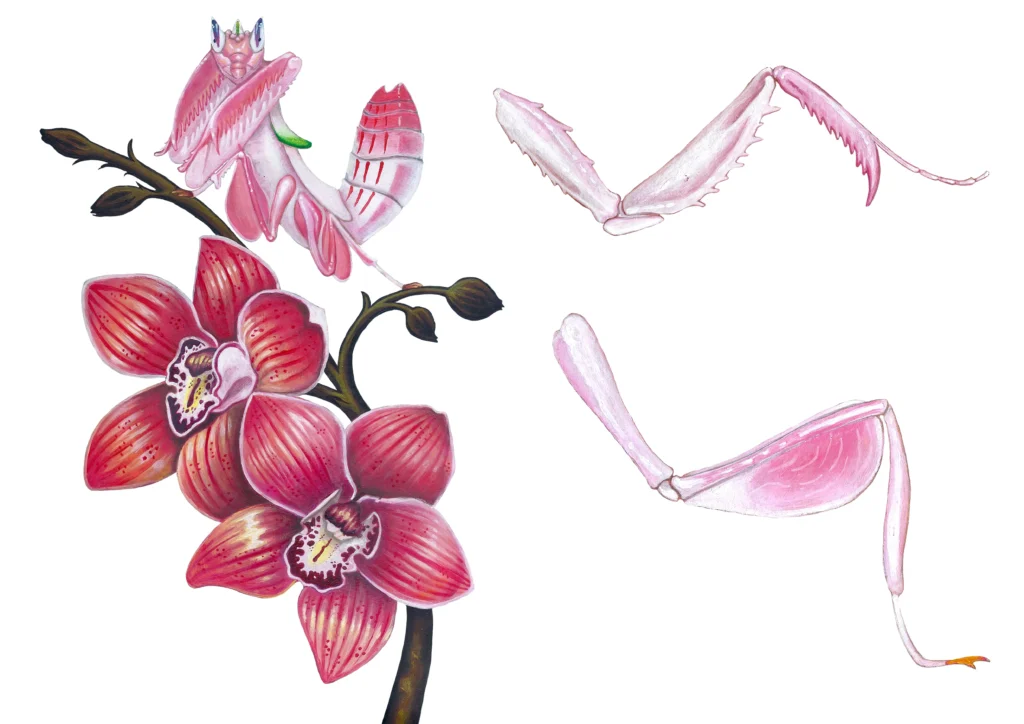
- Look for petals on the body. Real flower mantises imitate petals with flat lobes on their legs or bodies, not with actual layered petals.
- Read the original caption. Search for the first upload and look for #ai, #midjourney, #vfx or credits to AI video tools.
- Be suspicious of rarity claims. “Only three sightings in 150 years” with no location or researcher is a storytelling device.
Why These Fakes Spread
These clips succeed because they borrow from something true. Flower mantises really do exist, and they really are hard to believe the first time you see one. A real orchid mantis was shown in field research to attract pollinators at a higher rate than nearby flowers. An AI creator only needs to push that idea a little further, add a mountain and a monk, and the result feels plausible.
Scientists have started to worry about the side effects. Particle, a science outlet in Australia, reported in 2026 that a mantis specialist found an AI-generated mantis photo submitted to iNaturalist as a real observation, and that researchers have warned in Nature Ecology and Evolution about AI images contaminating citizen science records.
Real Mantises Worth Looking Up Instead
If the cherry blossom or celestial mantis caught your imagination, these real species deliver the same wonder:
| Real species | Why it is worth seeing | Our guide |
|---|---|---|
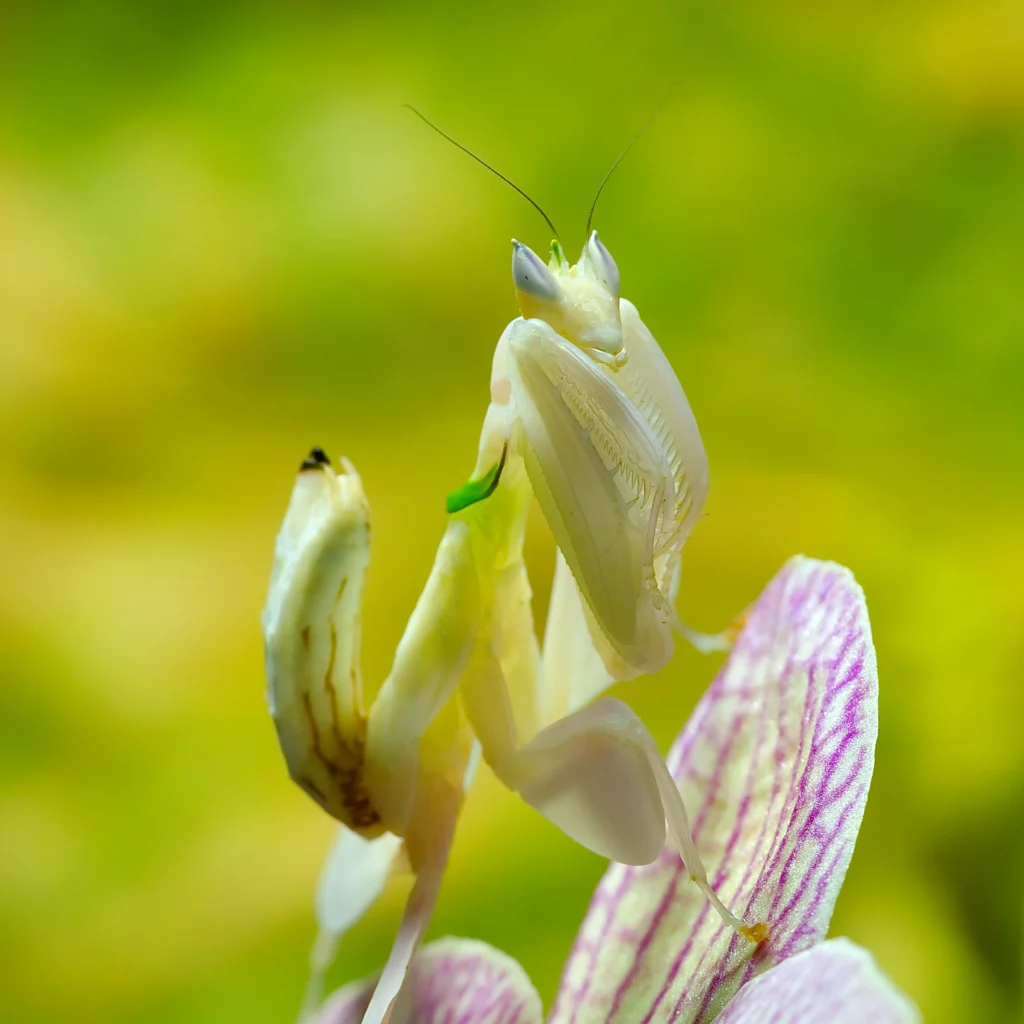
| Orchid mantis (Hymenopus coronatus) | White to pink, petal-shaped legs, lures pollinators | Orchid mantis |
| Spiny flower mantis (Pseudocreobotra) | Small, spiny, flashes a spiral eyespot | Flower mantis species |
| Devil’s flower mantis (Idolomantis diabolica) | Large, colorful forelegs, dramatic display | Blue orchid mantis explained |
| Wandering violin mantis (Gongylus gongylodes) | The real “Indian rose mantis,” twig-like and swaying | Flower mantis species |
| Conehead mantis (Empusa pennata) | Spiky, horned, sometimes pink | Pink praying mantis |
A Word on Buying
Because these names are popular, you may find listings offering cherry blossom, celestial or lotus mantis eggs. Do not pay for an animal that has no scientific name. MalwareTips, writing about a similar viral species, warns readers not to pay anyone selling eggs or pets of a creature that does not exist. If you want a real flower mantis, see where to buy an orchid mantis, and in the United States check the permit rules described in can you own an orchid mantis?
Related Guides
If you want to go deeper, these guides pick up where this page leaves off:
- Lotus mantis: real or fake?: the viral AI mantis fact-checked.
- Blue orchid mantis: the devil’s flower mantis behind the blue photos.
- Pink praying mantis: which mantises are pink, and why.
- Flower mantis species: every major flower-mimicking mantis compared.
Frequently Asked Questions
Is the cherry blossom praying mantis real?
We found no species with this name. The images match the AI “flower insect” trend. The closest real insect is the orchid mantis.
What is a celestial mantis?
It is the name given to a viral AI-generated clip first posted in March 2025 as the “lotus mantis.” It is not a real species.
Is the rose mantis real?
The “sleeping rose mantis” video is fake. However, “Indian rose mantis” is a real common name for Gongylus gongylodes, the wandering violin mantis from South Asia.
Is the pink emperor mantis real?
We could not find a species by this name. It is probably a mix-up with the pink form of Empusa pennata, a real Mediterranean mantis.
Why does the celestial mantis video look so real?
Modern AI video tools are trained on huge numbers of real photographs, including macro shots of insects. They reproduce lighting, texture and depth of field very well. Where they still struggle is structure: legs, joints, fingers and how parts connect. That is why counting legs and fingers is the fastest check.
Is there a sakura mantis?
Not as a species. “Sakura Mantis” is used as a name for art and LEGO builds, and for AI images of a cherry blossom insect.
How can I tell if a mantis video is AI?
Count legs and fingers, look for transformations, check the original caption for AI hashtags, and search the scientific name on iNaturalist.
Sources
- Sportskeeda, “Is the celestial mantis real? Viral footage debunked”: https://www.sportskeeda.com/pop-culture/is-celestial-mantis-real-fake-viral-footage-debunked-video-floors-netizens
- Lead Stories, “Sleeping Rose Mantis Is NOT Real Insect” (April 30, 2025): https://leadstories.com/hoax-alert/2025/04/fact-check-sleeping-rose-mantis-is-not-real-insect.html
- MalwareTips, “Mantiflora Aurantia: Real Insect or AI Hoax?”: https://malwaretips.com/blogs/mantiflora-aurantia-exposed/
- BIC Bugs, “Entomologist Spotlight: Bug Hoaxes”: https://bicbugs.com/entomologist-spotlight-anna-maria-sibylla-merian-1867-1923/
- Wikipedia, Gongylus gongylodes: https://en.wikipedia.org/wiki/Gongylus_gongylodes
- A-Z Animals, “The Pink Empusa Mantis Is One of Nature’s Most Elegant Predators”: https://a-z-animals.com/articles/the-pink-empusa-mantis-is-one-of-natures-most-elegant-predators/
- Why Evolution Is True, “Not an AI photo!” (May 28, 2025): https://whyevolutionistrue.com/2025/05/28/not-an-ai-photo/
- UC Agriculture and Natural Resources, Bug Squad: https://ucanr.edu/node/102991
- US Mantis, “Mantis Lore: Praying mantis in cultural history”: https://usmantis.com/pages/mantis-lore-praying-mantis-in-cultural-history
- The Brothers Brick, mantis tag (Sakura Mantis build): https://www.brothers-brick.com/tag/mantis
- Particle, “The Creatures Born From Code”: https://particle.scitech.org.au/science-society/the-creatures-born-from-code/
- O’Hanlon, J.C. et al. (2014). Pollinator deception in the orchid mantis. The American Naturalist. https://www.journals.uchicago.edu/doi/reader/10.1086/673858