Orchid Mantis Enclosure: How to Set Up the Right Terrarium
The right orchid mantis enclosure does three jobs. It gives the mantis enough height to molt safely, keeps the air humid without letting it go stale, and puts prey within easy reach. Get the shape and airflow right and most other details fall into place.
This guide explains enclosure size for every life stage, compares the common types of terrarium, and walks through a full setup from empty box to finished home. For temperature, humidity targets, feeding and health, see the companion orchid mantis care sheet.
Quick Answer: What Size Enclosure Does an Orchid Mantis Need?
| Stage | Suggested enclosure | Source |
|---|---|---|
| Small nymphs (L1 to L3) | A very small, ventilated cup | InsectStore |
| Juveniles and adult males | A 32 oz deli cup with a ventilated top | Dubia Roaches |
| Subadult and adult females | At least 6 x 6 x 9 inches (L x W x H); larger is better | Dubia Roaches |
| General rule | Width and length about 2 times the mantis’s length; height about 3 times | Dubia Roaches |
| Molting space | Clear space at the top about twice the mantis’s height | Dubia Roaches |
Sources differ slightly at the minimum end. A US Mantis care sheet gives 32 oz as an absolute minimum for large females, while Dubia Roaches recommends at least 6 x 6 x 9 inches for subadult and older females. Treat the larger figure as the better target for an adult female, especially if you want space for branches and decoration.
Why Height Matters More Than Floor Space
Mantises molt hanging upside down. The nymph grips the ceiling with its back legs, splits its old skin and slowly lets its new body hang down and expand. If the enclosure is too short, the mantis can touch the floor before it is free, leading to a mismolt with bent legs or crumpled wings.
That is why the orchid mantis enclosure size is defined by height. Dubia Roaches recommends a height of about three times the mantis’s length, with open space at the top of about twice its height. Floor space matters less. Orchid mantises are sit-and-wait hunters; InsectStore notes they will not hunt around for food, so a smaller enclosure makes it easier for them to find prey.
The Ceiling: The Most Important Surface
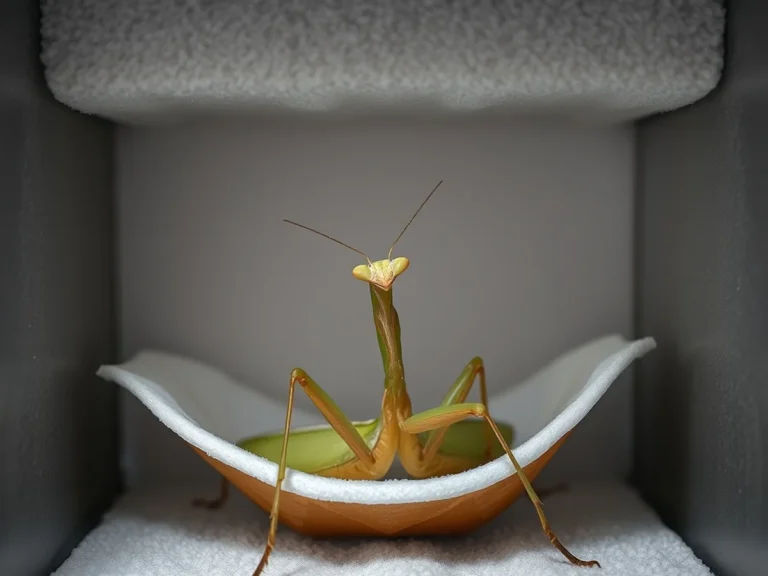
Whatever enclosure you choose, the top must be something the mantis can grip:
- Mesh or screen lids are ideal.
- Fabric or netting works for deli cups.
- Smooth glass or plastic ceilings are risky. A mantis that slips mid-molt can fall and be injured.
InsectStore specifically recommends a mesh or net lid as a gripping surface. If a lid is smooth, add a piece of mesh or rough fabric on the inside.
Types of Orchid Mantis Enclosure
| Type | Best for | Pros | Cons |
|---|---|---|---|
| Deli cup (16 to 32 oz) with fabric or mesh lid | Nymphs, adult males | Cheap, easy to replace, keeps prey close | Small; limited decoration |
| Small mesh cage | Juveniles and adults | Excellent airflow, easy grip everywhere | Loses humidity quickly; needs more misting |
| Glass terrarium with mesh top (front-opening) | Adult females, display | Good visibility, holds humidity, easy access from the front | Must have enough ventilation; check airflow |
| Acrylic or plastic box with mesh panels | Juveniles and adults | Light, clear, affordable | Can scratch; add mesh for grip if needed |
Mesh vs glass
Mesh cages give the best airflow, which matters a great deal for this species. A US Mantis care sheet warns that high humidity without adequate ventilation will kill orchid mantises. The downside is that humidity drops quickly, so you may need to mist more often. Dubia Roaches notes that mesh enclosures need more frequent misting.
Glass terrariums hold humidity better and look good on display, but airflow depends on the design. Choose one with a mesh top and ideally mesh vents low on the front, so air moves through rather than sitting still.
Ventilation
Good ventilation is what separates a healthy orchid mantis setup from a risky one. Aim for humid air that moves:
- Use mesh tops or vents.
- Never seal a container to trap humidity.
- Mist lightly so surfaces can dry between mistings.
- Watch for condensation that never clears, which is a sign of too little airflow.
Substrate
Substrate is optional for small cups but useful in larger enclosures because it holds moisture and raises humidity.
| Substrate | Notes |
|---|---|
| Paper towel | Easy to clean and replace; good for nymphs |
| Coconut fiber | Holds humidity well; common choice |
| Peat or soil | Holds humidity; listed by InsectStore |
| None (bare bottom) | Easiest to clean; works with good misting |
Dubia Roaches suggests at least 1 to 2 inches of substrate, replaced weekly, with the enclosure rinsed in hot water. Whatever you use, remove droppings and uneaten prey regularly and replace anything that grows mold.
Branches and Decoration
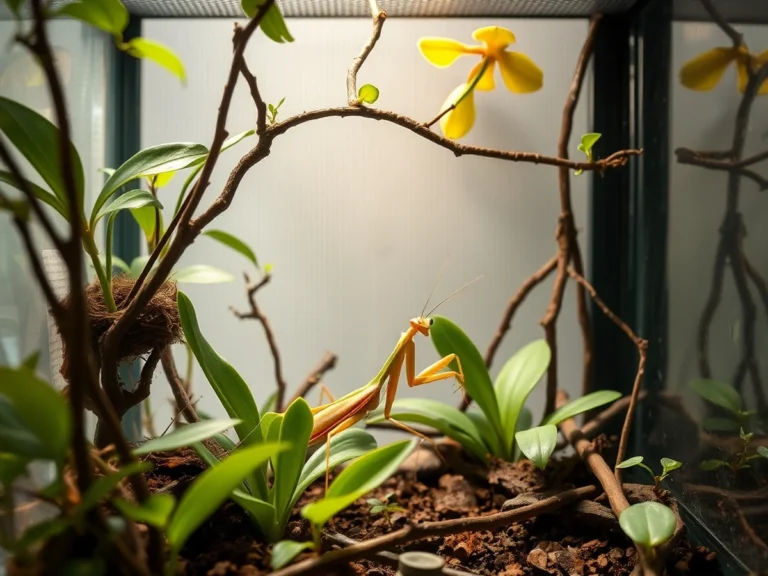
Decoration gives the mantis places to climb and perch, and it can make an orchid mantis terrarium look spectacular. Keep these principles:
- Thin twigs and branches angled from bottom to top let the mantis climb and choose a hunting spot.
- Artificial or live plants add cover and something to grip. Live plants can help humidity but need light and care.
- Leave the top clear. Dubia Roaches recommends leaving open space at the top equal to about twice the mantis’s height for molting.
- Avoid clutter. Too many leaves make it harder for the mantis to see prey and harder for you to see the mantis.
- Skip sharp or heavy objects that could fall or injure the mantis.
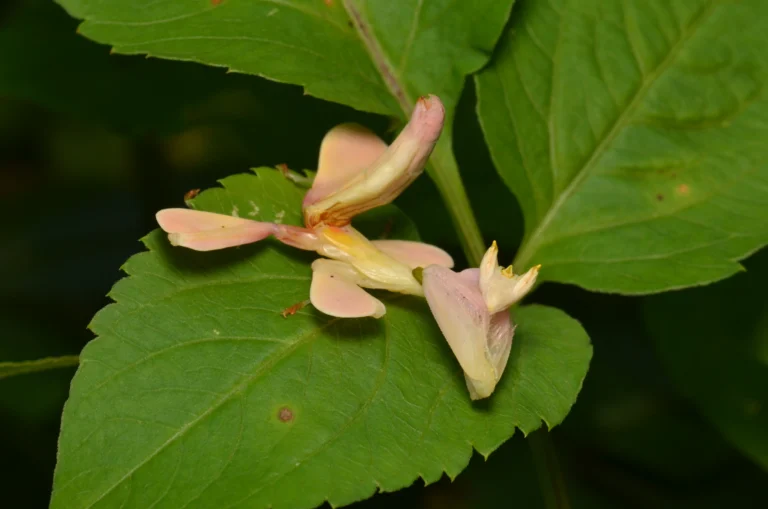
Some keepers add white or pink artificial flowers. They are decorative; there is no strong evidence they change the mantis’s color, though some keepers believe pale surroundings help. See orchid mantis colors.
Heat and Light Placement
Orchid mantises need warmth and daylight. The details of temperature are in the care sheet, but enclosure design affects how you deliver them:
- Heat lamps go above or beside a mesh enclosure, never inside. Dubia Roaches suggests a warmer basking area around 90°F in adult enclosures.
- Heat mats go on the side, not underneath; mantises spend their time high up, not on the floor.
- Lights should provide about 12 hours of bright light a day. A small white LED or fluorescent light around 6500K works, according to Dubia Roaches.
- No direct sun. Dubia Roaches warns that sunlight through a window can overheat an enclosure.
Place a thermometer and hygrometer at the height where the mantis usually sits.
Step-by-Step: Setting Up an Orchid Mantis Enclosure
- Choose the enclosure for the mantis’s current stage: a ventilated cup for nymphs, a mesh cage or mesh-topped terrarium for an adult female.
- Check the ceiling. Make sure it is mesh or add a gripping surface.
- Add substrate if using: paper towel, coconut fiber or peat, about 1 to 2 inches deep in larger setups.
- Place branches diagonally, reaching toward but not touching the top, so the upper area stays clear.
- Add a few plants for cover and grip, keeping the top third mostly open.
- Install heat and light outside the enclosure, with a thermostat if using a heat source.
- Add a thermometer and hygrometer near the mantis’s usual height.
- Mist lightly and let the setup settle for a few hours, checking temperature and humidity.
- Introduce the mantis gently by letting it walk in from its transport cup.
- Add prey once the mantis has settled, sized to no more than half its body length.
A Simple Deli Cup Setup for Nymphs
Most orchid mantis nymphs start life in a deli cup. A good cup setup takes only a few minutes:
- Use a clear plastic cup of a suitable size for the nymph, with a fabric or mesh lid. Small holes in the side add airflow.
- Lay a folded square of paper towel on the bottom to hold a little moisture.
- Wedge one thin twig diagonally from the bottom toward the lid.
- Mist lightly on the walls, not directly on the nymph.
- Add a few flightless fruit flies once the nymph has settled.
Small cups keep prey close, which matters because nymphs wait for food to come to them. Replace the paper towel whenever it gets dirty, and move the nymph to a larger cup as it grows.
Keeping Prey Inside
Flies and fruit flies escape easily, and an enclosure that lets them out also lets them into your home. A few tips:
- Use a feeding port or a small flap in the mesh so you can drop prey in without removing the lid.
- Chill flies briefly in the fridge before feeding. Cold flies move slowly for a minute, making them easier to transfer.
- Check gaps around doors and lids; fruit flies fit through tiny openings.
- Feed little and often rather than adding many flies at once, so uneaten prey does not build up.
Upgrading as the Mantis Grows
Nymphs outgrow small containers quickly. Move them up when the mantis’s length means it would no longer have about three times its length in height to molt. A female will need several upgrades; a male may stay in a 32 oz cup for life.
When moving a mantis:
- Never move it within a few days before or after a molt.
- Let it walk from the old container to the new one on a stick or your hand.
- Move some familiar branches or plants if possible.
Housing More Than One Mantis
Each orchid mantis needs its own enclosure. Orchid mantises are not communal, and cannibalism is common, especially among nymphs. The Cincinnati Zoo, raising orchid mantises from confiscated egg cases, described building individual habitats for each one.
Orchid Mantis Vivarium Ideas
Some keepers build a planted vivarium for a display female. If you try this:
- Use a front-opening glass enclosure with a mesh top and good ventilation.
- Choose small, low-light plants that tolerate humidity.
- Keep the top third open for molting.
- Make sure prey cannot hide too easily; the mantis needs to see it.
- Clean regularly; a planted setup can hide mold and uneaten prey.
A simple setup is easier to manage and safer for nymphs. Save elaborate vivariums for adult females.
Common Enclosure Mistakes
| Mistake | Why it is a problem | Fix |
|---|---|---|
| Enclosure too short | Mantis cannot hang fully to molt | Height about 3 times the mantis’s length |
| Smooth ceiling | Mantis may fall mid-molt | Add mesh or fabric |
| Sealed container | Stagnant humidity, mold | Use mesh vents; mist lightly |
| Enclosure too large for a small nymph | Nymph cannot find prey | Use small cups for young nymphs |
| Cluttered top | No clear space to molt | Keep the top third open |
| Heat source inside | Risk of burns | Place heat outside |
| Window placement | Overheating | Keep out of direct sun |
Related Guides
If you want to go deeper, these guides pick up where this page leaves off:
- Orchid mantis care sheet: temperature, humidity, feeding and molting.
- What orchid mantises eat: wild diet and a feeding guide.
- Orchid mantis life cycle: from red and black nymph to adult.
- Orchid mantis size: how big males and females get.
Frequently Asked Questions
How big should an orchid mantis enclosure be?
For an adult female, at least 6 x 6 x 9 inches, with height about three times her length. Nymphs and adult males can live in a 32 oz deli cup with a ventilated top.
Can an orchid mantis live in a glass tank?
Yes, if it has a mesh top, good ventilation and a ceiling the mantis can grip. Avoid sealed glass tanks.
Is a mesh cage good for an orchid mantis?
Yes. Mesh gives excellent airflow and grip, but it loses humidity faster, so you will need to mist more often.
What substrate is best for an orchid mantis?
Paper towel for nymphs; coconut fiber, peat or soil for larger enclosures. Replace it weekly.
Does an orchid mantis need a heat lamp?
Not always. If your room stays around 75 to 85°F, extra heat may not be needed. Otherwise, use a lamp or mat outside the enclosure with a thermostat.
How often should I clean an orchid mantis enclosure?
Spot-clean uneaten prey and droppings every few days, and refresh substrate weekly. Avoid cleaning just before or after a molt.
Can I put real flowers in an orchid mantis enclosure?
You can, but they wilt and can attract mold. Artificial flowers or live potted plants are easier to manage.
Sources
- Dubia Roaches, Orchid mantis care sheet: https://dubiaroaches.com/blogs/invert-care/orchid-mantis-care-sheet
- InsectStore, Hymenopus coronatus: https://insectstore.com/mantids/hymenopus-coronatus-orchid-mantis
- US Mantis, orchid mantis care sheet (PDF): https://cdn.shopify.com/s/files/1/1296/7335/files/Orchid_Mantis_care_sheet.pdf
- Cincinnati Zoo, “Mantis Mayhem”: https://cincinnatizoo.org/mantis-mayhem/