Orchid Mantis Life Cycle: From Red and Black Nymph to Flower-Like Adult
The orchid mantis goes through three life stages: egg, nymph and adult. It has no larva or pupa stage, which means it grows by molting, shedding its exoskeleton several times and coming out a little larger and a little more flower-like each time. Along the way it changes dramatically. A newly hatched orchid mantis is red and black and looks nothing like the white and pink adult.
This guide follows the orchid mantis life cycle step by step: the egg case, each nymph stage, the molting process, and the final change into a winged adult. For how long each sex lives overall, see our separate guide to orchid mantis lifespan.
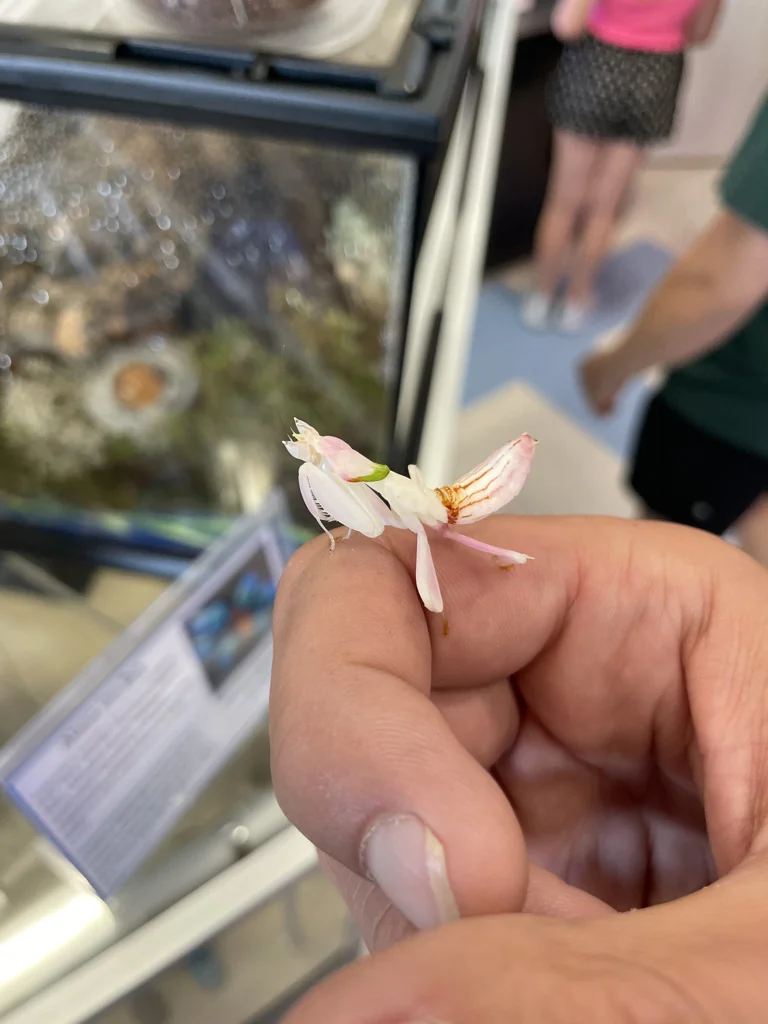
The Three Stages at a Glance
| Stage | What it looks like | Key facts |
|---|---|---|
| Egg (in an ootheca) | Foamy egg case attached to a twig | About 40 days at 80°F to hatch (US Mantis); dozens of nymphs per case |
| Nymph | Starts red and black; turns white and pink; grows femoral lobes | Grows through several molts; no wings, only wing buds |
| Adult | Full wings, full size | Sexually mature; does not molt again |
Mantises develop by what biologists call incomplete metamorphosis. The young look like small versions of the adult, without functional wings, and gradually change with each molt. That is why “orchid mantis larvae” is not quite the right term; the young are called nymphs.
Stage 1: The Egg Case (Ootheca)
After mating, the female orchid mantis produces an ootheca, a foamy mass that she attaches to a twig or other surface. The foam hardens into a protective case with the eggs sealed inside.
Sources give these figures for the orchid mantis:
- Incubation: about 40 days at 80°F, according to a US Mantis care sheet. The Montreal Insectarium gives about one and a half months.
- Number of nymphs: an average of about 40, though highly variable (US Mantis). InsectStore says a case can produce up to about 90. The Montreal Insectarium reports 25 to 50 eggs per case.
- Number of cases: a female typically produces about three (US Mantis). The Montreal Insectarium says she may produce up to four more after the first.
The ootheca, mating and incubation are covered in full in orchid mantis eggs and breeding.
Stage 2: The Nymph
Hatching
Nymphs emerge from the egg case together, often over a short period. They are tiny and need food quickly. Keepers offer the smallest flightless fruit flies right away and mist the container so the nymphs can drink.
Why baby orchid mantises are red and black
A baby orchid mantis does not look like a flower at all. InsectStore describes nymphs emerging in black and red, with those colors fading after their first molt. Wikipedia notes that first-stage nymphs mimic assassin bugs (family Reduviidae), which have a powerful bite and taste bad to predators. Looking like a dangerous, unpleasant insect is a form of protection for a tiny, defenseless nymph.
Naturalist Hugh Cott wrote about the orchid mantis nymph’s coloration in 1940, and the idea that early nymphs use warning-style mimicry has been repeated in reference works since.
“Red praying mantis” and “red and black praying mantis” searches
If you found a small red and black mantis-like insect in a breeder’s container or a photo labeled “baby orchid mantis,” this is the stage you are looking at. A red orchid mantis or “orchid mantis red” in hobby listings usually refers to these first-stage nymphs. Outside a breeder’s setup, a red or red and black mantis in your garden is far more likely to be a local species or a different insect, since orchid mantises are tropical.
The instar system: L1, L2, L3 and beyond
Each stage between molts is called an instar. Keepers label them L1, L2, L3 and so on, where L1 is a newly hatched nymph and each number goes up by one after every molt.
| Instar | Typical appearance and notes |
|---|---|
| L1 | Red and black; slim legs; looks like an assassin bug |
| L2 | Red and black colors fading; white begins to appear |
| L3 | Mostly white or pink; femoral lobes starting to show; sexing becomes possible in some individuals |
| L4 to L5 | Clear flower shape; broad abdomen often curled upward |
| Late instars | Wing buds visible on the back; size difference between sexes obvious |
| Subadult | The last nymph stage before adulthood; final molt takes longer |
Exact appearance varies between individuals and with temperature. The table gives the general pattern.
How many instars?
Males need fewer molts to reach adulthood. Keepers commonly report around 5 to 6 molts for males and around 7 to 8 for females. This is why males grow up months sooner and stay so much smaller. See male vs female orchid mantis.
How Often Do Orchid Mantises Molt?
A US Mantis care sheet reports molts about every three weeks, with the final molt (into the adult) taking roughly twice as long. Dubia Roaches gives a similar picture: every 2 to 3 weeks for juveniles and every 3 to 4 weeks for subadults.
Temperature changes the pace. In warmer conditions, nymphs molt sooner; in cooler conditions, later. Breeders use this to control timing, for example keeping males cooler so they do not mature too far ahead of females.
The Molting Process, Step by Step
Molting is the most delicate event in an orchid mantis’s life. Here is what normally happens:
- Pre-molt. The nymph stops eating, often for a day or two. Dubia Roaches notes this is normal. The nymph may look slightly swollen and less active.
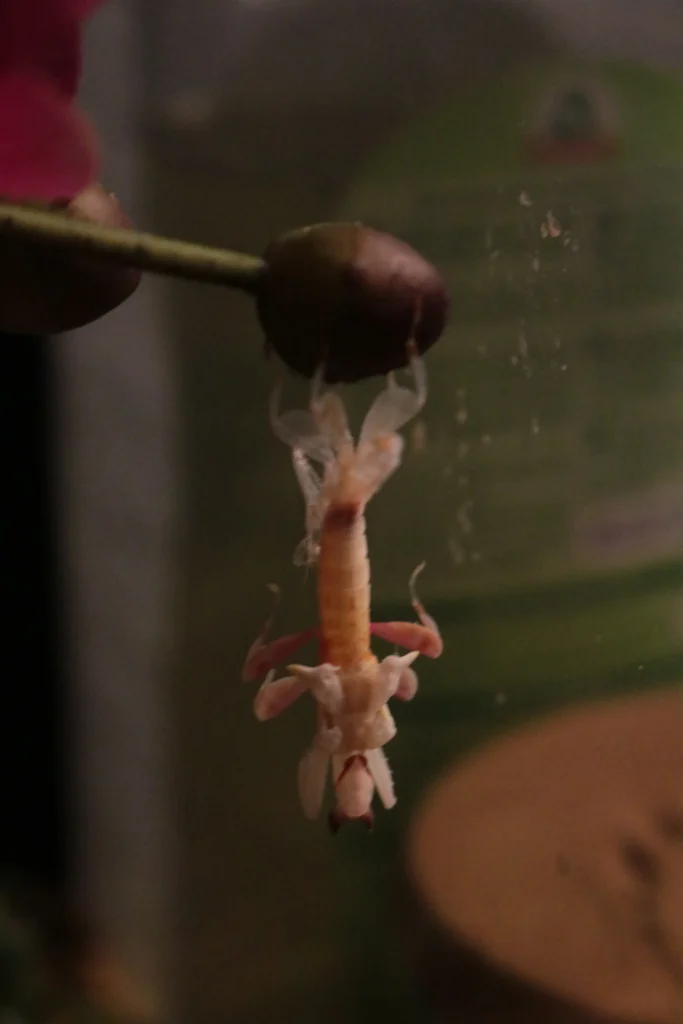
- Hanging. It climbs to the ceiling or a high branch and hangs upside down by its back legs.
- Splitting. The old exoskeleton splits along the back of the thorax.
- Emerging. The nymph slowly pulls its head, legs, femoral lobes and (later) wing buds out of the old skin, letting gravity help.
- Expanding. The new body is soft and pale. It pumps fluid to expand to its new size while hanging.
- Hardening. Over the next hours to days, the new exoskeleton hardens. Dubia Roaches recommends not disturbing a mantis for about three days after a molt.
The cast-off skin, called the exuvia, is usually left hanging where the molt happened.
Signs a molt is coming
- Refusing food for a day or two
- Hanging still from the ceiling for long periods
- A slightly bloated look
- Less interest in moving around
When you see these signs, remove any live prey, keep humidity steady and leave the mantis alone.
What goes wrong: mismolts
A mismolt happens when the mantis cannot pull itself free cleanly. Results include bent legs, twisted femoral lobes, crumpled wings or, in the worst case, death. Common causes include:
- Low humidity, which leaves the old skin too dry to shed easily
- Not enough height, so the mantis touches the floor before it is free
- A smooth ceiling with nothing to grip
- Live prey in the enclosure disturbing or biting the mantis
- Handling or moving the enclosure mid-molt
A US Mantis care sheet notes that molting rarely runs into problems in captivity despite the species’ leg extensions, provided conditions are right. Height, grip and humidity are the three things to get right. See orchid mantis enclosure for setup details.
Stage 3: The Adult
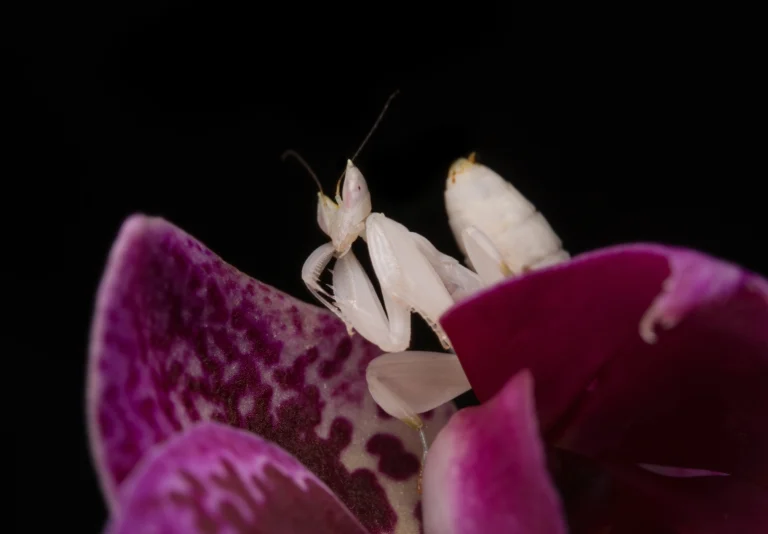
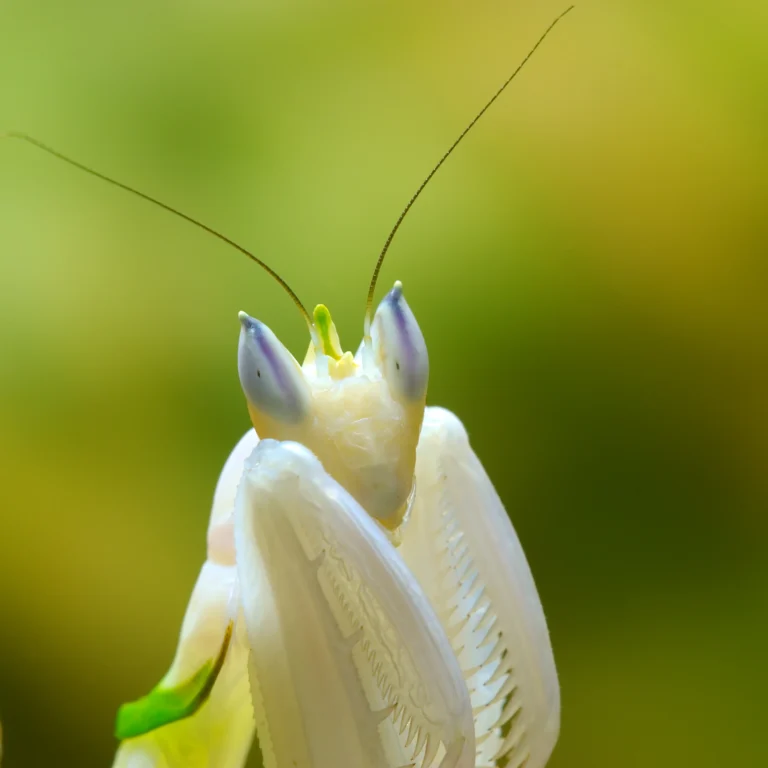
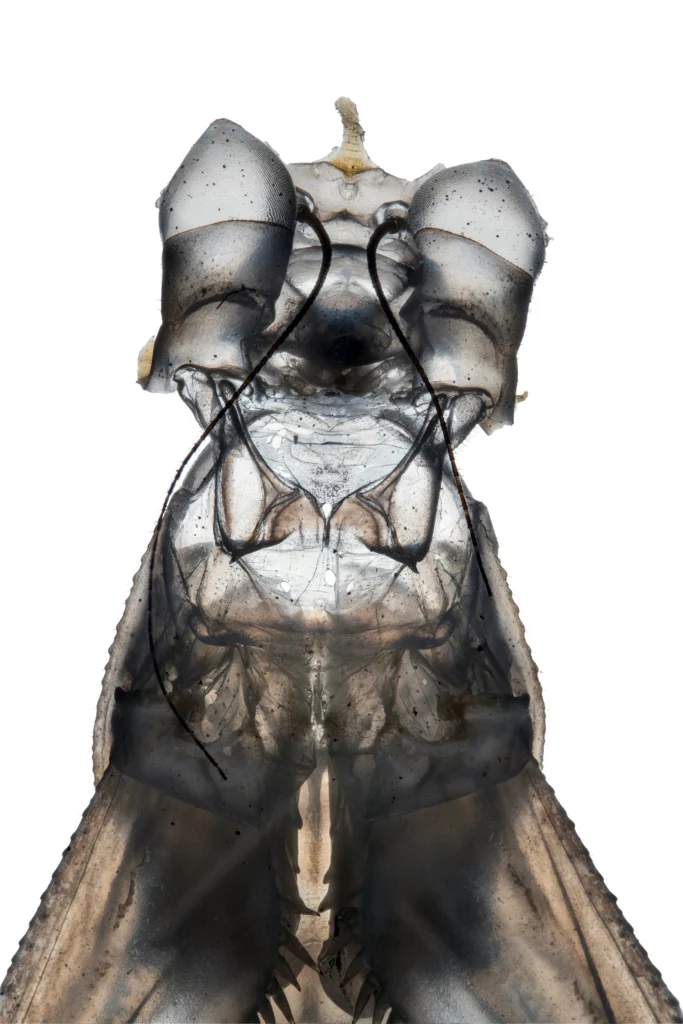
After the final molt, the orchid mantis is an adult. It now has two pairs of fully formed wings, and it will not molt again.
- Adult females are about 6 to 7 cm long, white to pink, with wings covering much of the abdomen. They rarely fly.
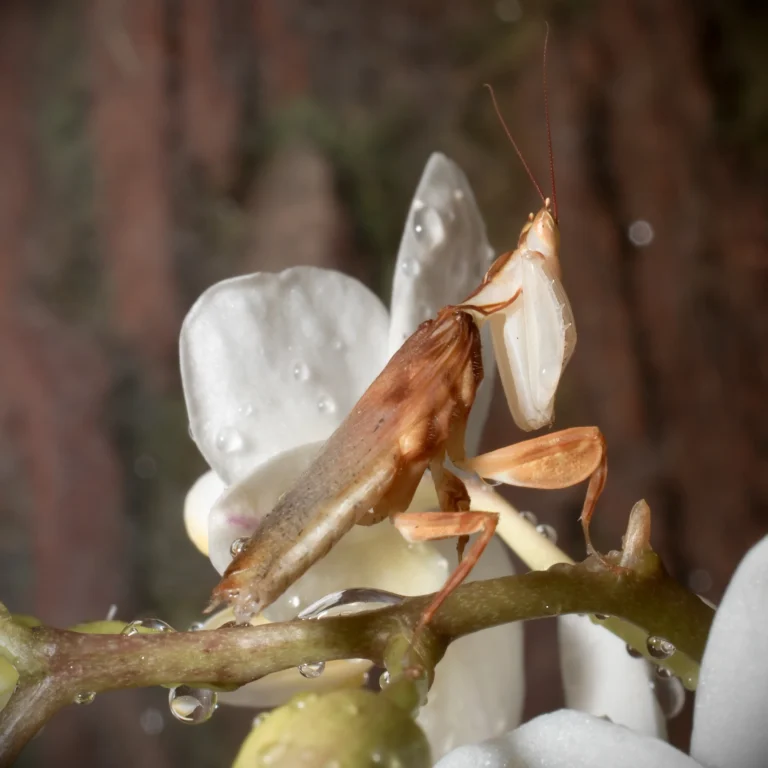
- Adult males are about 2.5 to 3 cm long, greenish brown and good fliers.
US Mantis reports that mating happens about 3 to 4 weeks after the female’s final molt. Adult life lasts several months, with females usually living longer than males. Our orchid mantis size guide has more on adult dimensions.
Tropical vs Temperate Life Cycles
Many garden mantises in Europe and North America follow the seasons. National Geographic describes how temperate mantises lay egg cases that wait through winter, with nymphs hatching in spring and reaching adulthood by summer. Their whole life cycle is tied to one year.
The orchid mantis lives in tropical Southeast Asia, where there is no cold winter to wait out. In captivity, at least, its eggs hatch after a set incubation period rather than after winter, and breeders can raise generation after generation year round. Little has been published on whether wild populations follow wet and dry seasons, so this is an area where more field research is needed.
Telling an Orchid Mantis Nymph Apart
Young nymphs of many mantis species look alike to the untrained eye. An orchid mantis nymph is easier to identify than most:
- At L1, the red and black color sets it apart from the green or brown hatchlings of most common mantises.
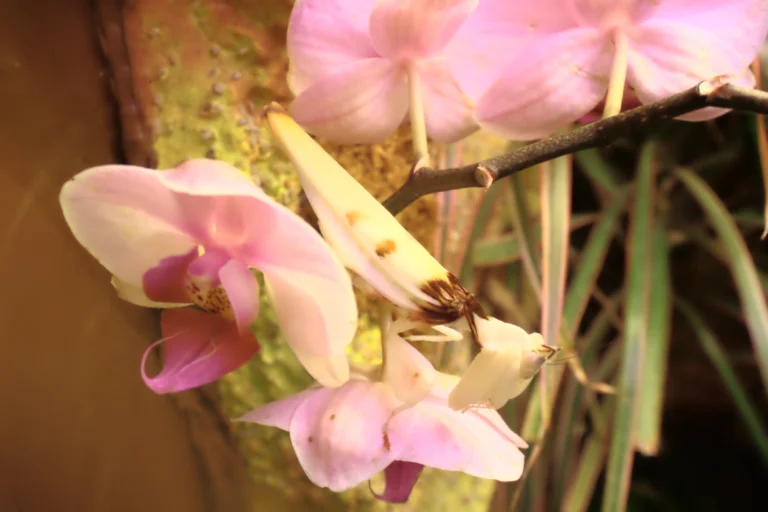
- From around L3, the white or pink body and growing femoral lobes on the middle and hind legs are distinctive.
- The curled, upturned abdomen of a middle-stage nymph adds to its flower-like look.
If a “baby orchid mantis” you have bought stays green or brown with plain legs after several molts, it may be a different species. Ask your breeder for the scientific name.
The Full Cycle in One View
| Step | Approximate timing |
|---|---|
| Egg case laid | About 2 weeks after mating (Montreal Insectarium) |
| Hatching | About 40 days at 80°F (US Mantis) |
| Nymph molts | Roughly every 3 weeks; final molt about twice as long |
| Males reach adulthood | After about 5 to 6 molts |
| Females reach adulthood | After about 7 to 8 molts |
| Mating | About 3 to 4 weeks after the female’s final molt (US Mantis) |
| Next egg case | The cycle repeats |
Caring for a Baby Orchid Mantis
Baby orchid mantises are fragile. A few basics make a big difference:
- House them separately early. Nymphs will eat each other. Asian Geographic reports that hungry orchid mantises have been seen eating their own siblings.
- Feed tiny live prey. Flightless fruit flies are the standard first food.
- Mist regularly. Nymphs drink from droplets.
- Use small containers. Small nymphs find prey more easily in a small space. InsectStore notes small nymphs need very small enclosures, with enough height to molt.
- Ensure ventilation. Humid but moving air prevents mold.
Full instructions are in the orchid mantis care sheet, and feeding details by stage are in what orchid mantises eat.
How Color Changes Through the Life Cycle
Color is one of the most striking parts of the orchid mantis life cycle:
- L1: red and black.
- Early instars: red and black fade; white appears.
- Middle instars: white to pink, sometimes yellow-tinted; most flower-like stage for many keepers.
- Adults: females keep white to pink colors; males turn greenish brown.
The Natural History Museum of Utah notes that color change in young orchid mantises takes days or weeks, not seconds, and happens while the mantis is still growing. See orchid mantis colors for more.
Related Guides
If you want to go deeper, these guides pick up where this page leaves off:
- Orchid mantis eggs and breeding: ootheca, mating and hatching.
- Orchid mantis lifespan: how long males and females live.
- Orchid mantis colors: white, pink, yellow and why they change.
- Orchid mantis care sheet: temperature, humidity, feeding and molting.
Frequently Asked Questions
What are the stages of the orchid mantis life cycle?
Egg (inside an ootheca), nymph and adult. There is no larva or pupa.
Why is a baby orchid mantis red and black?
First-stage nymphs are thought to mimic assassin bugs, which bite and taste bad. The colors fade after the first molt.
How often do orchid mantis nymphs molt?
Roughly every 2 to 3 weeks for juveniles. The final molt into an adult takes longer.
How many times does an orchid mantis molt?
Keepers commonly report about 5 to 6 molts for males and 7 to 8 for females.
What does L3 mean for an orchid mantis?
L3 means third instar, the stage after the nymph’s second molt. L numbers count instars from hatching.
Should I remove the old skin after a molt?
There is no rush. Wait until the mantis has fully hardened and moved away, usually after a few days, then remove the exuvia when you next clean the enclosure.
Do orchid mantises molt as adults?
No. Once they have full wings, they are adults and do not molt again.
Sources
- US Mantis, orchid mantis care sheet (PDF): https://cdn.shopify.com/s/files/1/1296/7335/files/Orchid_Mantis_care_sheet.pdf
- InsectStore, Hymenopus coronatus: https://insectstore.com/mantids/hymenopus-coronatus-orchid-mantis
- Montreal Insectarium (Espace pour la vie), Orchid praying mantis: https://espacepourlavie.ca/en/insects-arthropods/orchid-praying-mantis?mode=76
- Wikipedia, Hymenopus coronatus: https://en.wikipedia.org/wiki/Hymenopus_coronatus
- Dubia Roaches, Orchid mantis care sheet: https://dubiaroaches.com/blogs/invert-care/orchid-mantis-care-sheet
- National Geographic, Praying mantis: https://www.nationalgeographic.com/animals/invertebrates/p/praying-mantis/
- Asian Geographic, The Pink Orchid Mantis: https://asiangeo.com/?p=40053
- Natural History Museum of Utah: https://nhmu.utah.edu/articles/orchid-mantis-breathtakingly-beautiful-deceptively-deadly
- Howard Hughes Medical Institute, Beautiful Biology, “Orchids with a Bite”: https://www.hhmi.org/beautifulbiology/media-detail/orchids-bite