Orchid Mantis Camouflage: Does It Really Mimic an Orchid?
For more than a century, orchid mantis camouflage was the textbook example of an insect disguised as a flower. Naturalists wrote about it, artists drew it and nature documentaries filmed it, yet nobody had tested how its disguise actually works. Since 2013, a series of studies has changed the story. The orchid mantis does attract prey by looking like a flower, and it does so remarkably well, but it does not copy an orchid, its famous leg “petals” may have a different job than expected, and young mantises may use scent as well as color.
This guide walks through what scientists have found, in plain language, and explains what the orchid mantis’s camouflage is really for.
Two Kinds of Disguise
Biologists separate two ideas that are often mixed together:
- Camouflage (crypsis): looking like the background so you are not noticed. A stick insect that looks like a twig is a classic example.
- Aggressive mimicry: looking like something attractive or harmless so that prey comes to you. Wikipedia’s flower mantis article describes this as camouflage in which a predator’s colors and patterns lure prey.
The orchid mantis is a case of aggressive mimicry. It does not just hide among flowers. It acts as a flower, and prey that comes to “feed” on it gets eaten. It may also gain some protection from its own predators, as later sections explain.
A Long History of Speculation
The orchid mantis appeared in some of the most important early writing on animal coloration:
- 1870s to 1880s. James Wood-Mason recorded the species in India and sent a drawing to Alfred Russel Wallace.
- 1889. Wallace described the mantis in Darwinism, noting its resemblance to a flower.
- 1890. Edward Bagnall Poulton, in The Colours of Animals, described an “Indian Mantis” that attracts insects with its flower-like shape and pink color.
- Around 1900. Nelson Annandale watched it hunt on the flowers of the Straits rhododendron in the Malay Peninsula and described it catching a large fly.
- 1940. Hugh Cott, in Adaptive Coloration in Animals, discussed the nymph’s “alluring coloration,” treating the animal itself as a decoy.
These accounts, summarized on Wikipedia, built a strong story. But they were observations, not experiments. As James O’Hanlon and colleagues noted in a 2013 paper, the flower-mimic idea had been widely discussed but never tested.
Study 1 (2013): What Color and Shape Is the Orchid Mantis, Really?
O’Hanlon, Li and Norma-Rashid published the first detailed study of the orchid mantis’s color and shape in the Journal of Orthoptera Research. Instead of judging color by human eyes, they used models of how pollinating insects such as bees see.
Their findings:
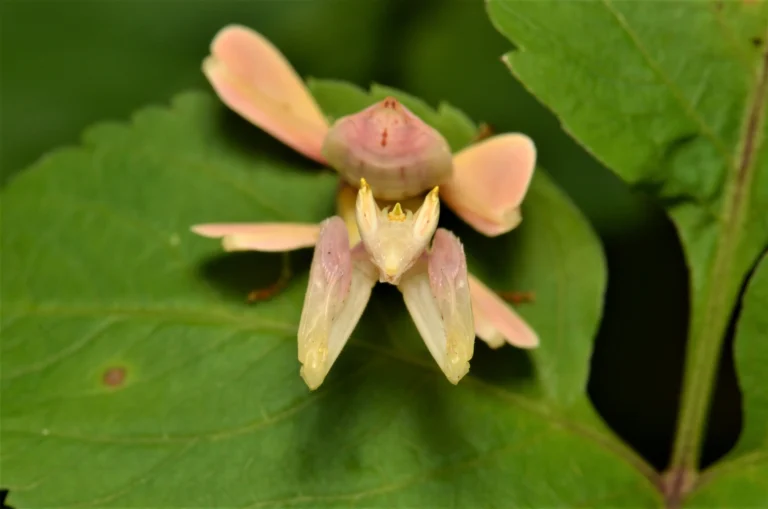
- The mantis is predominantly white, often with pink or yellow hues, and reflects mainly UV-absorbing white.
- Visual models suggested that color differences within an individual mantis’s body would be hard for a pollinator to tell apart.
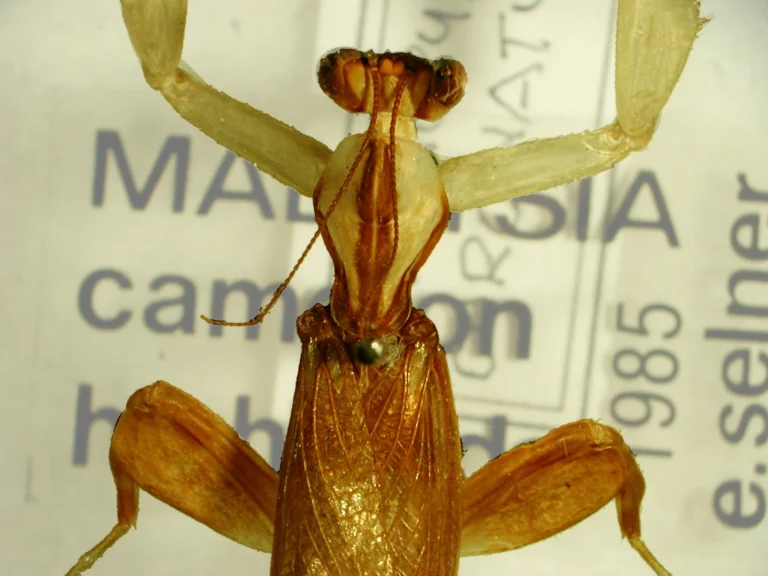
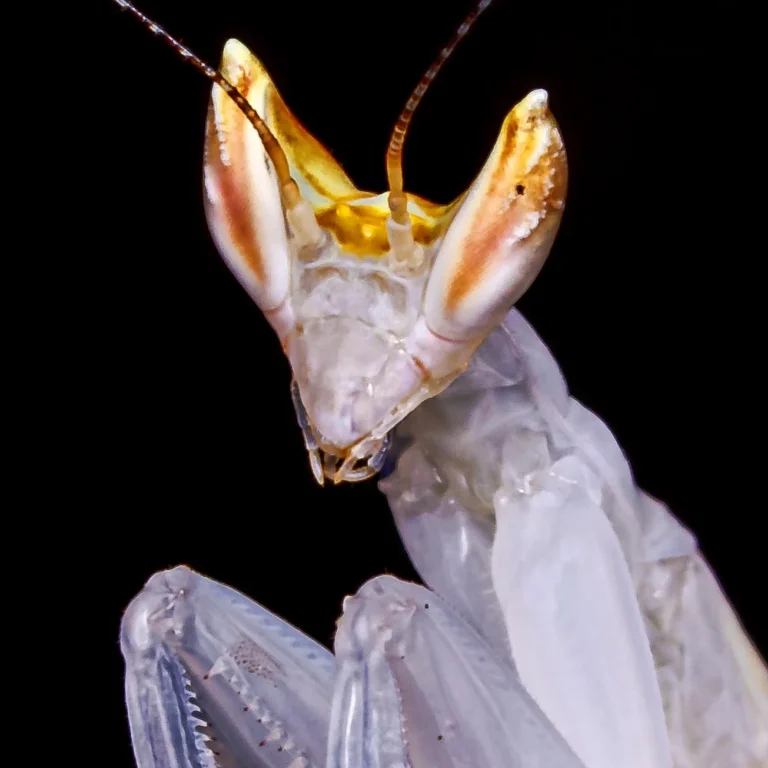
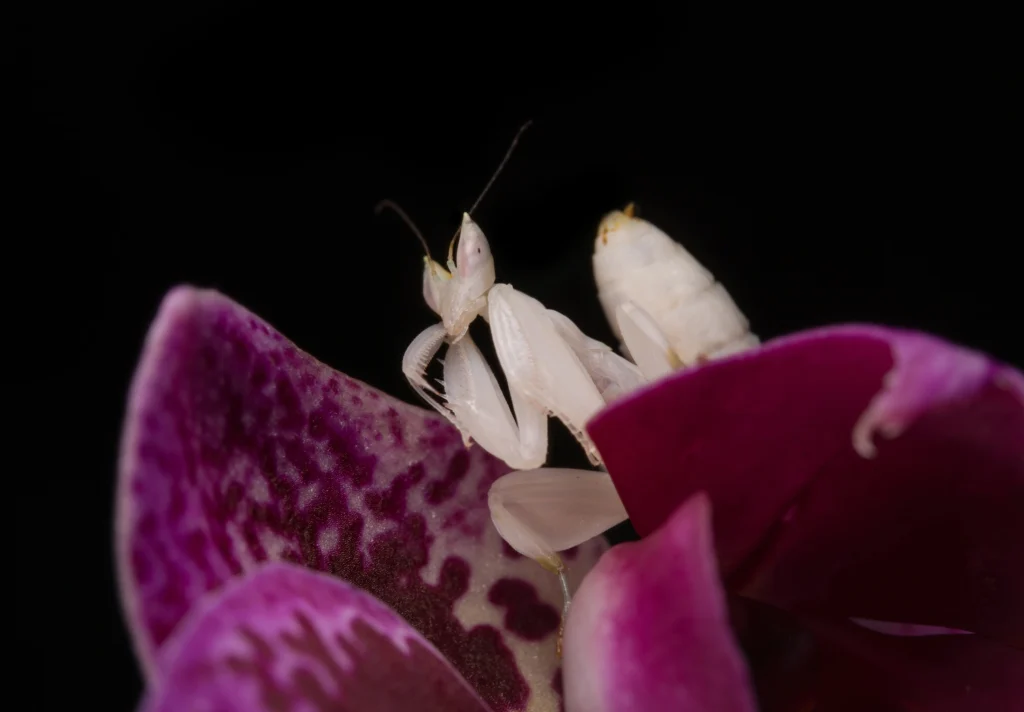
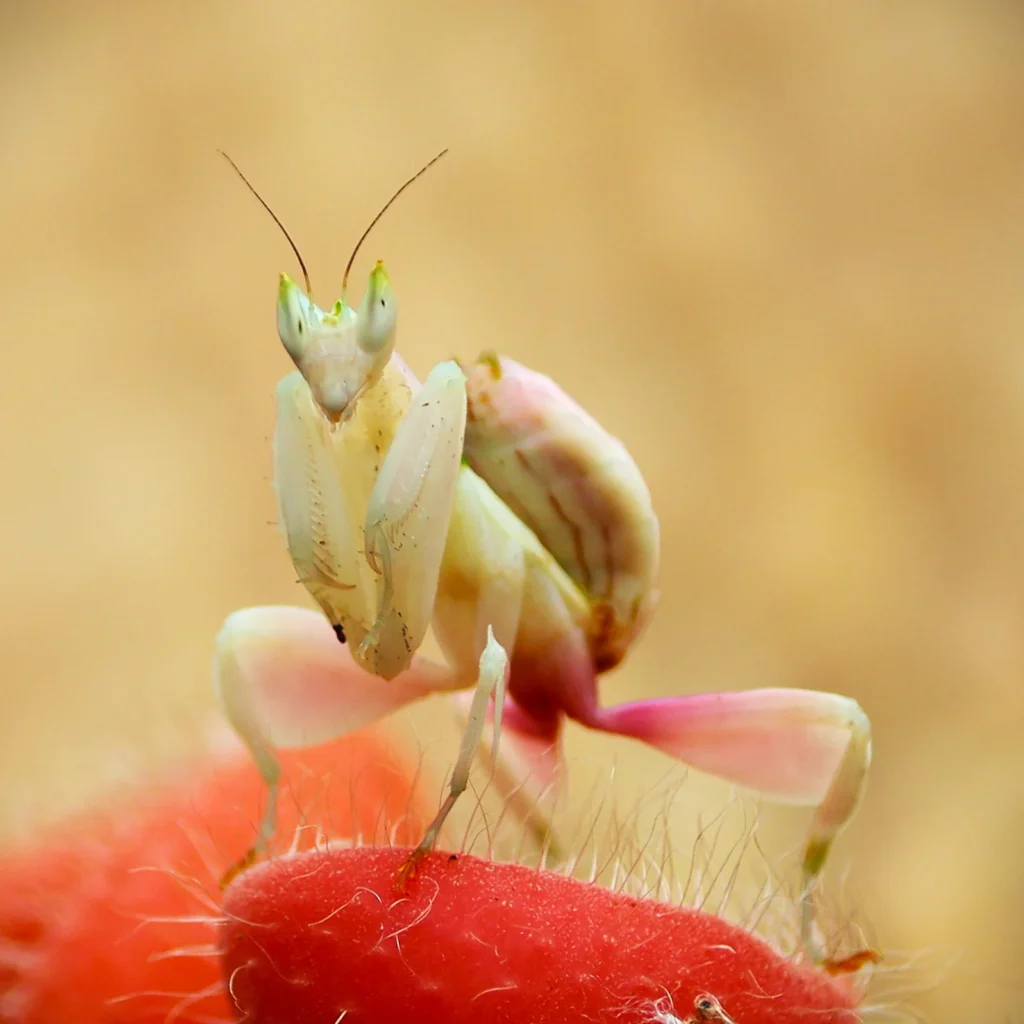
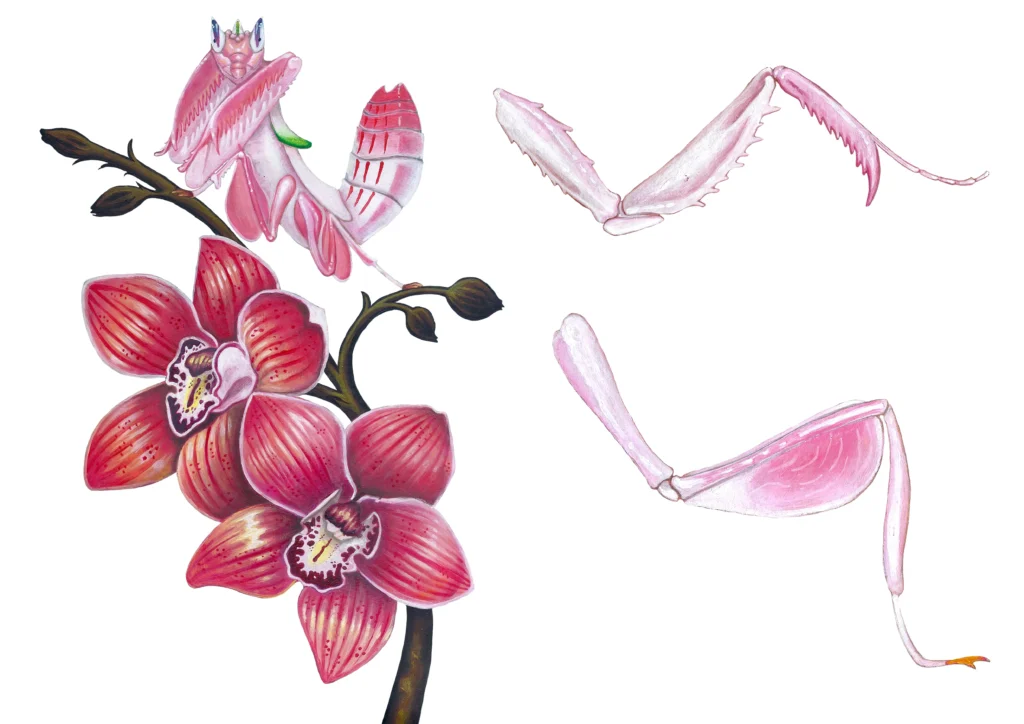
- Its distinctive femoral lobes, the flat expansions on the middle and hind legs, together with the broad abdomen, give it a flower-like outline.
The study set up clear, testable predictions about how those features might attract pollinators.
Study 2 (2014): Does It Really Attract Pollinators?
The key test came in a 2014 paper in The American Naturalist by James O’Hanlon, Gregory Holwell and Marie Herberstein, titled “Pollinator Deception in the Orchid Mantis.” Working in forested areas of Peninsular Malaysia where orchid mantises occur naturally, the team asked two questions: what does the mantis look like to a pollinator, and do pollinators actually approach it?
Their results:
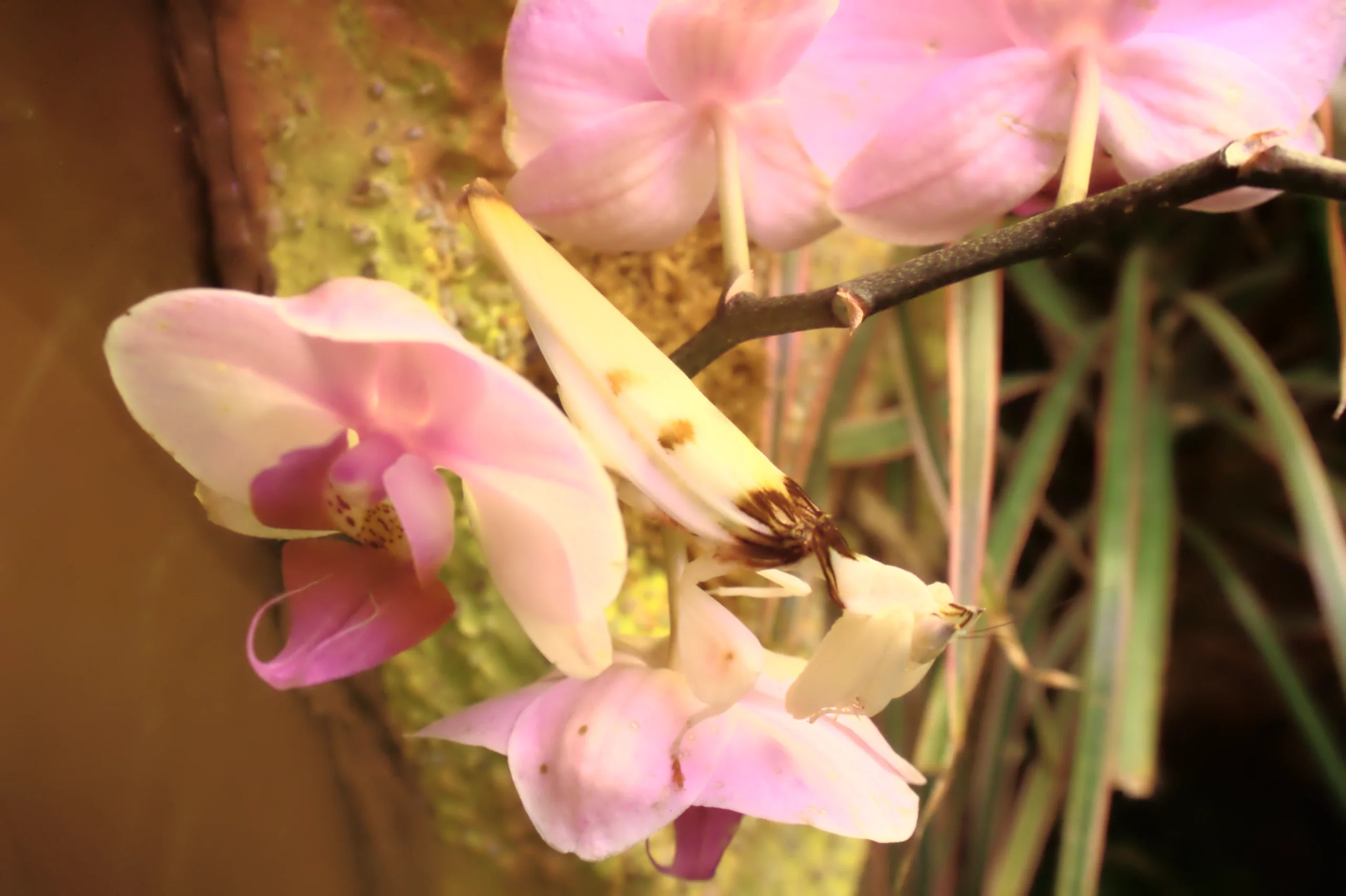
- Using color modeling, they found that, to pollinating insects, the orchid mantis’s color could not be distinguished from the colors of flowers growing in the same habitat.
- In field trials, orchid mantises attracted pollinators at a higher rate than real flowers did.
The authors described this as the first experimental evidence of pollinator deception by the orchid mantis. Science Friday quoted O’Hanlon saying the most surprising finding was just how good the mantises are at attracting pollinators.
Study 3 (2014): Does It Copy One Particular Flower?
If the orchid mantis mimics a flower, which one? A follow-up study by the same research group, published in Current Zoology, compared juvenile orchid mantises with more than a dozen species of Malaysian flowers.
According to Science Friday’s summary:
- The mantis’s color fell within the range of floral colors in its habitat but did not match any particular species.
- Its abdomen and leg lobes resembled the general shape of petals without matching any specific flower.
- The researchers found “no compelling evidence” that the orchid mantis imitates a single model.
A 2015 article in Discover Magazine, written by James Gilbert of the University of Sussex, summed this up with the headline that the orchid mantis doesn’t mimic an orchid after all.
The current interpretation is that the orchid mantis offers a generalized flower-like signal. Pollinators have built-in preferences for certain colors, shapes and patterns. A mantis that matches those preferences can attract many kinds of pollinators, without being tied to one flower. As O’Hanlon put it to Science Friday, a hungry mantis cannot afford to be picky.
What Are the Leg Lobes For?
The petal-like femoral lobes look like the centerpiece of the disguise. Surprisingly, experiments did not support that idea in a simple way.
Science Friday reports that, in a field experiment, removing or rearranging the lobes on model mantises did not stop pollinators from approaching. A 2014 report in the journal Ethology suggested the lobes might instead help camouflage the mantis against its own predators, by breaking up its insect outline.
So the “petals” may serve as protective camouflage as much as, or more than, a lure. This is an area where research is still developing.
Study 4 (2014): A Chemical Trick Too
Color and shape are not the only tools. In 2014, Takafumi Mizuno and colleagues published a study in Zoological Science titled “Double-Trick Visual and Chemical Mimicry by the Juvenile Orchid Mantis.” Their work focused on how juvenile orchid mantises catch Oriental honeybees (Apis cerana).
Key findings:
- Juvenile female orchid mantises often succeeded in catching Oriental honeybees, while adult females often failed.
- Most honeybees approached the juveniles from the front, which led the team to suspect a chemical lure.
- They detected two compounds, known as 3HOA and 10HDA, released into the air only while juvenile mantises were trying to catch prey. These are components of honeybee communication signals.
- In field tests, Oriental honeybees preferred dummies treated with a mixture of those compounds.
The authors concluded that juvenile mantises use these chemicals to trick and attract Oriental honeybees. Combined with their flower-like look, this is a two-part lure: visual and chemical.
Study 5 (2016): How the Disguise Evolved
Why did orchid mantis females become large and flower-colored while males stayed small and brown? A 2016 study in Scientific Reports led by Gavin Svenson of the Cleveland Museum of Natural History looked at the evolutionary history.
National Geographic summarized their results:
- Ancestral mantises began spending time around flowers, gaining access to pollinators as prey.
- A lineage evolved larger females that could catch a wider range of prey.
- In the orchid mantises, the ancestral green and black camouflage was replaced in females by bright yellow, white and pink colors that let them mimic flowers.
Males kept the original camouflage. A small, conspicuous “flower” moving through the forest would give itself away, Svenson explained, so staying cryptic helps males find mates and avoid predators. See male vs female orchid mantis.
Behavior: The Disguise in Action
Color and shape are only part of the camouflage. Behavior completes it.
- Sitting in plain view. Science Friday notes that, unlike flower-hiding predators, orchid mantises sit openly and catch more prey in flower-rich areas.
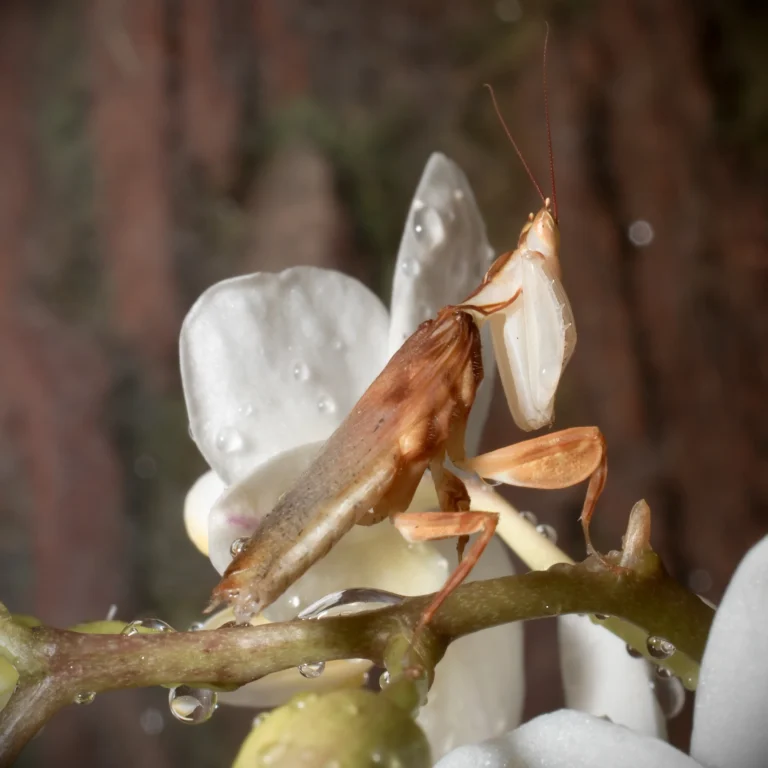
- Swaying. Wikipedia describes the mantis holding on with its rear legs and swaying from side to side, as if moved by a breeze.
- Staying still. It holds its position for long periods, striking only when prey is within reach.
- Ambushing varied prey. A 2020 report from the Chinese Academy of Sciences described orchid mantises ambushing butterflies, crickets, bees, flies and grasshoppers.
Does the Orchid Mantis Change Color to Match Flowers?
Partly, and slowly. The Natural History Museum of Utah notes that juveniles can shift among white, pink, purple and yellowish green over days or weeks while they are growing. This is not instant color change like an octopus or a chameleon. There is also no good evidence that a mantis changes to match the exact flower it is sitting on. See orchid mantis colors.
Flower Camouflage in Other Animals
The orchid mantis is not the only predator that uses flowers. O’Hanlon’s 2016 overview in Current Biology notes that other animals, such as crab spiders and assassin bugs, also camouflage themselves on flowers. Other flower mantises, including the spiny flower mantis and the devil’s flower mantis, use bright colors and display behaviors too.
What sets the orchid mantis apart is that it does not need a flower to work. It can sit on a plain leaf and still draw pollinators to itself. Compare species in our flower mantis guide.
Orchid Mantis Adaptations Summary
| Adaptation | Type | What it does |
|---|---|---|
| White to pink color | Visual | Matches the color range of local flowers as seen by pollinators |
| UV-absorbing white surface | Visual | Fits pollinator color vision |
| Femoral lobes | Visual | Breaks up the insect outline; may protect against predators |
| Broad, curled abdomen (juveniles) | Visual | Adds to the flower shape |
| Swaying motion | Behavioral | Mimics a flower moving in the breeze |
| Sitting in the open | Behavioral | Lets the mantis act as the lure itself |
| 3HOA and 10HDA release (juveniles) | Chemical | Attracts Oriental honeybees |
| Red and black first-stage nymphs | Visual | Thought to mimic distasteful assassin bugs |
| Spined raptorial forelegs | Structural | Catches and holds prey |
Why the Orchid Mantis Matters to Science
The orchid mantis is more than a curiosity. It has become a test case for ideas about mimicry that go back to Darwin and Wallace’s time. Its story shows how a long-accepted explanation can be partly right and partly wrong: the mantis does lure pollinators, but not by copying an orchid, and its most famous feature, the petal-like lobes, may matter more for defense than for hunting.
It also shows how many senses can be involved in deception. A predator that combines a flower-like color, a flower-like shape, flower-like movement and, at least in juveniles, bee-like chemical signals is exploiting several channels of prey perception at once. That makes it a useful model for researchers who study how animals perceive and are fooled by signals.
Seeing the Camouflage for Yourself
If you keep an orchid mantis, you can watch some of these behaviors at home. Place the enclosure where it gets bright daytime light, add thin branches and a few leaves, and watch how the mantis chooses a spot and holds still. Many keepers notice the gentle swaying when the mantis moves, and the way it waits for prey to come close rather than chasing. See the orchid mantis as a pet before deciding to keep one.
What Is Still Unknown
Research has answered big questions but left others open. The 2020 Chinese Academy of Sciences report listed several: the role of the camouflage as protection against predators, how hunting behavior changes across life stages, the chemical cues involved in attracting butterflies, and the threatened status of the species in the wild. Future studies may change parts of this picture again.
Related Guides
If you want to go deeper, these guides pick up where this page leaves off:
- Orchid mantis colors: white, pink, yellow and why they change.
- Orchid mantis anatomy: eyes, ear, wings and petal-shaped legs.
- Orchid mantis facts: 35 facts checked against the science.
- Flower mantis species: every major flower-mimicking mantis compared.
Frequently Asked Questions
Does the orchid mantis mimic an orchid?
Not a specific one. Research suggests it imitates a general flower signal that pollinators find attractive.
How does the orchid mantis use camouflage to hunt?
It sits in the open, looks like a flower to pollinators, sways gently and strikes when insects come close. Juveniles may also release chemicals that attract honeybees.
Is orchid mantis camouflage for hunting or hiding?
Mainly hunting, through aggressive mimicry. Its leg lobes and coloring may also help protect it from predators.
Do orchid mantises attract more insects than real flowers?
Yes. In field trials, they attracted pollinators at a higher rate than nearby flowers.
Why are male orchid mantises not flower-colored?
Males stayed small and camouflaged, which helps them move around to find mates without being spotted by predators.
When did scientists prove the orchid mantis lures prey?
The first experimental evidence was published in 2014 in The American Naturalist.
Sources
- O’Hanlon, J.C., Li, D. and Norma-Rashid, Y. (2013). Coloration and morphology of the orchid mantis. Journal of Orthoptera Research 22(1): 35-44. https://rune.une.edu.au/web/handle/1959.11/27641
- O’Hanlon, J.C., Holwell, G.I. and Herberstein, M.E. (2014). Pollinator deception in the orchid mantis. The American Naturalist 183(1): 126-132. https://www.journals.uchicago.edu/doi/reader/10.1086/673858
- Science Friday, “Unraveling the Orchid Mantis Mystery”: https://www.sciencefriday.com/articles/unraveling-the-orchid-mantis-mystery/
- Discover Magazine, “The Bloodthirsty Truth of the Beautiful Orchid Mantis” (2015): https://www.discovermagazine.com/planet-earth/the-bloodthirsty-truth-of-the-beautiful-orchid-mantis
- Mizuno, T. et al. (2014). Zoological Science 31(12): 795-801. https://bioone.org/journals/Zoological-Science/volume-31/issue-12/zs140126/Double-Trick-Visual-and-Chemical-Mimicry-by-the-Juvenile-Orchid/10.2108/zs140126.full
- National Geographic, “Praying Mantis Looks Like a Flower, And Now We Know Why”: https://www.nationalgeographic.com/animals/article/orchid-mantises-evolution-insects
- O’Hanlon, J.C. (2016). Orchid mantis. Current Biology 26(4): R145-R146.
- Chinese Academy of Sciences, “Orchid Mantis Ambushes Foraging Butterflies” (2020): https://english.cas.cn/newsroom/research_news/life/202003/t20200312_231167.shtml
- Wikipedia, Hymenopus coronatus: https://en.wikipedia.org/wiki/Hymenopus_coronatus
- Wikipedia, Flower mantis: https://en.Wikipedia.com/wiki/Flower_mantis
- Natural History Museum of Utah: https://nhmu.utah.edu/articles/orchid-mantis-breathtakingly-beautiful-deceptively-deadly