Orchid Mantis Size: How Big Do Orchid Mantises Get?
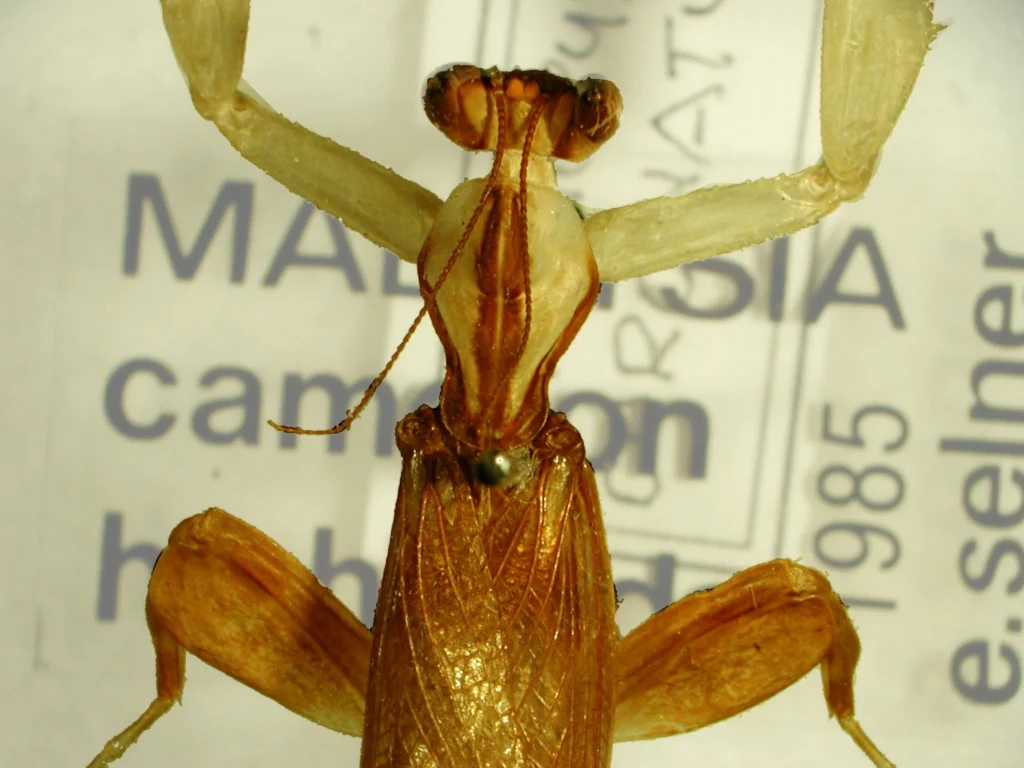
A full-grown female orchid mantis is about 6 to 7 cm long (roughly 2.4 to 2.8 inches). A full-grown male is about 2.5 to 3 cm (around 1 inch). That difference in orchid mantis size between the sexes is one of the largest of any praying mantis, and it shapes almost everything about how the species lives, hunts and is kept in captivity.
This guide gives the size figures from reliable sources, explains how orchid mantises grow from tiny nymphs, looks at why females are so much bigger, and covers what size means if you keep one.
Orchid Mantis Adult Size at a Glance
| Measurement | Adult female | Adult male | Source |
|---|---|---|---|
| Body length | About 6 to 7 cm (2.4 to 2.8 in) | About 2.5 to 3 cm (1 to 1.2 in) | InsectStore, keeper data, Asian Geographic |
| Maximum length noted by a supplier | Up to 6 cm in captivity, wild-caught often slightly longer | Up to 3 cm | InsectStore |
| Mass | Roughly 12 times heavier than the male | US Mantis care sheet | |
| Typical overall range for the species | 3 to 7 cm length, 5 to 12.5 mm width, 3 to 7 mm height | Dimensions.com |
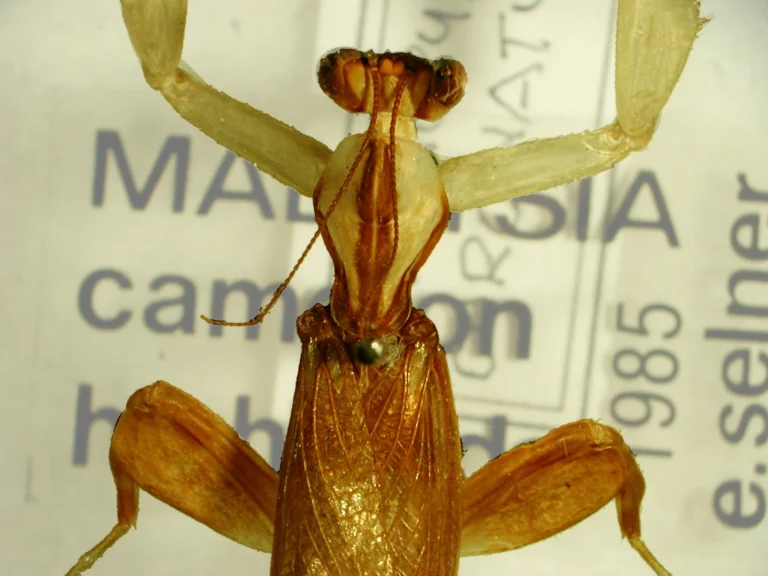
Different sources round these figures differently, so you will see “up to 6 cm” in one place and “up to 7 cm” in another. Both are reasonable for a large, healthy female. Body length is measured from the head to the tip of the abdomen or wings, not counting antennae or legs.
How Big Does an Orchid Mantis Get? Female vs Male
Female orchid mantis size
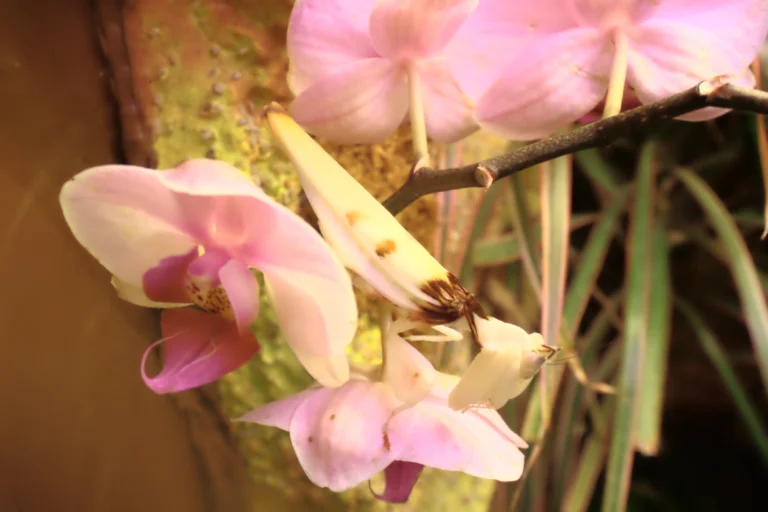
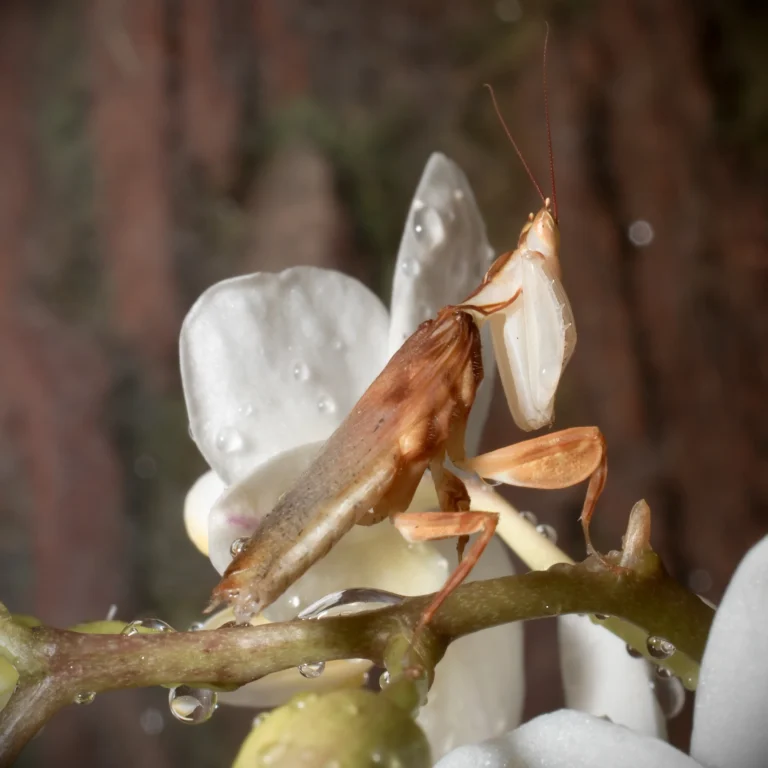
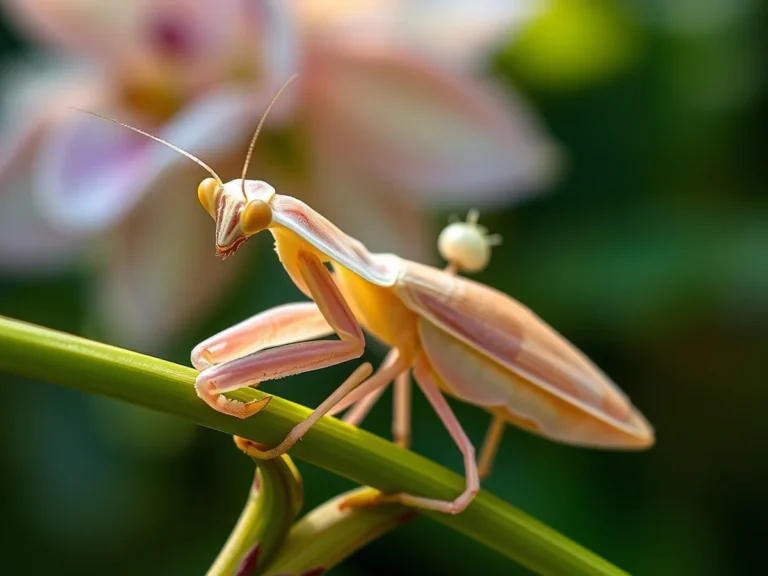
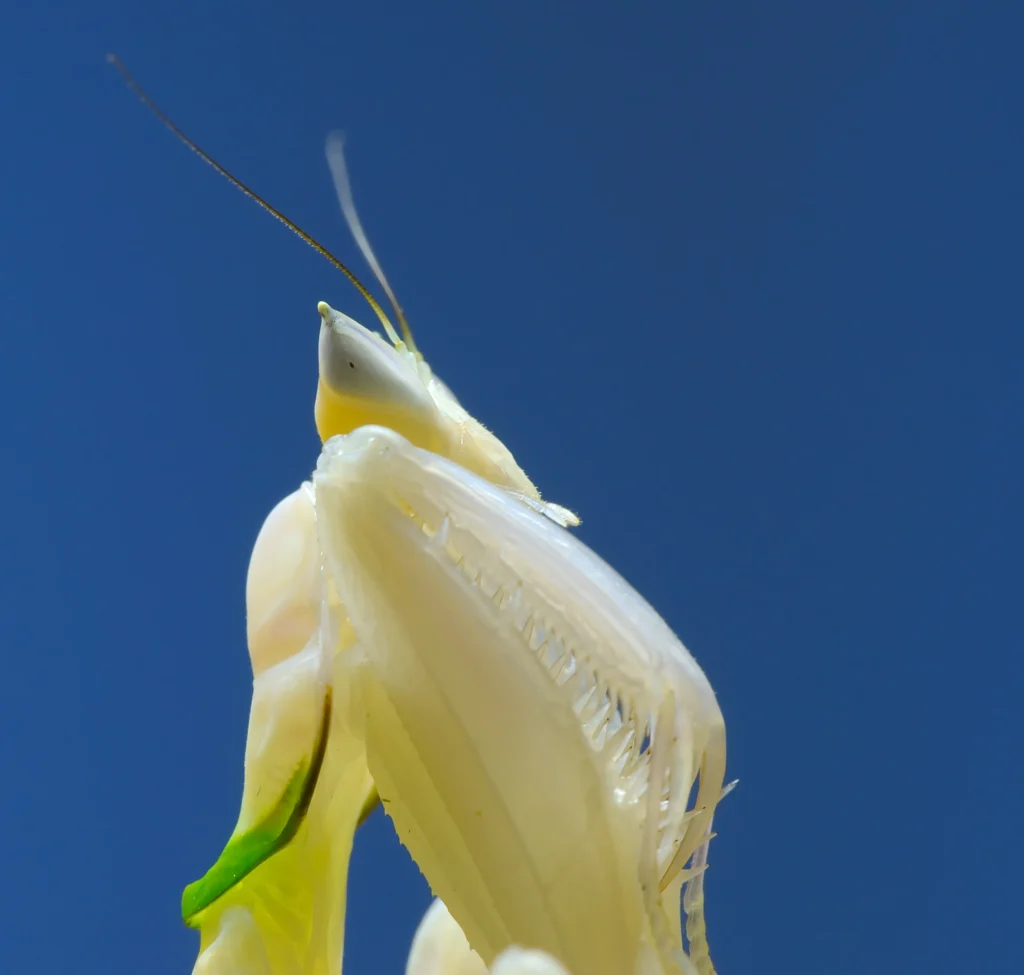
Females are the large, flower-like sex. InsectStore’s care sheet says females can reach up to 6 cm, with wild-caught specimens usually slightly longer. Many keepers report adult females at 6 to 7 cm. When measured with legs spread, a large female looks even bigger, because the femoral lobes on her legs widen her outline.
Male orchid mantis size
Males are small. InsectStore gives a maximum of about 3 cm and notes that males are mostly under half the length of females. Asian Geographic describes males as no bigger than about 3 cm. National Geographic describes adult males as about half the size of females and a dull, greenish brown.
The mass difference is even bigger
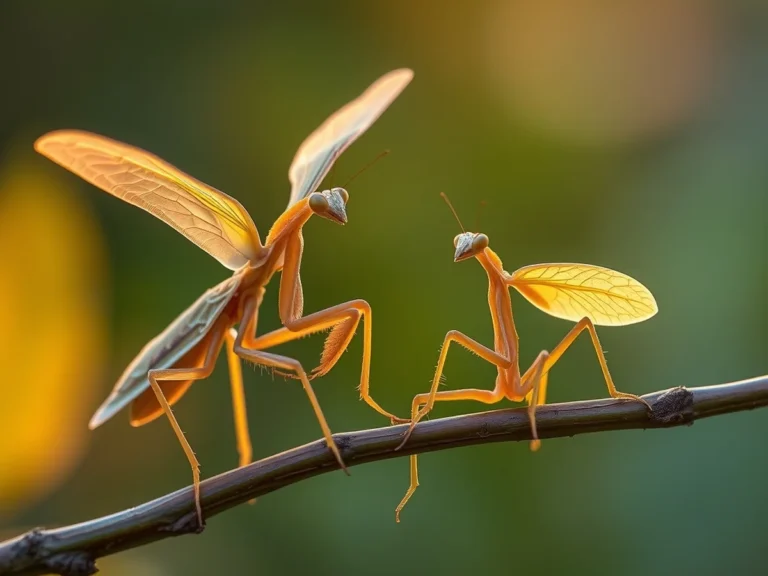
Length understates the gap. A US Mantis care sheet states that adult females are about 12 times more massive than males. A female is not just longer; she is broader, with a much bigger abdomen.
Why Are Female Orchid Mantises So Much Bigger?
In many insects, females are larger because larger bodies can produce more eggs. A 2016 study led by Gavin Svenson of the Cleveland Museum of Natural History tested whether that explained the orchid mantis. According to National Geographic’s report, the team measured more than 100 specimens, modeled how traits changed over evolutionary time and reconstructed relationships with related mantises.
Their conclusion was different from the usual explanation. Large females evolved because size improved their hunting. Early ancestors began spending time around flowers, gaining access to pollinating insects as prey. A larger female could catch a wider range of prey, including big pollinators like bees. Males stayed small, which helps them stay hidden from predators and move around to find mates.
Entomologist Hojun Song, who was not involved in the study, called the predation explanation “entirely novel,” according to National Geographic. For more on the differences between the sexes, see male vs female orchid mantis.
Growth by Life Stage
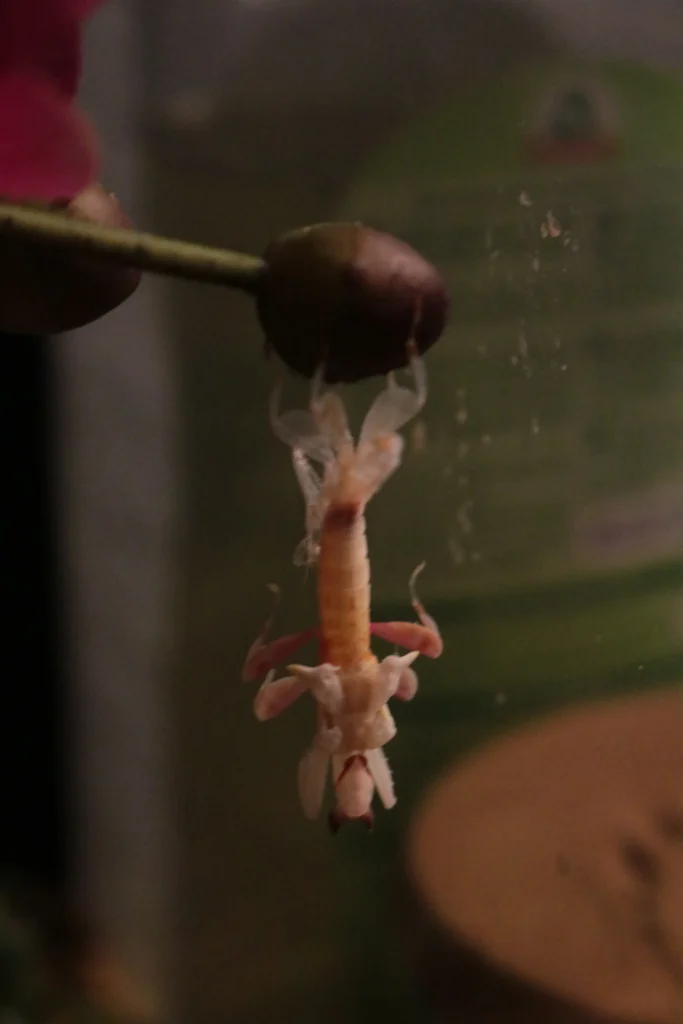
Orchid mantises grow in steps, not gradually. Each time a nymph molts, it sheds its old exoskeleton and expands into a larger one. The stage between molts is called an instar, labeled L1, L2, L3 and so on.
| Stage | Relative size and appearance |
|---|---|
| L1 (just hatched) | Tiny, slim, red and black; looks like a small assassin bug |
| L2 to L3 | Turns white and pink; femoral lobes start to show |
| Middle instars | Rapid growth; flower shape becomes clear |
| Subadult | Nearly full length; wing buds visible on the back |
| Adult | Full size and full wings; no further molts |
Two points matter here:
- Males need fewer molts. Keepers commonly report around 5 to 6 molts for males and 7 to 8 for females. That is why males reach adulthood months earlier and stay small.
- Timing between molts. A US Mantis care sheet reports molts about every three weeks, with the final molt taking about twice as long.
We have not found a reliable source giving exact millimeter sizes for each instar, so we do not list them. Our orchid mantis life cycle guide covers each stage in detail.
What Affects How Big an Orchid Mantis Gets?
Genetics and sex set the upper limit, but care decides whether a mantis reaches it.
Food. InsectStore notes that a varied diet of flying insects produces larger specimens and, in females, a larger and more fertile egg case. A mantis that is underfed during the nymph stages may molt into a smaller adult, because each molt can only expand to the size the body has grown into.
Temperature. Warmth speeds up growth and shortens the time between molts. Breeders use this deliberately: InsectStore describes keeping males cooler, at about 15 to 18°C, to slow their development so they mature at the same time as females. Faster growth is not always better growth. Dubia Roaches notes that females live longer at lower temperatures, which suggests a trade-off between speed and lifespan.
Successful molts. A mismolt can leave a mantis with bent legs or crumpled wings, and a badly stressed mantis may stop growing well. Humidity, ventilation and enough height to hang all matter.
Sex. No amount of food will make a male grow to female size. The difference is built into the species.
Size and Hunting
Size determines what an orchid mantis can catch. Researchers who studied its evolution argued that large females can tackle large pollinators such as bees. Field observations back this up: a 2020 report from the Chinese Academy of Sciences described orchid mantises ambushing butterflies, crickets, bees, flies and grasshoppers.
Size is not the whole story, though. A 2014 study in Zoological Science found that juvenile female orchid mantises often succeeded in catching Oriental honeybees, while adult females often failed. The researchers linked this to chemical cues released by the juveniles, not to body size. A bigger mantis is not automatically a better hunter.
How Big Is the Egg Case?
The egg case, or ootheca, is surprisingly long for the size of the mantis. A US Mantis care sheet describes orchid mantis oothecae up to about 4 inches long and about 1/3 inch wide. A female typically produces about three of them, according to the same source. See orchid mantis eggs and breeding.
Is There a Giant Orchid Mantis?
No. There is no giant species or “giant form” of the orchid mantis. Searches for a giant orchid mantis usually lead to one of three things:
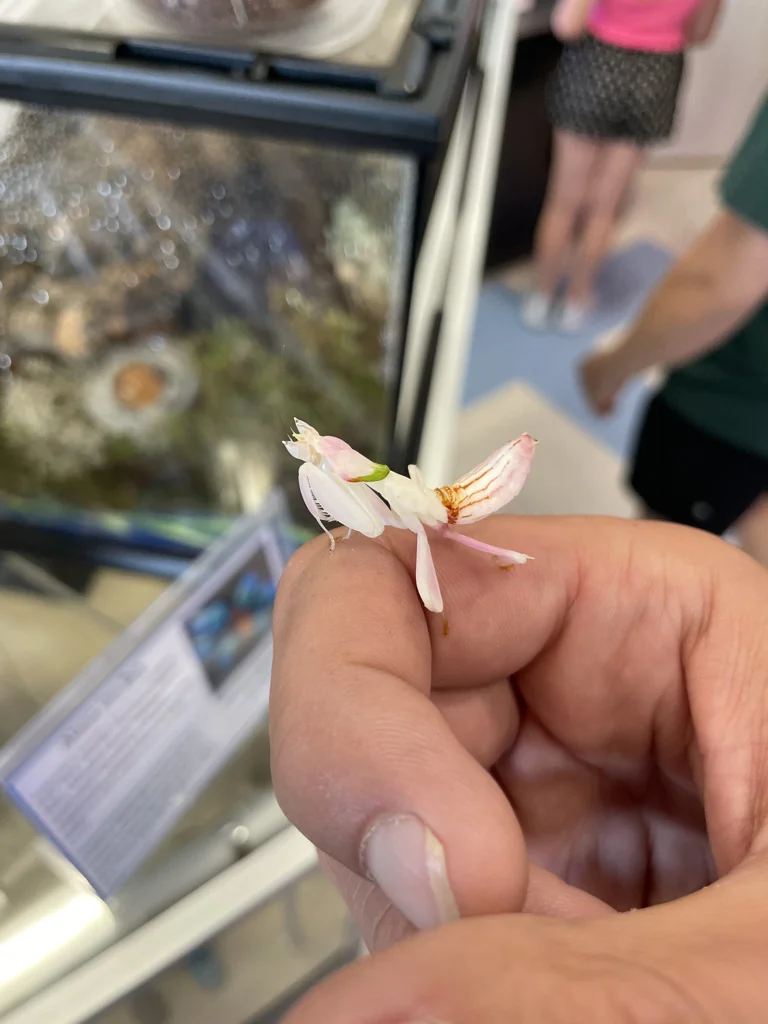
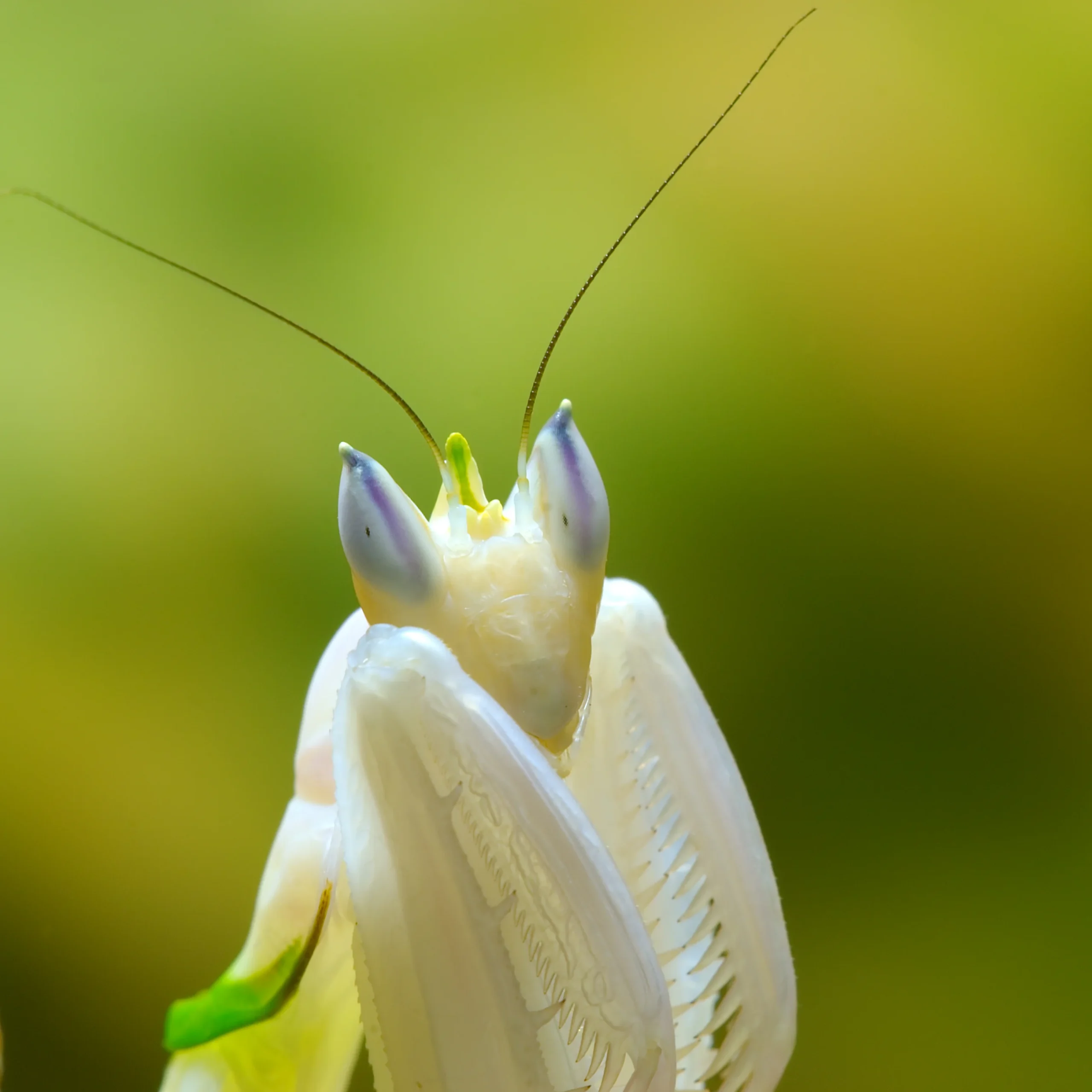
- Close-up photos. Macro photography makes a 6 cm insect fill the frame.
- The devil’s flower mantis. Idolomantis diabolica is a much larger African flower mantis, roughly twice the length of an orchid mantis. See blue orchid mantis.
- Video games. In the game Grounded, the player is shrunk to insect size, so the Orchid Mantis boss looks enormous. See orchid mantis in Grounded.
AI-generated “flower mantises” are often shown larger than life too, sitting on a whole hand. Those are not real; see lotus mantis.
How Orchid Mantis Size Compares With Other Mantises
| Species | Typical adult length |
|---|---|
| Orchid mantis, female | About 6 to 7 cm |
| Orchid mantis, male | About 2.5 to 3 cm |
| Ghost mantis (Phyllocrania paradoxa) | About 4.5 to 6 cm |
| Spiny flower mantis (Pseudocreobotra wahlbergii) | About 1 to 2 inches (2.5 to 5 cm) |
| Wandering violin mantis (Gongylus gongylodes) | Up to about 11 cm |
| Devil’s flower mantis (Idolomantis diabolica) | Roughly 10 to 13 cm |
So the orchid mantis is a medium-sized mantis. The female is larger than a ghost mantis or spiny flower mantis but far smaller than the big African and South Asian species. Compare in more detail in orchid mantis vs ghost mantis and flower mantis.
What Size Means for Keeping an Orchid Mantis
If you keep an orchid mantis, its size sets several rules.
Enclosure height
A mantis hangs upside down to molt and needs space below it to stretch out. A common rule is an enclosure at least three times as tall as the mantis. Dubia Roaches’ care sheet suggests that juveniles and adult males fit in a 32 oz deli cup with a ventilated top, while subadult and older females need at least 6 x 6 x 9 inches (length, width, height). Our orchid mantis enclosure guide expands on this.
Prey size
Prey should be no more than about half the mantis’s body length, according to Dubia Roaches. A tiny L1 nymph needs fruit flies; a large adult female can take house flies, blue bottle flies and small moths. Because males stay small, they need smaller prey than females of the same age. See what orchid mantises eat.
Feeding amounts
InsectStore advises feeding males less than females. A large female needs more food to fuel her growth and, if she is to breed, egg production. US Mantis notes that late-instar females can eat large quantities each day.
Breeding
The size gap makes breeding tricky. A small male mating with a female 12 times his mass is at real risk of being eaten. Breeders usually feed the female well before introducing the male and supervise the pairing. More in orchid mantis eggs and breeding.
How to Measure Your Orchid Mantis
If you want to track growth, measure gently and without handling:
- Wait until the mantis is resting on a flat surface or the enclosure wall.
- Hold a ruler or a card with a printed scale just outside the enclosure, parallel to the mantis.
- Take a photo straight on, with the ruler in the frame.
- Measure from the front of the head to the tip of the abdomen (or wings in adults) on the photo.
- Record the date and the instar, if you know it.
Never measure during or just after a molt. The new exoskeleton is soft for a few days, and handling can deform it.
Orchid Mantis Size in Games
For fans of Animal Crossing, the game’s encyclopedia, Nookipedia, lists the orchid mantis bug size as 35 mm in some games and 25 mm in New Leaf. These figures fall within the real species’ range, closer to a male or a medium juvenile. See orchid mantis in Animal Crossing.
Related Guides
If you want to go deeper, these guides pick up where this page leaves off:
- Male vs female orchid mantis: how to tell them apart.
- Orchid mantis anatomy: eyes, ear, wings and petal-shaped legs.
- Orchid mantis enclosure: terrarium size and step-by-step setup.
- Orchid mantis lifespan: how long males and females live.
Frequently Asked Questions
How big is a full-grown orchid mantis?
A full-grown female is about 6 to 7 cm long. A full-grown male is about 2.5 to 3 cm long.
How big are orchid mantis babies?
Newly hatched nymphs are very small and slim, red and black, and need tiny prey such as fruit flies. They grow with each molt.
Why are male orchid mantises so small?
Research suggests that females grew large to catch big pollinators, while males stayed small and camouflaged to avoid predators and find mates.
Are wild orchid mantises bigger than captive ones?
InsectStore notes that wild-caught females are usually slightly longer than the 6 cm typical of captive females. Captive size depends heavily on diet and temperature.
How long does it take an orchid mantis to reach full size?
Several months. Males mature faster than females, after fewer molts. Temperature and food both affect the pace.
Can you tell the sex of an orchid mantis by size?
In adults, yes: anything around 3 cm or less is almost certainly a male, while females are roughly twice as long. In young nymphs, size is unreliable, so keepers count abdominal segments instead.
Is the orchid mantis the biggest flower mantis?
No. The devil’s flower mantis and the wandering violin mantis are both considerably longer.
Sources
- InsectStore, Hymenopus coronatus care sheet: https://insectstore.com/mantids/hymenopus-coronatus-orchid-mantis
- US Mantis, orchid mantis care sheet (PDF): https://cdn.shopify.com/s/files/1/1296/7335/files/Orchid_Mantis_care_sheet.pdf
- Dimensions.com, Orchid Mantis: https://www.dimensions.com/element/orchid-mantis-hymenopus-coronatus
- Asian Geographic, The Pink Orchid Mantis: https://asiangeo.com/?p=40053
- National Geographic, “Praying Mantis Looks Like a Flower, And Now We Know Why”: https://www.nationalgeographic.com/animals/article/orchid-mantises-evolution-insects
- Dubia Roaches, Orchid mantis care sheet: https://dubiaroaches.com/blogs/invert-care/orchid-mantis-care-sheet
- Chinese Academy of Sciences, “Orchid Mantis Ambushes Foraging Butterflies”: https://english.cas.cn/newsroom/research_news/life/202003/t20200312_231167.shtml
- Mizuno, T. et al. (2014). Zoological Science 31(12): 795-801. https://bioone.org/journals/zoological-science/volume-31/issue-12/zs140126/Double-Trick-Visual-and-Chemical-Mimicry-by-the-Juvenile-Orchid/10.2108/zs140126.short
- Dimensions.com, Ghost Mantis: https://www.dimensions.com/element/ghost-mantis-phyllocrania-paradoxa
- Mental Floss, “6 Spectacular Praying Mantises”: https://www.mentalfloss.com/animals/insects/6-spectacular-praying-mantises
- Wikipedia, Gongylus gongylodes: https://www.wikipedia.com/wiki/Gongylus_gongylodes
- Wikipedia, Flower mantis: https://en.wikipedia-on-ipfs.org/wiki/Flower_mantis
- Nookipedia, Orchid mantis: https://www.nookipedia.com/wiki/Orchid_Mantis