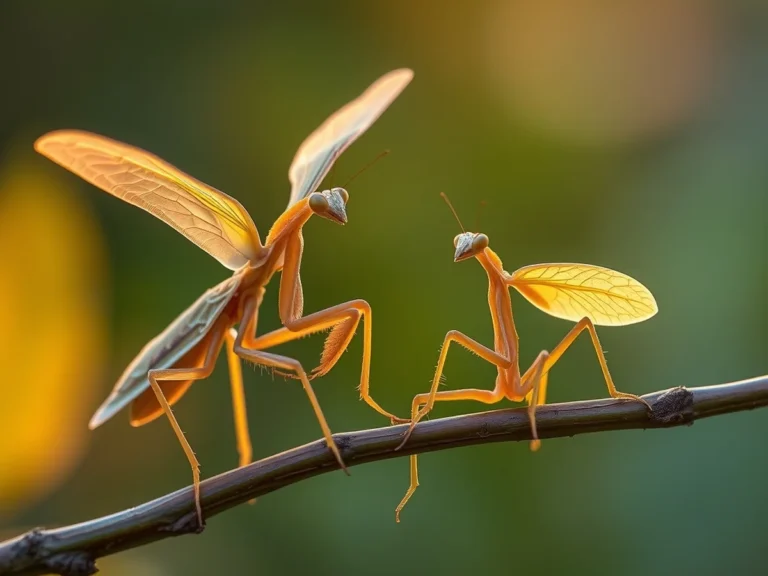
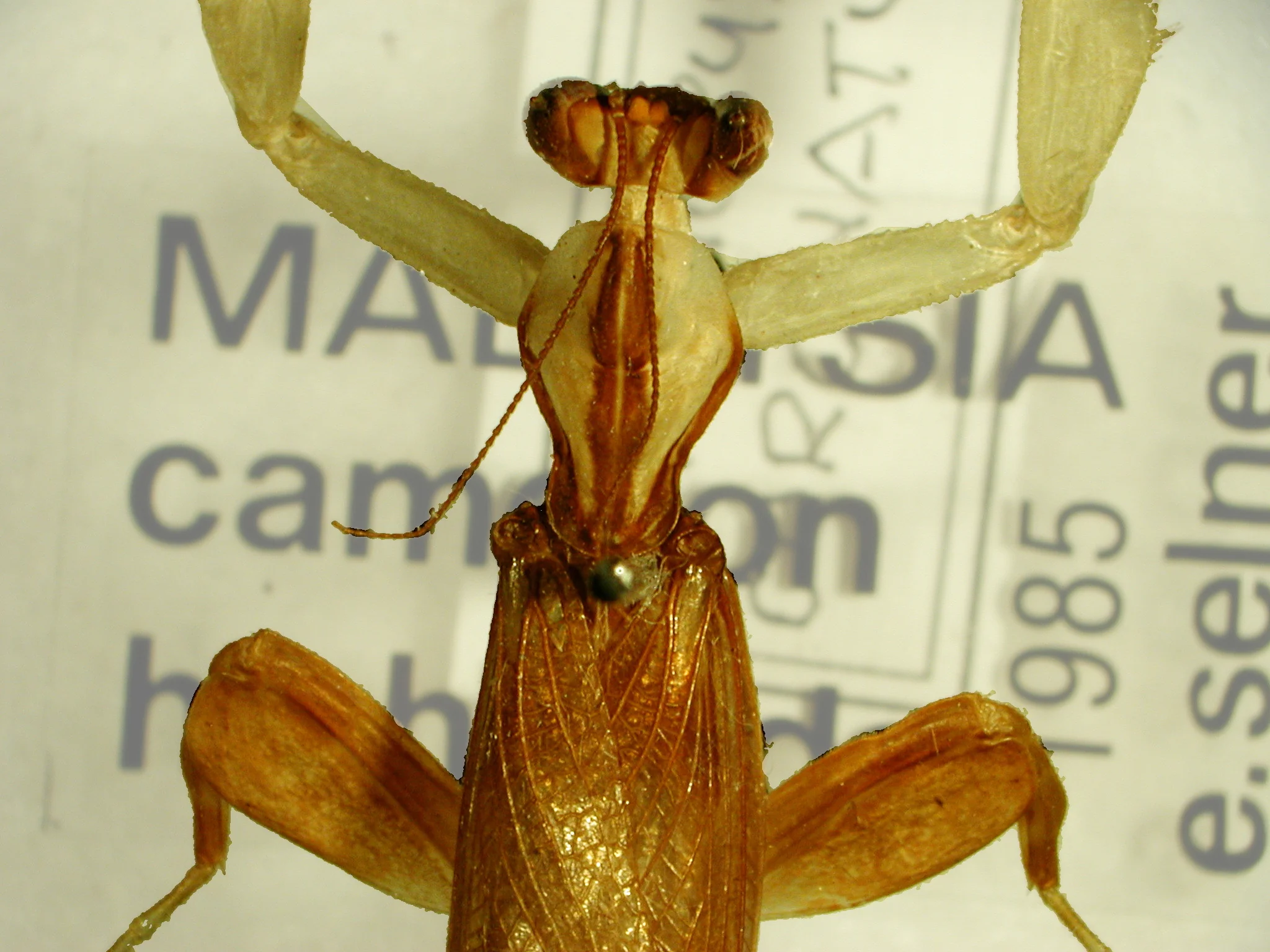
What Do Orchid Mantises Eat? Wild Diet and Feeding Guide
Orchid mantises eat live insects, and they strongly prefer flying ones. In the wild, their flower-like bodies attract pollinators such as bees, flies, butterflies and moths, which they grab with their spiked forelegs. In captivity, keepers feed them live flies and moths sized to each stage of growth.
This guide covers both sides: what orchid mantises eat in nature, based on field studies, and a practical feeding guide for keepers, including prey sizes, how often to feed, and the mistakes that cause most problems.
The Short Answer
| Question | Answer |
|---|---|
| What do orchid mantises eat? | Live insects, mainly flying pollinators |
| Wild prey | Bees, flies, butterflies, moths, crickets, grasshoppers, beetles and more |
| Best captive food | Fruit flies for small nymphs; house flies, blue bottle flies and small moths for larger mantises |
| How often to feed | Commonly every other day, or every 2 to 3 days, adjusted to age and appetite |
| Prey size | No longer than about half the mantis’s body length |
| Water | From misted droplets on the enclosure |
The Orchid Mantis Diet in the Wild
A predator that uses itself as bait
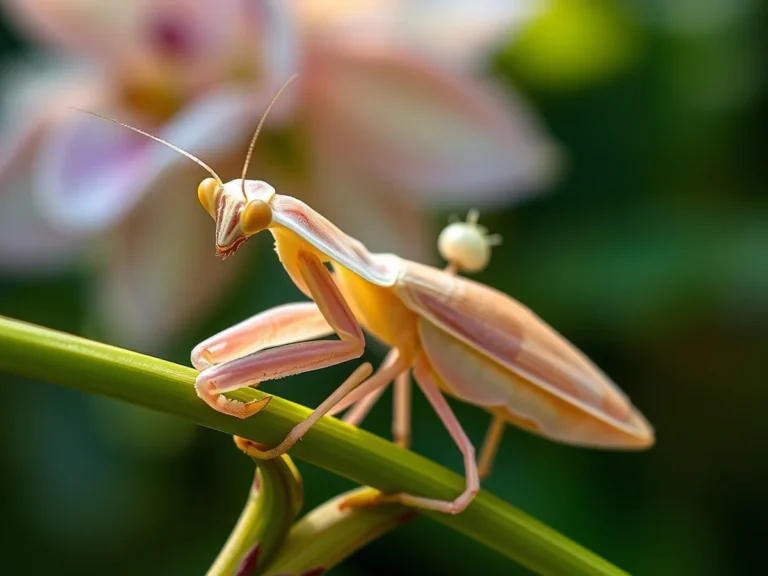
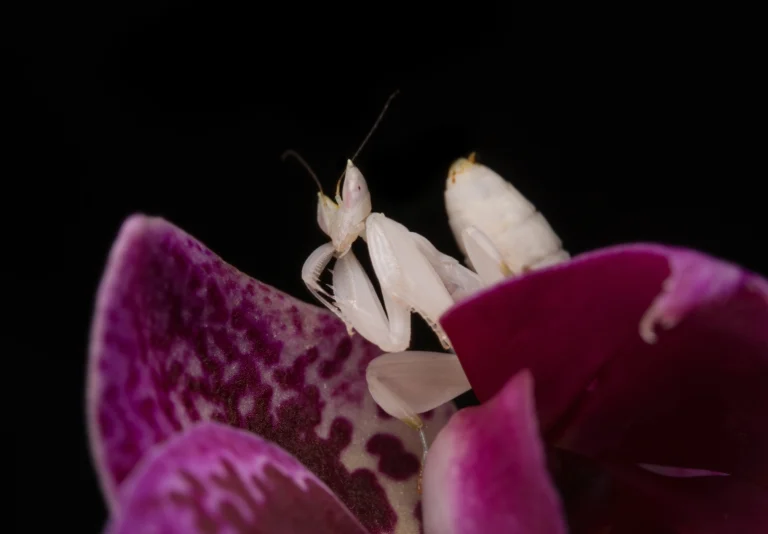
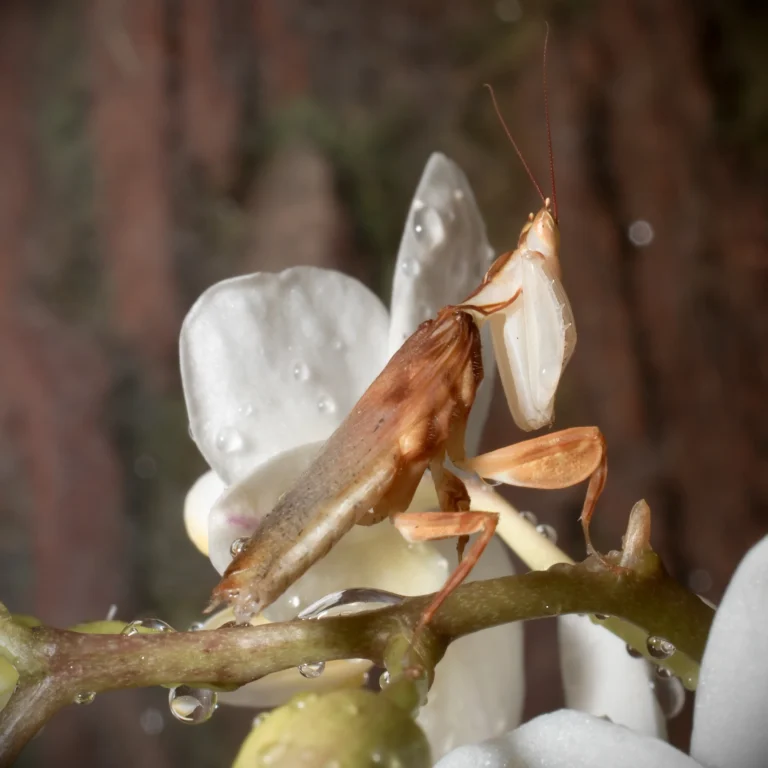
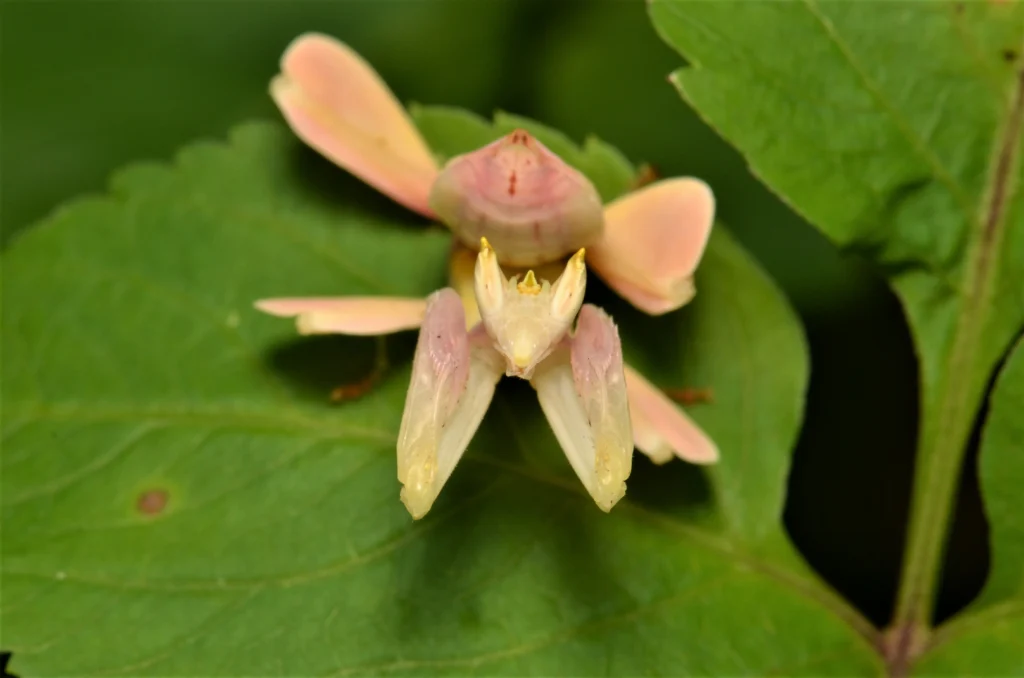
The orchid mantis is an ambush predator. Rather than chase prey, it waits for prey to come close. What makes it unusual is how it draws prey in. A 2014 study by James O’Hanlon and colleagues found that orchid mantises attracted pollinating insects at a higher rate than nearby flowers. To a bee, the mantis’s coloring could not be told apart from local blossoms.
A second study, published in Zoological Science in 2014 by Takafumi Mizuno and colleagues, found that juvenile orchid mantises also release chemical compounds while hunting that attract Oriental honeybees. The team found that juvenile females often caught honeybees, while adult females often failed.
What it catches
Field and laboratory sources describe a broad insect diet:
- Bees and wasps. Oriental honeybees are a documented target. Wikipedia also lists bees and miniature wasps among recorded prey.
- Flies. Naturalist Nelson Annandale described an orchid mantis catching a fly “as big as a house fly” around 1900.
- Butterflies and moths. In 2020, the Chinese Academy of Sciences reported orchid mantises ambushing foraging butterflies in the wild, eating the abdomen and discarding the wings. In laboratory work, the species has been reported to prefer moth and butterfly prey (Prete, 1999, as cited by Wikipedia).
- Crickets and grasshoppers. The same 2020 report recorded crickets and grasshoppers among wild prey.
- Beetles, caterpillars and other larvae. Wikipedia lists these among foods taken in nature and captivity.
How an orchid mantis catches and eats its prey
A typical hunt follows the same pattern:
- Position. The mantis settles on a flower or leaf, holding on with its four walking legs. Wikipedia describes it swaying gently, as if moved by a breeze.
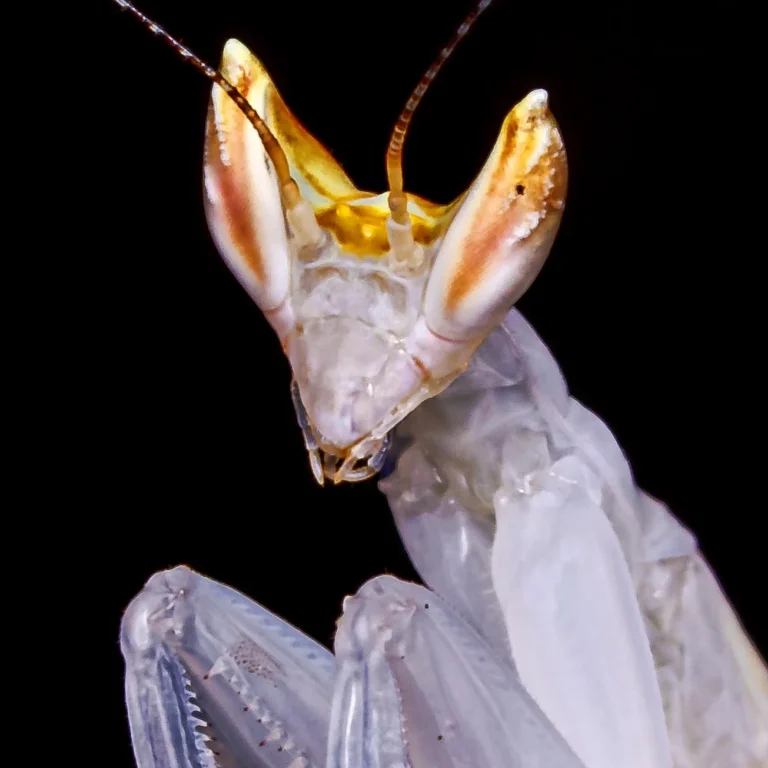
- Wait. It stays still while pollinators approach. Its large compound eyes track movement and judge distance.
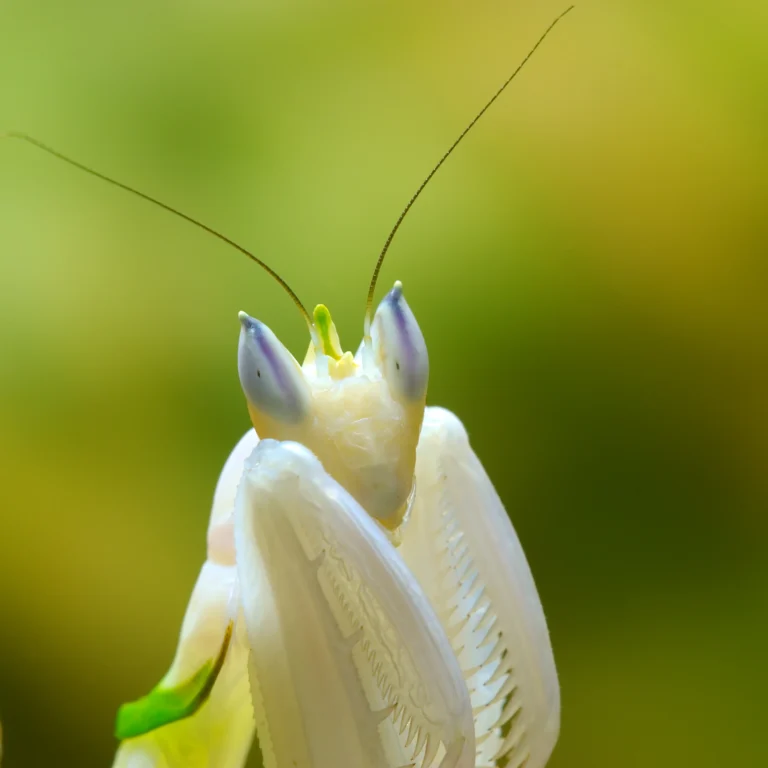
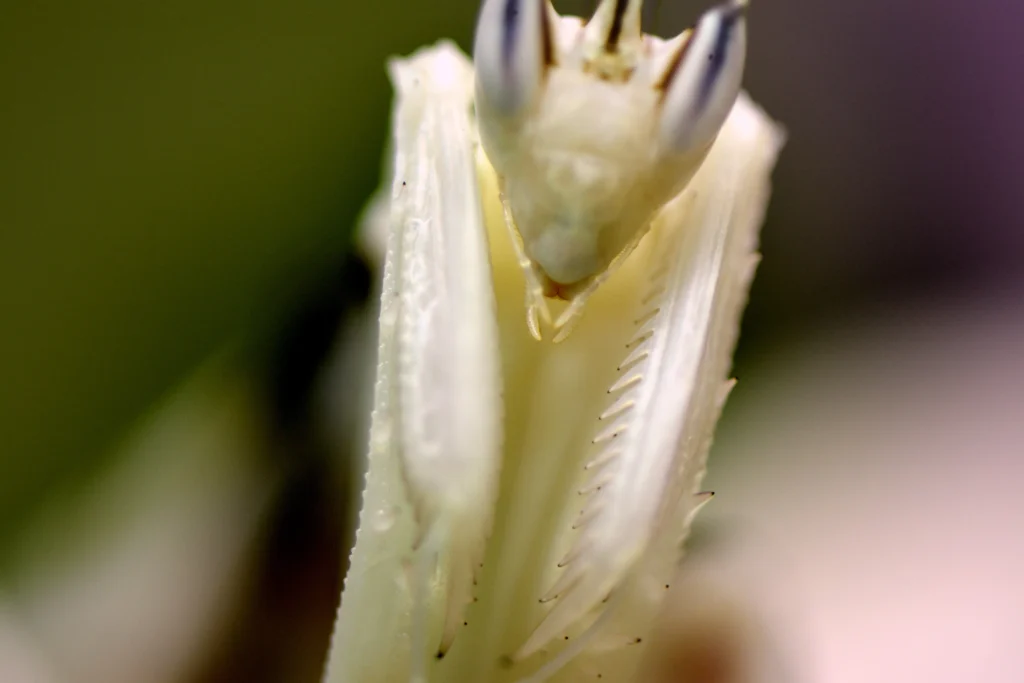
- Strike. When prey comes within reach, the folded forelegs shoot out and snap shut. Spines on the legs interlock to hold the insect.
- Eat. The mantis bites into the prey with its chewing mouthparts while holding it in its forelegs. In the butterfly hunts described by the Chinese Academy of Sciences, the mantis ate the abdomen and discarded the wings.
Because it hunts by sight and waits for prey to come close, the orchid mantis is best fed insects that move and fly. A motionless or dead insect rarely triggers a strike.
Cannibalism
Orchid mantises will also eat each other. Wikipedia notes that some individuals are cannibalistic, and Asian Geographic reports that hungry nymphs have been seen eating their own siblings. This is why every orchid mantis in captivity needs its own enclosure.
Do orchid mantises eat nectar or pollen?
They are carnivores, not nectar feeders. However, some keepers offer bee pollen as a supplement. Dubia Roaches suggests dusting feeder insects with bee pollen powder, or offering a dab of honey and pollen mixture on a chopstick, at least once a week. This is a supplement, never a substitute for live prey.
What to Feed an Orchid Mantis in Captivity
Why flying prey matters
The Cincinnati Zoo, which raises orchid mantises, says its orchid mantises will only eat flying prey. To have the right size of food for every life stage, its team rears fruit flies, house flies, flesh flies, wax moths and soldier flies. A US Mantis care sheet gives a similar progression: fruit flies for early instars, then blue bottle flies.
Not every source is so strict. Wikipedia lists crickets among foods taken in nature and captivity. On the other hand, Dubia Roaches advises avoiding crickets for this species. Since crickets can bite and do not trigger the mantis’s flower-based hunting, most keepers treat flying insects as the staple and crickets as an occasional fallback at most.
Feeding by life stage
| Stage | Suitable prey | Notes |
|---|---|---|
| L1 to L2 nymphs | Small fruit flies (flightless cultures) | Offer several at a time; nymphs need frequent meals |
| L3 to L4 nymphs | Larger fruit flies, very small house flies | Watch that prey is not too large |
| Middle and late nymphs | House flies, small blue bottle flies, small moths | Females need more food than males |
| Adult females | House flies, blue bottle flies, wax moths, other flying insects | Large females can eat a lot each day |
| Adult males | Fruit flies and small house flies | Males are small; feed less |
Keep prey no larger than about half the mantis’s body length, as Dubia Roaches recommends. Prey that is too big can injure a mantis or simply be ignored.
Raising and buying feeders
Most keepers use one or more of these:
- Fruit fly cultures. Flightless strains are easy to contain and ideal for small nymphs.
- Fly pupae (spikes). House fly or blue bottle fly pupae can be bought and hatched as needed. Keeping pupae cool slows hatching so you have a steady supply.
- Wax moths. Wax worm larvae can be allowed to pupate and hatch into moths for adult mantises.
The Cincinnati Zoo’s approach of rearing several prey species is a good model: variety lets you match prey size to each mantis.
Gut-loading
Dubia Roaches recommends gut-loading feeder insects for at least 24 hours before feeding, so the prey carries nutrition into the mantis. For flies, this usually means offering them sugar water, honey water or a commercial fly food before use.
How Often to Feed an Orchid Mantis
There is no single schedule that fits every mantis, but sources give a consistent range:
- Dubia Roaches: offer prey every other day, as much as the mantis will eat in one session.
- Common keeper practice: every 2 to 3 days for most nymphs and adults.
- InsectStore: feed males less than females.
- US Mantis: late-instar females can eat large quantities each day.
A practical approach is to watch the abdomen. A thin, flat abdomen means the mantis needs more food. A plump abdomen means you can space meals out. A female preparing to lay eggs will grow noticeably heavier.
Remove uneaten prey after about a day, as InsectStore advises. Live insects left in the enclosure can stress or even injure a mantis, especially during a molt.
An example feeding week
The plan below is an example, not a rule. Adjust it to your mantis’s size and appetite.
| Day | Middle-stage female nymph | Adult female |
|---|---|---|
| Monday | Several large fruit flies or 1 small house fly | 2 to 3 house flies or blue bottle flies |
| Tuesday | Mist only | Mist only |
| Wednesday | Several large fruit flies or 1 small house fly | 1 to 2 flies or 1 wax moth |
| Thursday | Mist only | Mist only |
| Friday | Several large fruit flies or 1 small house fly | 2 to 3 flies |
| Weekend | Mist; skip a meal if the abdomen is plump | Mist; offer a pollen-dusted fly once a week |
For adult males, use smaller prey and fewer items. Before a molt, when the mantis stops eating, simply keep misting and wait.
Feeding a breeding female
A female that will be paired needs extra attention. InsectStore notes that varied feeding produces larger specimens and a larger, more fertile egg case. Breeders also feed the female well just before introducing a male, because a hungry female is more likely to treat him as prey. After mating, her appetite usually rises as eggs develop. Our orchid mantis eggs and breeding guide covers the full process.
When an Orchid Mantis Stops Eating
Refusing food is not always a problem. Common reasons include:
- An upcoming molt. Dubia Roaches notes that refusing food for one or two days before a molt is normal.
- Just after a molt. The new exoskeleton is soft. Dubia Roaches recommends not disturbing the mantis for about three days after molting, so hold off on feeding.
- Being full. A well-fed mantis may simply ignore prey for a few days.
- Cool temperatures. A cold mantis has a slow metabolism and less appetite.
- Old age. Appetite drops near the end of life.
If a mantis refuses food for a long time outside these situations, check temperature, humidity and ventilation first. Our orchid mantis care sheet has a full troubleshooting list.
Water: Do Orchid Mantises Drink?
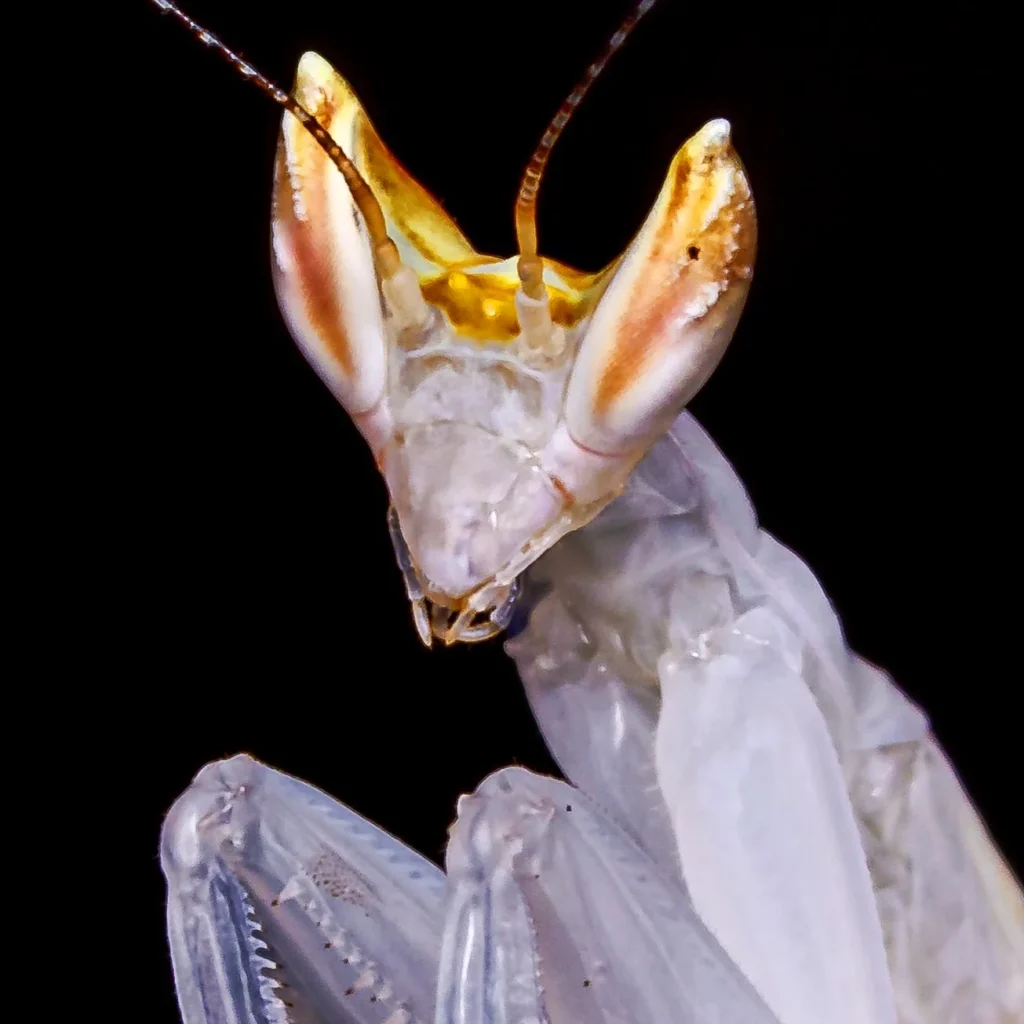
Yes. They drink droplets from leaves and enclosure walls. Dubia Roaches recommends lightly misting the enclosure twice a day, which both raises humidity and provides drinking water, then letting it dry between mistings. Videos of orchid mantises sipping water droplets from a keeper’s finger show the same behavior. Do not leave standing water dishes, which small nymphs can drown in.
Common Feeding Mistakes
- Prey that is too large. Big prey can fight back or knock a mantis from its perch.
- Only non-flying prey. Many orchid mantises ignore crawling insects.
- Feeding during a molt. Live prey can bite a soft, molting mantis.
- Leaving uneaten prey for days. It stresses the mantis and fouls the enclosure.
- Skipping misting. A mantis that cannot find water droplets can dehydrate even when well fed.
- Wild-caught insects. Insects from outdoors may carry pesticides or parasites. Use cultured feeders where possible.
- Feeding two mantises together. One may eat the other.
Orchid Mantis Diet vs Other Mantises
The orchid mantis is a pickier eater than beginner species such as the Chinese mantis or ghost mantis, which take a wider range of prey. Its specialization on flying pollinators is part of what makes it an intermediate species to keep. If you are still deciding, see the orchid mantis as a pet and orchid mantis vs ghost mantis.
Related Guides
If you want to go deeper, these guides pick up where this page leaves off:
- Orchid mantis care sheet: temperature, humidity, feeding and molting.
- Orchid mantis enclosure: terrarium size and step-by-step setup.
- Orchid mantis camouflage: the science of its flower disguise.
- Orchid mantis eggs and breeding: ootheca, mating and hatching.
Frequently Asked Questions
What do orchid mantises eat in the wild?
Mainly flying insects that visit flowers, such as bees, flies, butterflies and moths, as well as crickets, grasshoppers and beetles.
What should I feed my orchid mantis?
Fruit flies for small nymphs, then house flies, blue bottle flies and small moths as it grows. Keep prey no longer than half the mantis’s body.
Can orchid mantises eat crickets?
Some keepers have used small crickets, but many avoid them. Flying insects are the recommended staple.
Can orchid mantises eat mealworms?
Mealworms are not a good staple. They do not fly, many orchid mantises ignore them, and they are less suited to this species than flies.
How often should I feed an orchid mantis?
Commonly every other day or every 2 to 3 days. Adjust based on age, sex and how full the abdomen looks.
Can I feed my orchid mantis dead insects?
Usually not. Orchid mantises hunt by sight and strike at moving prey, so dead insects are mostly ignored. Live, cultured flies are the safest choice.
What do baby orchid mantises eat?
Newly hatched nymphs need very small live prey, such as flightless fruit flies. They should be fed soon after hatching and given misted droplets to drink.
Do orchid mantises eat honey?
Not as a main food, but some keepers offer a small dab of honey and bee pollen, or dust feeders with pollen, as a weekly supplement.
Sources
- O’Hanlon, J.C. et al. (2014). Pollinator deception in the orchid mantis. The American Naturalist. https://www.journals.uchicago.edu/doi/reader/10.1086/673858
- Mizuno, T. et al. (2014). Zoological Science 31(12): 795-801. https://bioone.org/journals/zoological-science/volume-31/issue-12/zs140126/Double-Trick-Visual-and-Chemical-Mimicry-by-the-Juvenile-Orchid/10.2108/zs140126.short
- Chinese Academy of Sciences, “Orchid Mantis Ambushes Foraging Butterflies” (2020): https://english.cas.cn/newsroom/research_news/life/202003/t20200312_231167.shtml
- Wikipedia, Hymenopus coronatus (diet): https://en.wikipedia.org/wiki/Hymenopus_coronatus
- Asian Geographic, The Pink Orchid Mantis: https://asiangeo.com/?p=40053
- Cincinnati Zoo and Botanical Garden: https://cincinnatizoo.org/?p=252752
- Dubia Roaches, Orchid mantis care sheet: https://dubiaroaches.com/blogs/invert-care/orchid-mantis-care-sheet
- InsectStore, Hymenopus coronatus: https://insectstore.com/mantids/hymenopus-coronatus-orchid-mantis
- US Mantis, orchid mantis care sheet (PDF): https://cdn.shopify.com/s/files/1/1296/7335/files/Orchid_Mantis_care_sheet.pdf
- AOL / A-Z Animals, “Orchid Mantis Looks Like a Flower and Drinks Like a Fairy”: https://www.aol.com/lifestyle/orchid-mantis-looks-flower-drinks-123200530.html