Orchid Mantis Eggs, Ootheca and Breeding
Orchid mantis eggs are laid inside an ootheca, a foamy egg case the female attaches to a twig. After roughly 40 days at about 80°F, dozens of tiny red and black nymphs emerge. Getting to that point takes planning: male and female orchid mantises mature at very different speeds, the female is many times heavier than the male, and a mating can end with the male being eaten.
This guide explains orchid mantis reproduction from courtship to hatching, using zoo, museum and breeder sources, and gives practical steps for anyone planning to breed this species.
Key Numbers
| Topic | Figure | Source |
|---|---|---|
| Mating after female’s final molt | About 3 to 4 weeks | US Mantis |
| Mating duration | 24 to 36 hours | Montreal Insectarium |
| First egg case after mating | About 15 days | Montreal Insectarium |
| Egg cases per female | Typically about 3 (US Mantis); up to 4 more after the first (Montreal) | US Mantis, Montreal Insectarium |
| Ootheca size | Up to about 4 inches long and 1/3 inch wide | US Mantis |
| Eggs per case | 25 to 50 eggs (Montreal); average about 40 nymphs (US Mantis); up to about 90 nymphs (InsectStore) | Various |
| Incubation | About 40 days at 80°F (US Mantis); about 1.5 months (Montreal) | US Mantis, Montreal Insectarium |
The ranges vary because conditions, the female’s size and diet, and counting methods differ.
How Orchid Mantis Reproduction Works
Step 1: Both partners reach adulthood
Only adults can breed. Adulthood is reached at the final molt, when the mantis gets full wings. The problem for breeders is that males reach this point much earlier than females, after roughly 5 to 6 molts compared with 7 to 8. A male hatched on the same day as a female may be an adult, and even nearing the end of his life, before she is ready.
Step 2: Timing the pair
InsectStore suggests slowing male development by keeping males cooler, at around 15 to 18°C, and feeding them less, so they mature at about the same time as females. Some breeders stagger hatchings from different egg cases instead, raising males from a later batch.
A US Mantis care sheet reports that mating takes place about 3 to 4 weeks after the female’s final molt. During this time, the female should be eating well.
Step 3: Courtship
The Montreal Insectarium describes the male making advances by drumming on the female’s thorax with his forelegs. He approaches carefully, because the female is far larger. US Mantis describes adult females as about 12 times more massive than males.
Step 4: Mating
The Montreal Insectarium reports that mating takes between 24 and 36 hours. During that time the male stays on the female’s back.
Step 5: Laying the ootheca
About 15 days after mating, according to the Montreal Insectarium, the female lays her first egg case. She produces a foamy substance from the tip of her abdomen, shapes it around the eggs and attaches it to a twig or the side of the enclosure. The foam hardens into a protective shell.
She may lay more cases over the following weeks. US Mantis reports that females typically produce about three.
Do Orchid Mantises Eat Their Mates?
Sometimes. Sexual cannibalism is well known in praying mantises, and the orchid mantis is no exception. The Montreal Insectarium notes that because the male is about half the female’s size, she sometimes feeds on him during mating, though it describes this as infrequent.
Breeders reduce the risk by:
- Feeding the female well just before introducing the male.
- Introducing the male from behind, so he can mount without being seen as prey.
- Supervising the pairing and having a container ready to separate them.
- Using a large enclosure for the pairing, so the male has space to retreat.
- Removing the male once mating is complete.
What an Orchid Mantis Ootheca Looks Like
An orchid mantis ootheca is long and narrow. US Mantis describes cases up to about 4 inches long and about 1/3 inch wide. It is usually light brown or tan once hardened, and it is attached along a twig or flat surface.
Keepers sometimes call it an orchid mantis egg sack or egg sac, but it is not a soft sac. It is a hardened foam case with rows of eggs inside, which protects them from drying out and from small predators.
Does the female guard her eggs?
There is some evidence that she may. Wikipedia cites an early observation by naturalist Robert Shelford in 1903, quoted by entomologist James Costa in 2006, reporting that orchid mantis females guard their eggs. Costa notes that parental care in mantises is understudied, so this behavior is not well documented.
Fertile and Infertile Egg Cases
A female that has not mated may still lay egg cases. These are unfertilized and will not hatch. If your female lays an ootheca without having mated, you can remove it after it hardens. If she has mated, keep the case and incubate it.
There is no reliable way to check fertility by looking at the outside of an ootheca. Incubate any case from a mated female for the full period and watch for hatching.
How to Incubate Orchid Mantis Eggs
Breeders use a simple setup:
- Leave the ootheca attached. If it is on a twig, move the whole twig. If it is on the enclosure wall, it can sometimes be carefully removed after it has fully hardened, but leaving it in place is safer.
- Keep its orientation. Hang or mount the case the way it was laid, with space below it so hatching nymphs can drop and hang free.
- Use a ventilated container. A deli cup or small mesh-topped container works.
- Keep it warm. US Mantis gives about 40 days at 80°F as a guide.
- Keep humidity steady. Light misting of the container walls, not soaking the case, prevents it from drying out. Avoid stagnant, wet conditions that encourage mold.
- Prepare food in advance. Have flightless fruit fly cultures ready before the expected hatch date.
Hatching
When orchid mantis eggs hatch, many nymphs emerge over a short period. InsectStore describes them as black and red at this stage, with colors fading after the first molt. Wikipedia notes that first-stage nymphs mimic assassin bugs.
What to do at hatching:
- Feed quickly. Offer small flightless fruit flies right away.
- Mist. Nymphs drink from droplets.
- Separate early. Orchid mantis nymphs are cannibalistic. Asian Geographic reports that hungry nymphs have been seen eating their siblings. Move them into individual containers as soon as practical.
- Expect losses. Not every nymph will survive. The AOL and A-Z Animals profile of the species notes that few nymphs survive to adulthood, which is part of why adults are expensive.
Follow the next stages in orchid mantis life cycle.
Feeding for Successful Breeding
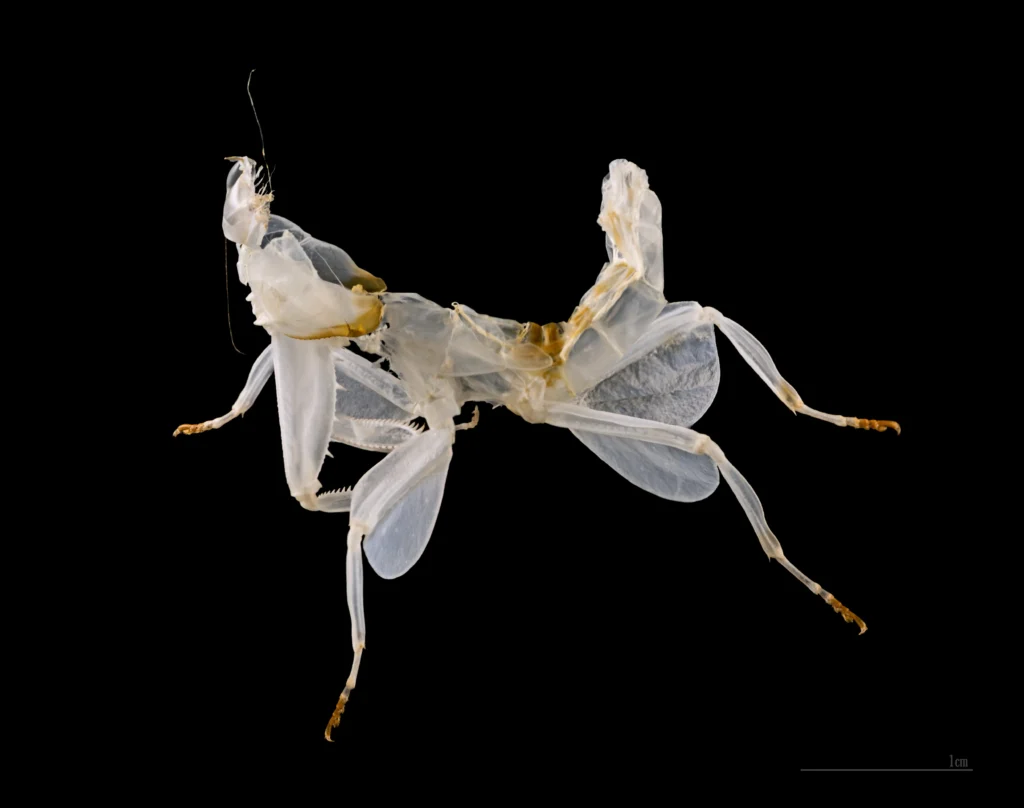
Breeding success starts with diet. InsectStore notes that a varied diet of flying insects produces larger specimens and a larger, more fertile ootheca. A well-fed female also poses less risk to the male. Females eat heavily while developing eggs; US Mantis notes that late-instar females can eat large quantities each day. See what orchid mantises eat.
An Example Breeding Calendar
The calendar below strings together the published figures into one possible plan. Real timings will shift with temperature and with each animal.
| Week | Event |
|---|---|
| 0 | Female molts into an adult. Feed her generously. |
| 3 to 4 | Pair with an adult male that has been held back by cooler conditions (US Mantis gives 3 to 4 weeks after the final molt). |
| About 5 to 6 | Female lays her first ootheca, roughly 15 days after mating (Montreal Insectarium). Move the case to an incubation container. |
| Following weeks | Female may lay further cases; incubate each separately and label it with its date. |
| About 11 to 12 | First case hatches, around 40 days after laying at 80°F (US Mantis). Feed and separate nymphs. |
Labeling each ootheca with its laying date makes it easy to know when to expect a hatch and when to give up on a case that is probably infertile.
Should You Breed Orchid Mantises?
Breeding is rewarding but demanding. Consider these points first.
Reasons to try:
- You can raise your own captive-bred animals instead of buying them.
- Watching red and black nymphs turn into white and pink flower mimics is one of the most memorable parts of keeping the species.
- Captive breeding reduces pressure on wild populations.
Reasons to wait:
- Dozens of nymphs each need their own container and a steady supply of fruit flies.
- Losses among young nymphs are common.
- Timing males and females takes experience.
- You may end up with more nymphs than you can house or rehome legally.
Most keepers raise at least one orchid mantis to adulthood successfully before attempting to breed. Our orchid mantis care sheet covers the basics you will need first.
Common Breeding Problems
| Problem | Likely cause | What to try |
|---|---|---|
| Male matures far before the female | Normal development speed | Keep males cooler and feed them less; stagger hatches |
| Female attacks the male | Hunger or poor approach | Feed her first; introduce the male from behind; supervise |
| Egg case dries out | Low humidity | Mist the container walls lightly and regularly |
| Mold on the ootheca | Too wet, poor airflow | Improve ventilation; avoid soaking the case |
| No hatch after the expected period | Unfertilized case, or cooler conditions | Wait longer if conditions were cool; otherwise assume infertile |
| Many nymphs lost after hatching | Cannibalism, no food, dehydration | Feed immediately, mist, separate early |
Orchid Mantis Eggs for Sale: Legal and Ethical Points
You may see orchid mantis eggs or oothecae offered online. Be careful:
- Import rules. It is illegal to import most insects and arthropods into the United States without the proper permits, according to National Geographic’s reporting on insect smuggling. In one case it described, inspectors at JFK Airport found 245 small containers of orchid mantis egg cases addressed to a New Jersey resident.
- Confiscations. The Cincinnati Zoo has described receiving nine orchid mantis egg cases confiscated by the US Fish and Wildlife Service, then raising the nymphs and sending 110 mantises to five other accredited zoos.
- Domestic rules. USDA APHIS advises contacting its Plant Protection and Quarantine program before buying any land-dwelling invertebrate, because many non-native species need a permit.
Buy only from breeders inside your own country and ask about permits. See can you own an orchid mantis? and where to buy an orchid mantis.
Related Guides
If you want to go deeper, these guides pick up where this page leaves off:
- Orchid mantis life cycle: from red and black nymph to adult.
- Male vs female orchid mantis: how to tell them apart.
- What orchid mantises eat: wild diet and a feeding guide.
- Can you own an orchid mantis?: permit and legal rules explained.
Frequently Asked Questions
How many eggs does an orchid mantis lay?
Each egg case holds dozens of eggs. Sources give 25 to 50 eggs per case, an average of about 40 nymphs, or up to about 90 nymphs. A female typically lays about three cases.
How long do orchid mantis eggs take to hatch?
About 40 days at 80°F, according to US Mantis. Cooler conditions take longer.
Is it an egg case or an egg sack?
Both terms are used, but “ootheca” or “egg case” is more accurate. It is a hardened foam shell, not a soft sack.
What does an orchid mantis egg case look like?
A long, narrow, hardened foam case, up to about 4 inches long, usually light brown and attached to a twig.
Do orchid mantises eat their mates?
Sometimes. The female is much larger and may eat the male during or after mating. Feeding her well first lowers the risk.
Can a female orchid mantis lay eggs without mating?
Yes, but those egg cases are not fertilized and will not hatch.
Can I move an orchid mantis ootheca?
Yes, once it has fully hardened, ideally by moving the twig it is attached to. Keep it the same way up as it was laid and avoid squeezing or soaking it.
How many baby orchid mantises survive?
Survival varies widely. Cannibalism, dehydration and lack of food cause many early losses, which is why breeders feed hatchlings quickly and separate them early.
How do I breed orchid mantises?
Time the pair so both are adults together, feed the female well, introduce the male carefully, supervise, then incubate the resulting egg cases warm and lightly humid.
Sources
- US Mantis, orchid mantis care sheet (PDF): https://cdn.shopify.com/s/files/1/1296/7335/files/Orchid_Mantis_care_sheet.pdf
- Montreal Insectarium (Espace pour la vie), Orchid praying mantis: https://espacepourlavie.ca/en/insects-arthropods/orchid-praying-mantis?mode=76
- InsectStore, Hymenopus coronatus: https://insectstore.com/mantids/hymenopus-coronatus-orchid-mantis
- Wikipedia, Hymenopus coronatus: https://en.wikipedia.org/wiki/Hymenopus_coronatus
- Asian Geographic, The Pink Orchid Mantis: https://asiangeo.com/?p=40053
- AOL / A-Z Animals, “Orchid Mantis: The Expensive Exotic Insect”: https://www.aol.com/articles/orchid-mantis-expensive-exotic-insect-154459188.html
- National Geographic, insect smuggling report: https://www.nationalgeographic.com/animals/2019/09/bug-smuggling-big-business
- Cincinnati Zoo, “Mantis Mayhem”: https://cincinnatizoo.org/mantis-mayhem/
- Mahoning Matters, confiscated orchid mantis egg cases: https://www.mahoningmatters.com/news/nation-world/article301345229.html
- USDA APHIS, Invertebrate Pets: https://www.aphis.usda.gov/organism-soil-imports/invertebrate-pets