Orchid Mantis Anatomy: A Body Built to Look Like a Flower
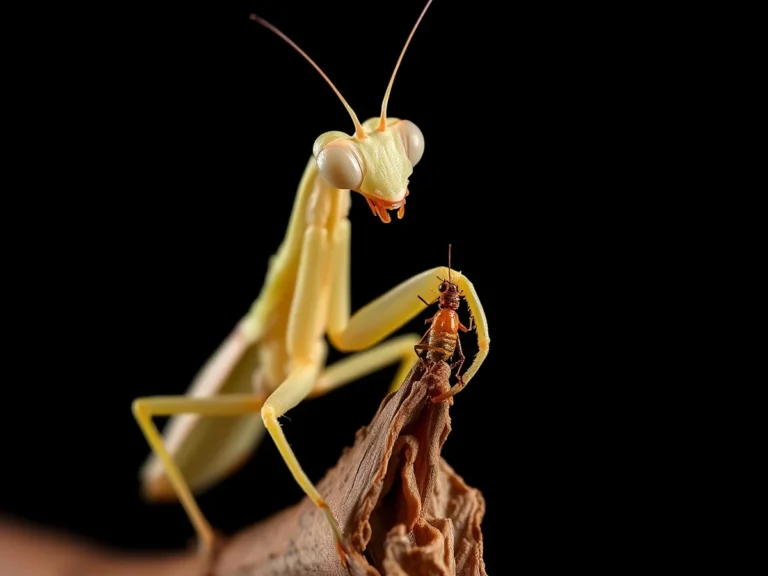
At first glance, an orchid mantis looks like a small white or pink blossom. Look closer and you see a precise hunting machine: spiked forelegs that snap shut on prey, eyes that judge distance, a hidden ear that listens for bats, and leg lobes shaped like petals. This guide walks through orchid mantis anatomy from head to abdomen, using research papers and museum sources, and explains how each part helps the insect survive.
The Basic Body Plan
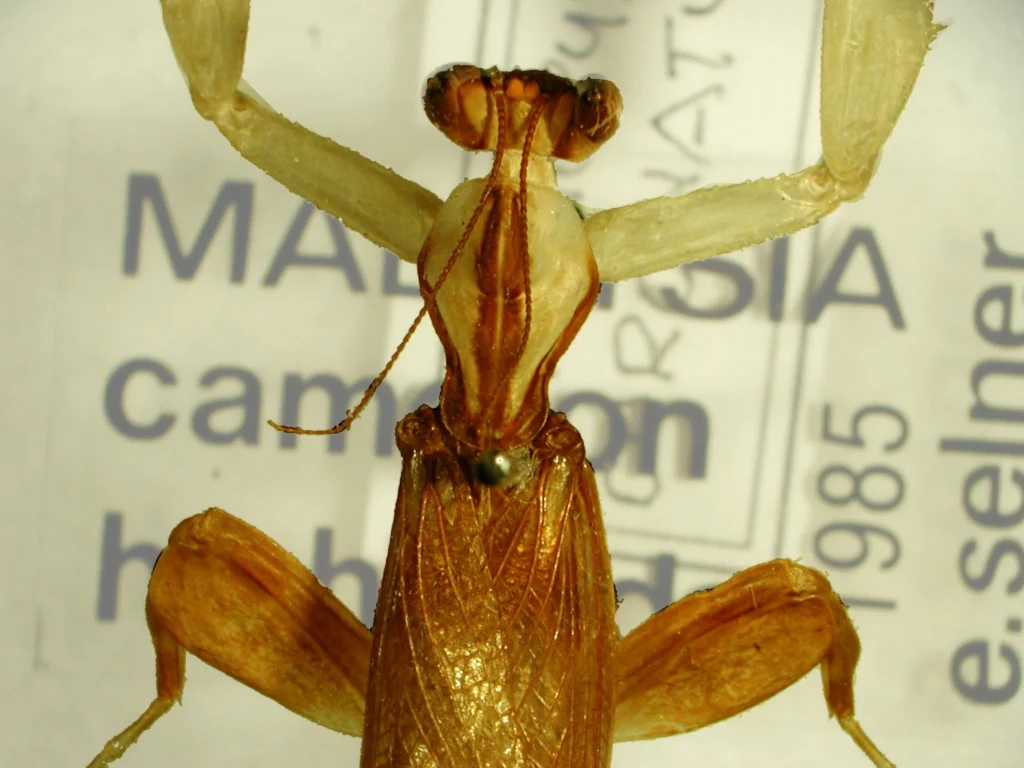
Like every insect, the orchid mantis has three main body regions:
| Region | What it includes | What it does |
|---|---|---|
| Head | Compound eyes, simple eyes, antennae, mouthparts | Sensing and eating |
| Thorax | Prothorax (the long “neck”), mesothorax, metathorax; six legs; two pairs of wings | Movement, grasping prey, flight |
| Abdomen | Segments that hold the digestive and reproductive organs | Digestion, breathing, reproduction |
What makes the orchid mantis different from a typical mantis is not the plan itself but the modifications laid on top of it: flattened leg lobes, pale flower colors and a broad abdomen in young females.
What Does an Orchid Mantis Look Like?
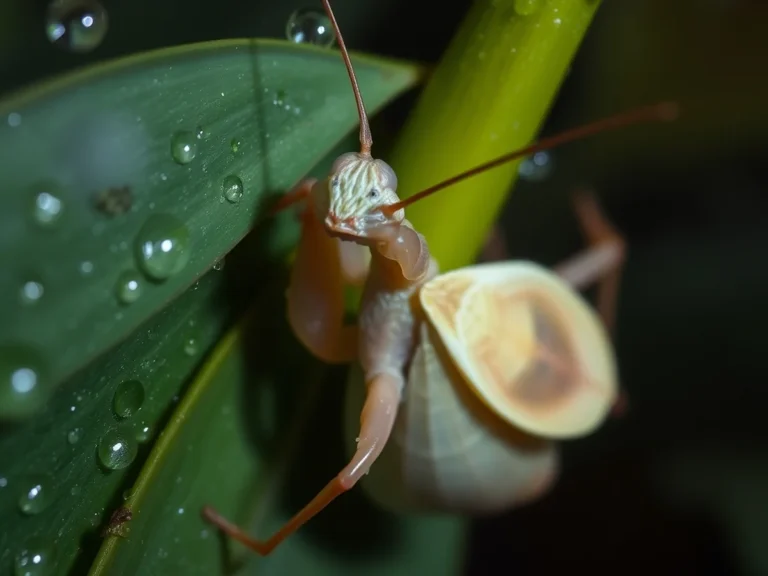
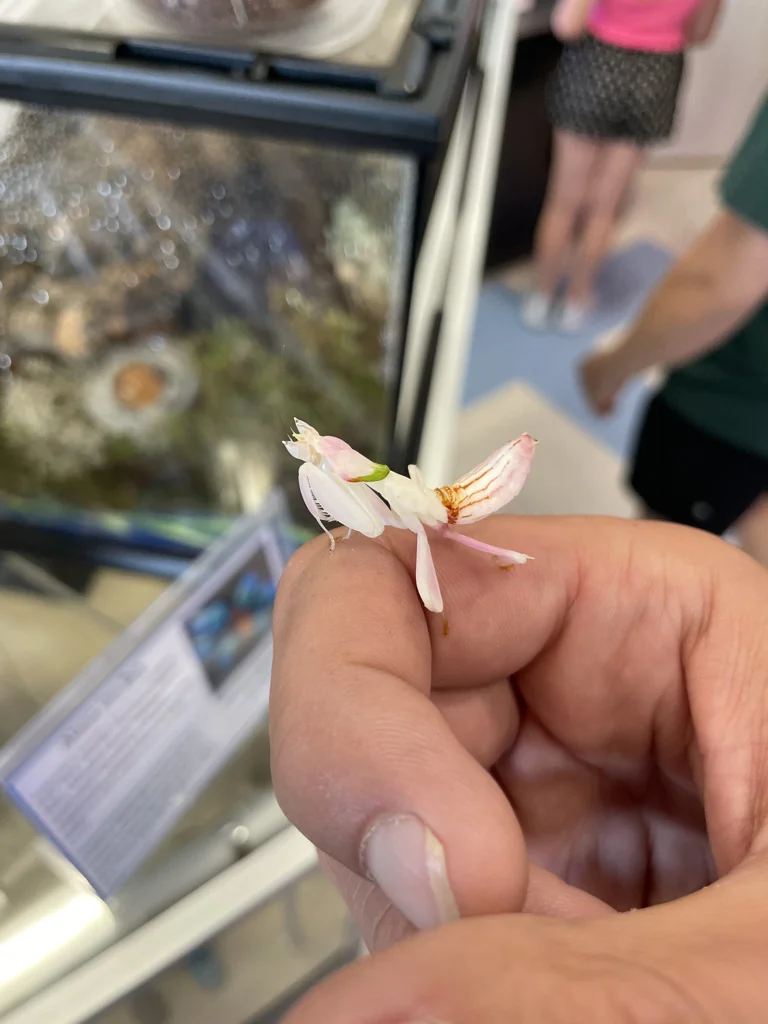
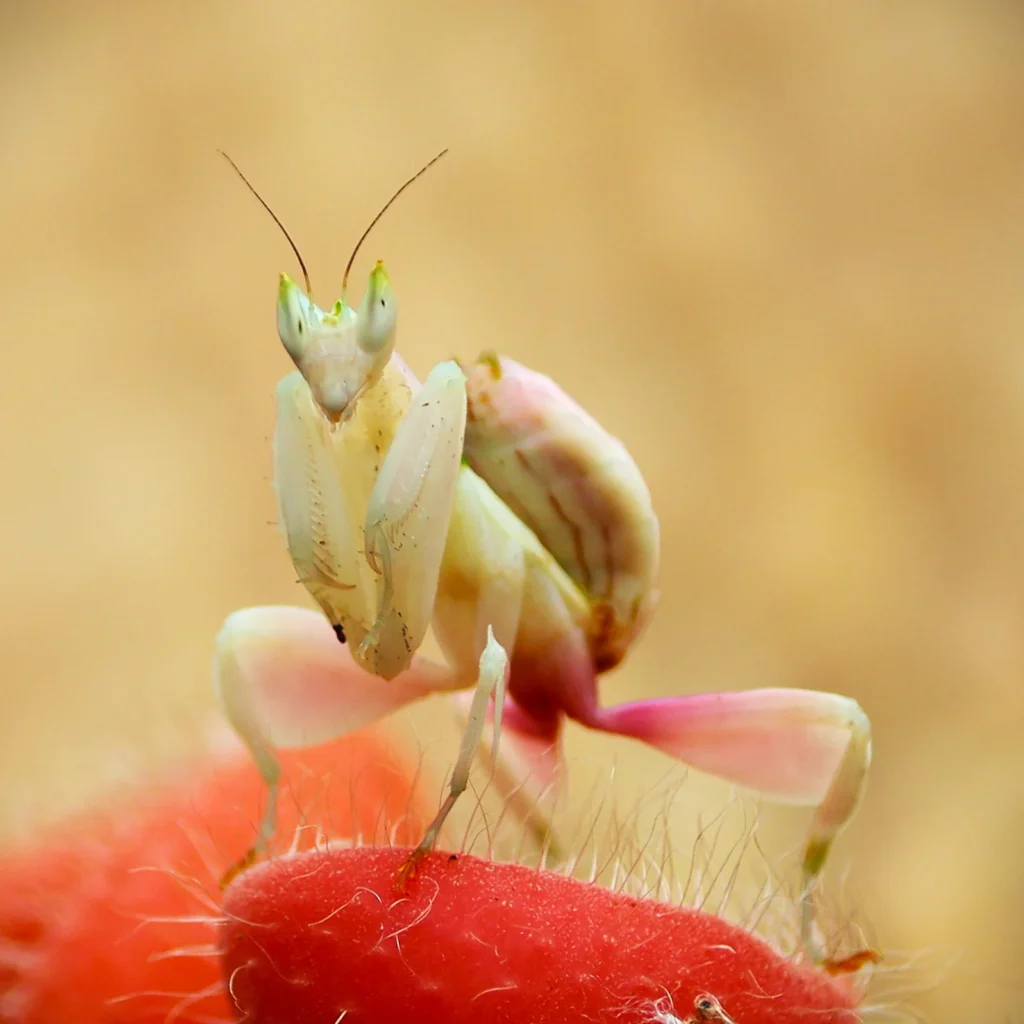
A juvenile or adult female orchid mantis looks like this:
- Color: predominantly white, often with pink or yellow hues, according to a 2013 study in the Journal of Orthoptera Research.
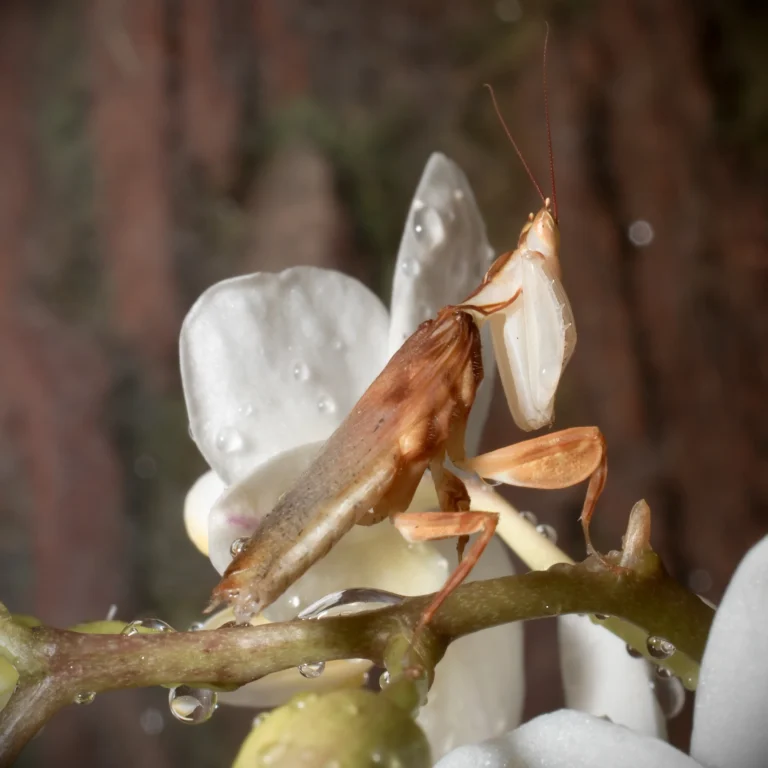
- Legs: four walking legs with wide, rounded lobes that resemble petals.
- Abdomen: broad and often held curled upward in juveniles, adding to the flower shape.
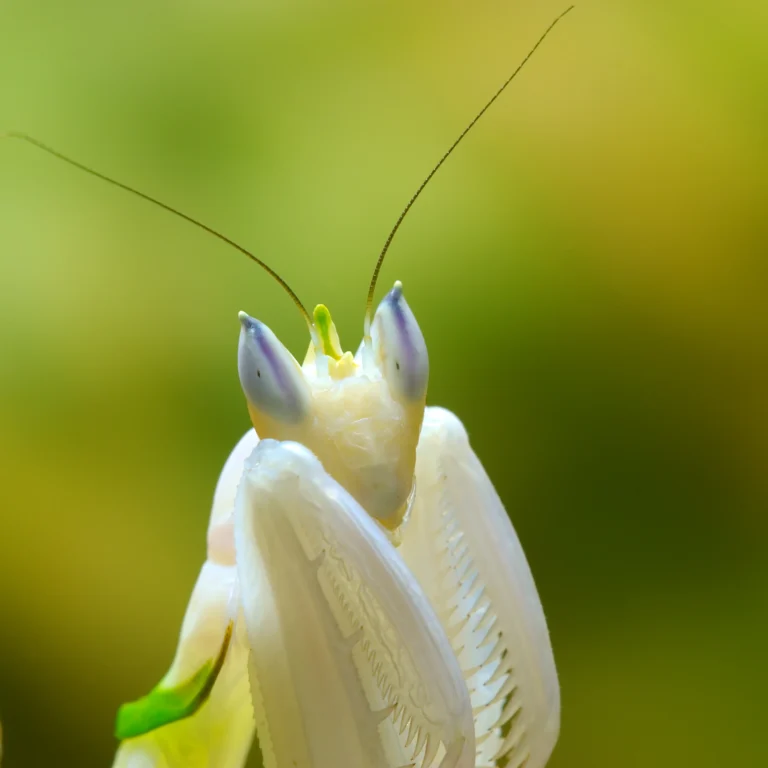
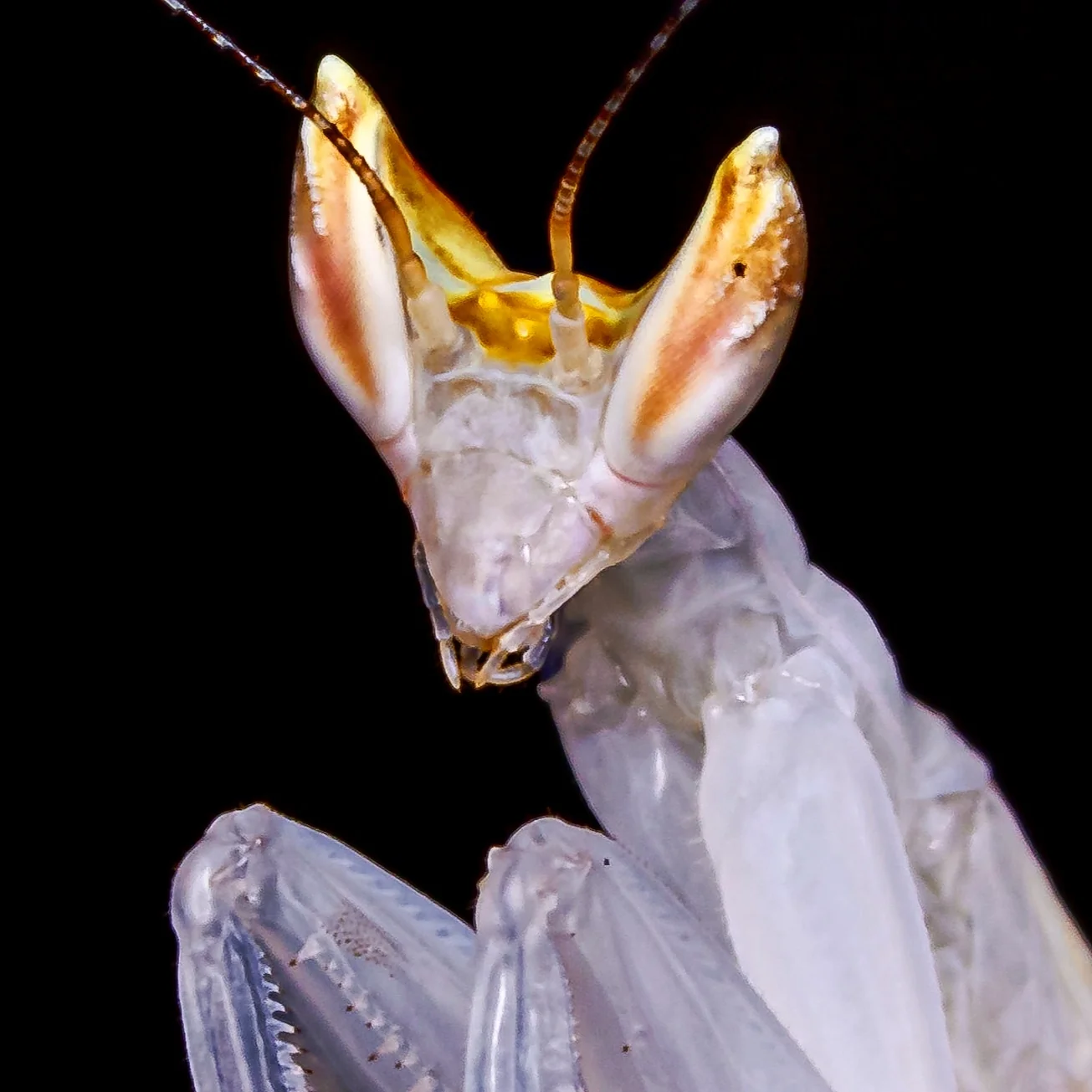
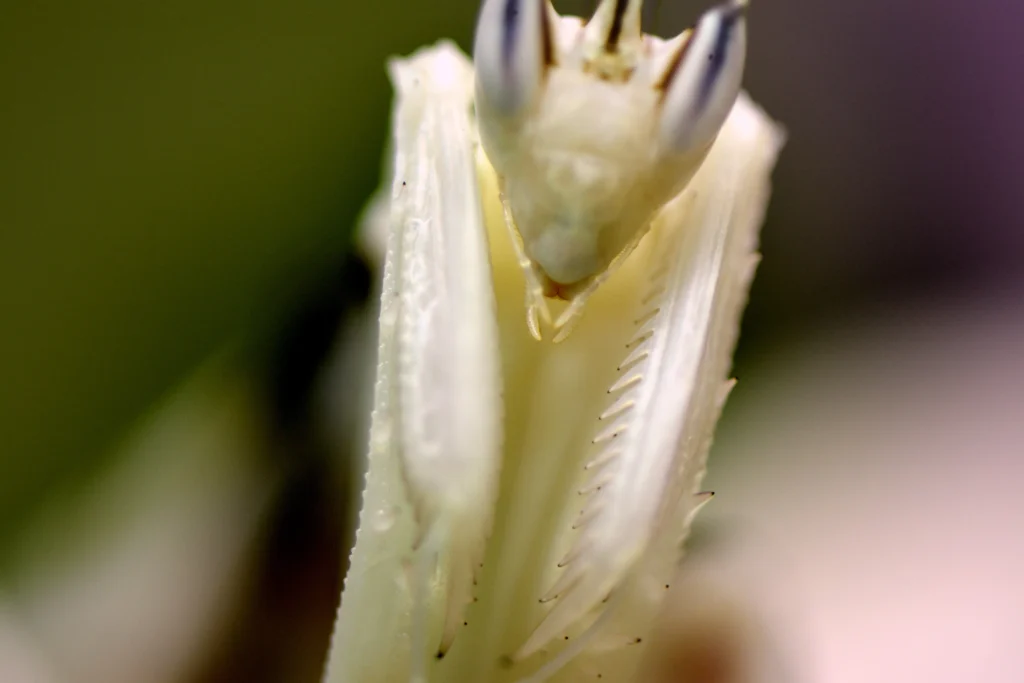
- Head: small and triangular, with a pointed cone on top and large eyes.
- Front legs: folded, spined raptorial forelegs held in front of the body.
Adult males look very different: small, slim, greenish brown and less flower-like. Our male vs female orchid mantis guide covers those differences.
A text diagram of the main parts
Reading front to back, the parts you can see on an adult female are:
- Antennae (two thin feelers)
- Head with compound eyes, three ocelli and a pointed crown
- Mouthparts (mandibles under the head)
- Prothorax (long neck-like segment)
- Raptorial forelegs (attached to the prothorax)
- Wings (folded over the back in adults)
- Middle legs with femoral lobes
- Hind legs with femoral lobes
- Abdomen (partly covered by the wings in adults)
If you are making an orchid mantis diagram for a class or poster, these nine labels cover the essentials.
The Head and Face
Shape
The orchid mantis face is triangular, like that of most mantises, with a beak-like front and the mouthparts underneath. A small, pointed cone rises from the top of the head between the eyes. The head sits on a flexible joint, and Wikipedia notes that some mantises can rotate their heads nearly 180 degrees. That is why an orchid mantis can turn to look at you over its shoulder.
The eyes
The orchid mantis has five eyes:
- Two compound eyes. These are the large, bulging eyes on either side of the head. Each is made of thousands of light receptors called ommatidia, according to EarthSky. They give the mantis a wide field of view and help it judge distance and movement.
- Three ocelli. These are small, simple eyes between the compound eyes. EarthSky explains they sense light and shadow rather than forming detailed images.
The dark spot that seems to follow you in each compound eye is a pseudopupil. It is not a real pupil; it is simply the part of the eye that absorbs light from your direction, so it looks black. As you move, the spot appears to move with you.
Mantises are known for their depth perception. EarthSky describes the praying mantis as the only invertebrate known to see in 3D, which helps explain how precisely they strike.
The mouth
Under the head are chewing mouthparts, including a pair of mandibles. The orchid mantis does not sting or inject venom. It holds prey with its forelegs and bites into it, often starting with the head or the soft abdomen. A 2020 report from the Chinese Academy of Sciences described orchid mantises eating the abdomens of butterflies and discarding the wings.
The antennae
Two thin antennae help the mantis sense its surroundings, including touch and smell.
The Hidden Ear
You will not find an ear on the orchid mantis’s head. Most mantises have a single ear on the underside of the thorax, between the middle and hind legs, according to National Geographic. Entomologist David Yager discovered this “cyclopean” ear in the late 1980s, as described by National Wildlife Federation.
The ear is tuned to ultrasound. It picks up the echolocation calls of hunting bats, which allows a flying mantis to dive or swerve away. This matters most for adult males, which fly far more than females.
The Raptorial Forelegs
The front pair of legs is built for catching prey. In most insects, the coxa and trochanter (the leg segments nearest the body) are short. In mantis raptorial legs, Wikipedia explains, these combine into a long segment about as long as the femur, which gives the leg extra reach.
Key features:
- Spines along the femur and tibia that interlock when the leg closes, trapping prey.
- A folding action like a pocket knife: the tibia snaps back against the femur.
- A resting “praying” pose when the forelegs are folded under the head, which gave praying mantises their name.
The Cincinnati Zoo describes the orchid mantid as lashing out from hiding to grab unsuspecting prey with its spiked forelegs.
The Petal Legs: Femoral Lobes
The petal-like parts that make the orchid mantis famous are not petals at all. A 2013 paper by James O’Hanlon and colleagues describes them as large, flat expansions of exoskeleton on the femur of the middle and hind legs, called femoral lobes.
These lobes:
- Make the body outline look like a flower rather than an insect.
- Catch light and color the same way the rest of the body does.
- Help the mantis blend into flowers and leaves where it sits.
Interestingly, follow-up field experiments described by Science Friday found that removing or rearranging the lobes on model mantises did not stop pollinators from approaching. A 2014 report in the journal Ethology suggested the lobes may help protect the mantis from its own predators, rather than being the main lure for prey. We explore that debate in orchid mantis camouflage.
The Wings
Do orchid mantises have wings?
Yes. Both males and females have two pairs of wings once they reach adulthood. Nymphs have only small wing buds, which grow with each molt. The wings appear fully only after the final molt.
Orchid mantis wings: what they look like
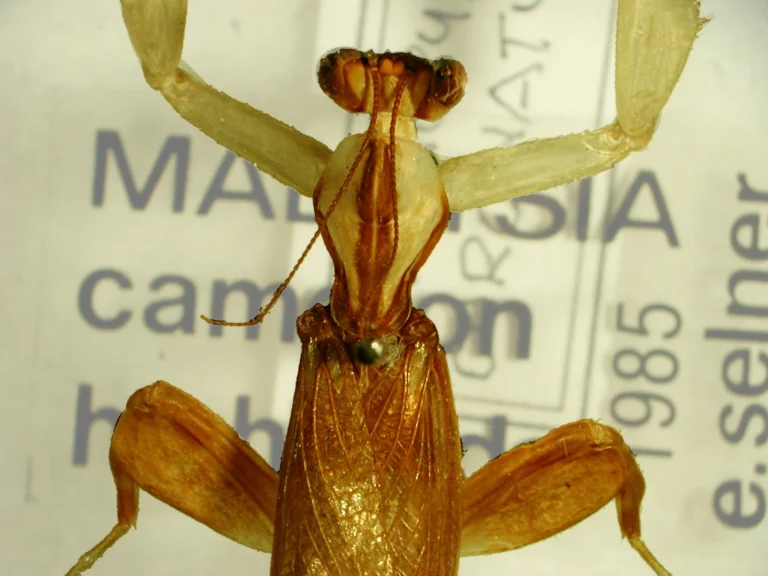
The front pair, the forewings, are leathery and cover the back like a cloak. The hind wings are thinner and fold under the forewings when at rest. On adult females, the wings cover much of the abdomen. This is one reason adults can look less flower-like than juveniles: the broad, colorful abdomen is partly hidden.
Some keepers describe a green or brownish patch on the back of the thorax. The Howard Hughes Medical Institute’s photo guide to the species points out a green plate just behind the head on its example.
Orchid mantis wings open
When an orchid mantis opens its wings, you see the thinner hind wings spread behind the forewings. Adults may open their wings when about to fly, when stretching after a molt, or in a defensive display. Photos of an orchid mantis with wings open are much rarer than photos of one at rest, because the species spends most of its time still.
Can orchid mantises fly?
Adult males fly readily. They are light, with large wings relative to their bodies, and InsectStore’s care sheet notes that males can fly very well. Adult females have full wings too, but they are heavy and rarely fly far. Nymphs cannot fly at all.
The Abdomen
The abdomen holds the digestive and reproductive organs. In young females, it is broad and often curled upward, which adds to the flower shape.
The number of visible abdominal segments is how keepers sex orchid mantises. InsectStore notes that males have eight segments and females six or seven. This works best on older nymphs; see male vs female orchid mantis for a step-by-step method.
After mating, a female’s abdomen swells as eggs develop. She uses glands at the tip of the abdomen to produce the foamy egg case, or ootheca. See orchid mantis eggs and breeding.
How Anatomy Changes With Age
| Stage | Key anatomical features |
|---|---|
| L1 nymph | Tiny, red and black, slim legs; resembles an assassin bug |
| Middle nymphs | White to pink; femoral lobes appear and grow; wing buds small |
| Late nymphs | Full flower shape; broad abdomen; wing buds visible on the back |
| Adult female | Full wings covering much of the abdomen; largest size, about 6 to 7 cm |
| Adult male | Full wings, slim body; about 2.5 to 3 cm |
The full sequence is in orchid mantis life cycle, and growth measurements are in orchid mantis size.
Praying Mantises That Look Like Orchids
The orchid mantis is not the only mantis with flower-like anatomy. Other flower mantises use similar tricks with different body parts:
- Spiny flower mantis (Pseudocreobotra): spines on the abdomen and a spiral eyespot on the wings.
- Devil’s flower mantis (Idolomantis diabolica): broad, colorful raptorial forelegs used in a threat display.
- Wandering violin mantis (Gongylus gongylodes): leaf-like flaps on slender legs and a wide plate on the thorax.
None of these has the orchid mantis’s broad femoral lobes. Compare them in our flower mantis guide.
Why Anatomy Matters for Keepers
Understanding the body helps you avoid common problems:
- Molting needs height. A mantis hangs upside down to shed its skin and pull out its legs and wings. Without enough clear space below, the new wings and lobes can harden bent. Keep the enclosure at least three times as tall as the mantis.
- Grip matters. The feet need a textured surface, like mesh, to hang from during molts. See orchid mantis enclosure.
- Wings show maturity. Full wings mean the mantis is an adult and will not molt again.
- Handle gently. Femoral lobes and wings are delicate. Let the mantis walk onto your hand rather than picking it up.
Anatomy Problems After a Bad Molt
Because a mantis has to pull every leg, lobe and wing out of its old skin, molting is the riskiest moment in its life. A molt that goes wrong is called a mismolt. Signs include:
- Wings that stay crumpled or bent after the final molt
- Femoral lobes that harden folded or twisted
- A leg that stays stuck in the old skin or ends up bent at an odd angle
- Trouble gripping, climbing or striking at prey afterward
Interestingly, the extra leg lobes do not seem to make orchid mantises unusually prone to this. A US Mantis care sheet notes that molting rarely encounters problems in captivity despite the leg extensions, as long as conditions are right. Most problems trace back to low humidity, poor grip on the ceiling, too little height, or a disturbance mid-molt. Our orchid mantis care sheet explains how to set conditions to avoid them.
Related Guides
If you want to go deeper, these guides pick up where this page leaves off:
- Orchid mantis size: how big males and females get.
- Male vs female orchid mantis: how to tell them apart.
- Orchid mantis camouflage: the science of its flower disguise.
- Orchid mantis life cycle: from red and black nymph to adult.
Frequently Asked Questions
How many eyes does an orchid mantis have?
Five: two large compound eyes and three small simple eyes called ocelli.
Where is the orchid mantis’s ear?
Most mantises have a single ear on the underside of the thorax, between the middle and hind legs. It detects ultrasound, such as bat calls.
Do orchid mantises have wings?
Yes, adults of both sexes have wings. Nymphs do not have functional wings.
Can orchid mantises fly?
Adult males fly well. Adult females are heavier and rarely fly.
What are the petals on an orchid mantis?
They are femoral lobes, flat expansions of the exoskeleton on the middle and hind legs.
What does an orchid mantis’s face look like?
Triangular, with large bulging compound eyes, three small ocelli, thin antennae, chewing mouthparts below and a small pointed cone on top of the head.
Sources
- O’Hanlon, J.C., Li, D. and Norma-Rashid, Y. (2013). Coloration and morphology of the orchid mantis. Journal of Orthoptera Research 22(1). https://bioone.org/journals/Journal-of-Orthoptera-Research/volume-22/issue-1/034.022.0106/Coloration-and-Morphology-of-the-Orchid-Mantis-iHymenopus-coronatus-i/10.1665/034.022.0106.full
- Wikipedia, Mantis (anatomy): https://Www.Wikipedia.org/wiki/Mantis
- EarthSky, praying mantis vision: https://earthsky.org/earth/praying-mantis-ferocious-insect-lifeform-of-the-week/ and https://earthsky.org/?p=476301
- National Geographic, Praying mantis: https://animals.nationalgeographic.com/animals/bugs/praying-mantis/
- National Wildlife Federation, “The Better to Hear You With”: https://www.nwf.org/Magazines/National-Wildlife/2009/The-Better-to-Hear-You-With
- Howard Hughes Medical Institute, Beautiful Biology, “Orchids with a Bite”: https://www.hhmi.org/beautifulbiology/media-detail/orchids-bite
- InsectStore, Hymenopus coronatus: https://insectstore.com/mantids/hymenopus-coronatus-orchid-mantis
- Science Friday, “Unraveling the Orchid Mantis Mystery”: https://www.sciencefriday.com/articles/unraveling-the-orchid-mantis-mystery/
- US Mantis, orchid mantis care sheet (PDF): https://cdn.shopify.com/s/files/1/1296/7335/files/Orchid_Mantis_care_sheet.pdf
- Cincinnati Zoo, Orchid mantid: https://cincinnatizoo.org/animals-archive/orchid-mantid/
- Chinese Academy of Sciences, “Orchid Mantis Ambushes Foraging Butterflies”: https://english.cas.cn/newsroom/research_news/life/202003/t20200312_231167.shtml
- Wikipedia, Flower mantis: https://en.wikipedia-on-ipfs.org/wiki/Flower_mantis