Orchid Mantis vs Ghost Mantis: How They Compare
The orchid mantis and the ghost mantis are two of the most popular exotic mantises in the hobby, and they are often sold side by side. One looks like a fresh white or pink flower. The other looks like a dry, curled brown leaf. Surprisingly, they are in the same family, and researchers at the American Museum of Natural History point out that the ghost mantis is more closely related to orchid mantises than to other dead-leaf mantises that look almost identical to it.
This guide compares the two species point by point, from appearance and origin to lifespan and care, and ends with a broader look at how the orchid mantis differs from a “typical” praying mantis.
Side-by-Side Comparison
| Feature | Orchid mantis | Ghost mantis |
|---|---|---|
| Scientific name | Hymenopus coronatus | Phyllocrania paradoxa |
| Family | Hymenopodidae | Hymenopodidae |
| Native range | Southeast Asia (Malaysia, Indonesia, Thailand and nearby) | Sub-Saharan Africa and Madagascar |
| Camouflage | Flower-like: white to pink with petal-shaped leg lobes | Dead-leaf-like: brown, beige or green with a leafy head crest |
| Adult size | Females about 6 to 7 cm; males about 2.5 to 3 cm | About 4.5 to 6 cm; females bulkier than males |
| Size difference between sexes | Extreme | Moderate |
| Typical lifespan | Females about 8 to 9 months, males about 5 to 6 months (keeper reports) | About 7 to 12 months total (Dubia Roaches, Reptile Supply) |
| Humidity | About 60 to 80%, with good ventilation | About 35 to 50%, tolerates higher (Jack of All Inverts) |
| Temperature | Roughly 75 to 85°F | Roughly 72 to 80°F (Jack of All Inverts) |
| Diet | Live flying insects | Flying insects and other small insects |
| Group housing | Not recommended | Sometimes possible with care and plenty of food |
| Experience level | Intermediate | Beginner to intermediate |
Appearance: Flower vs Dead Leaf
The orchid mantis
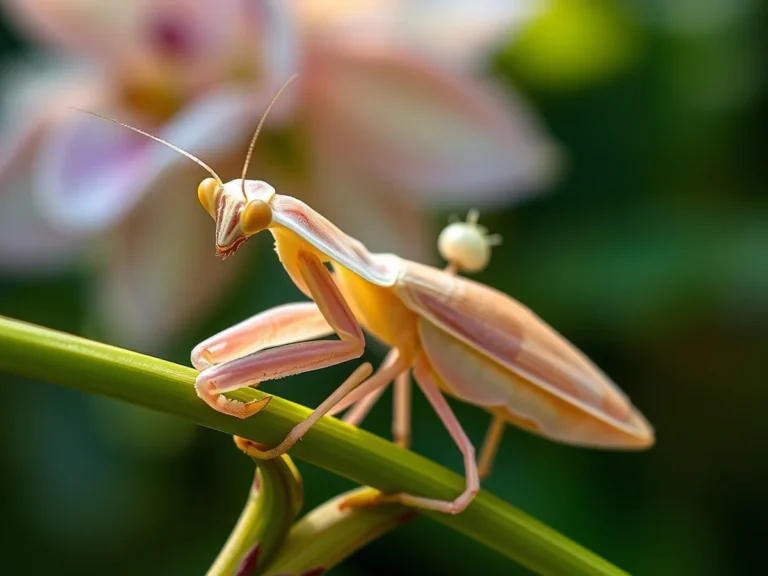
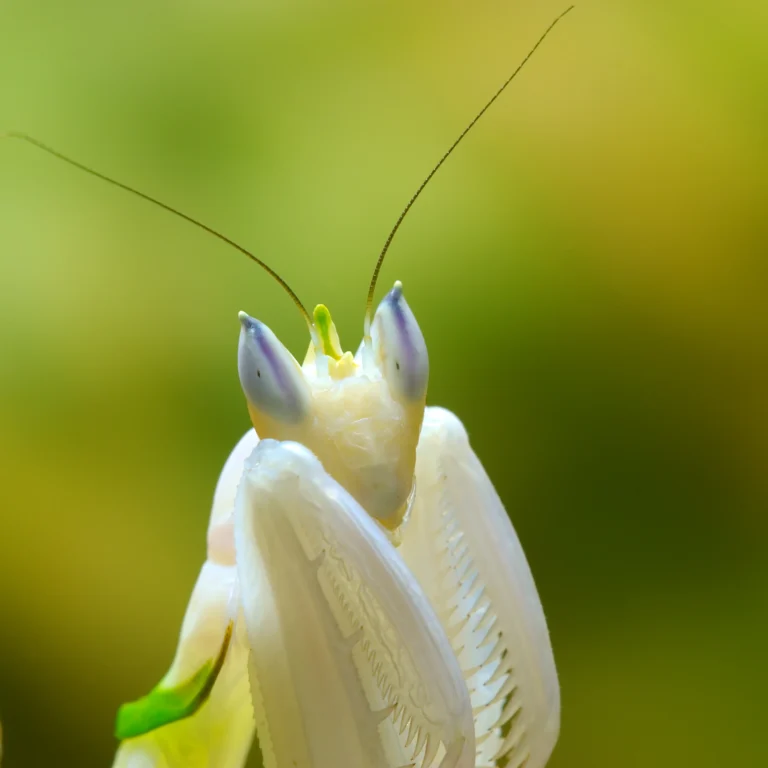
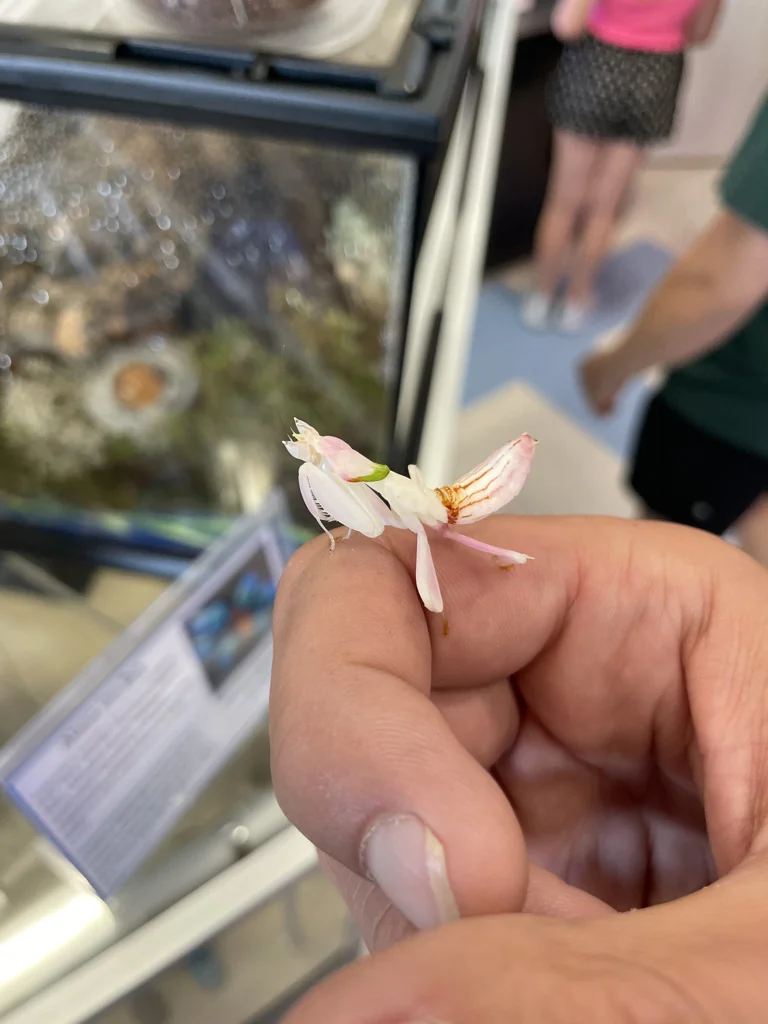
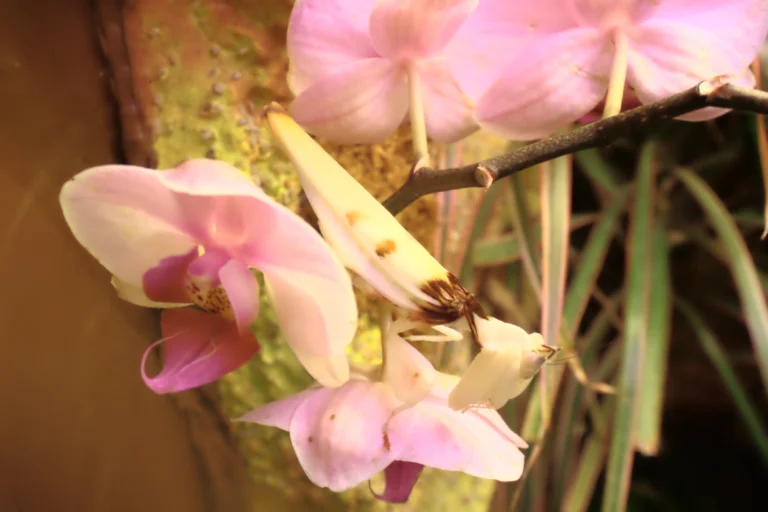
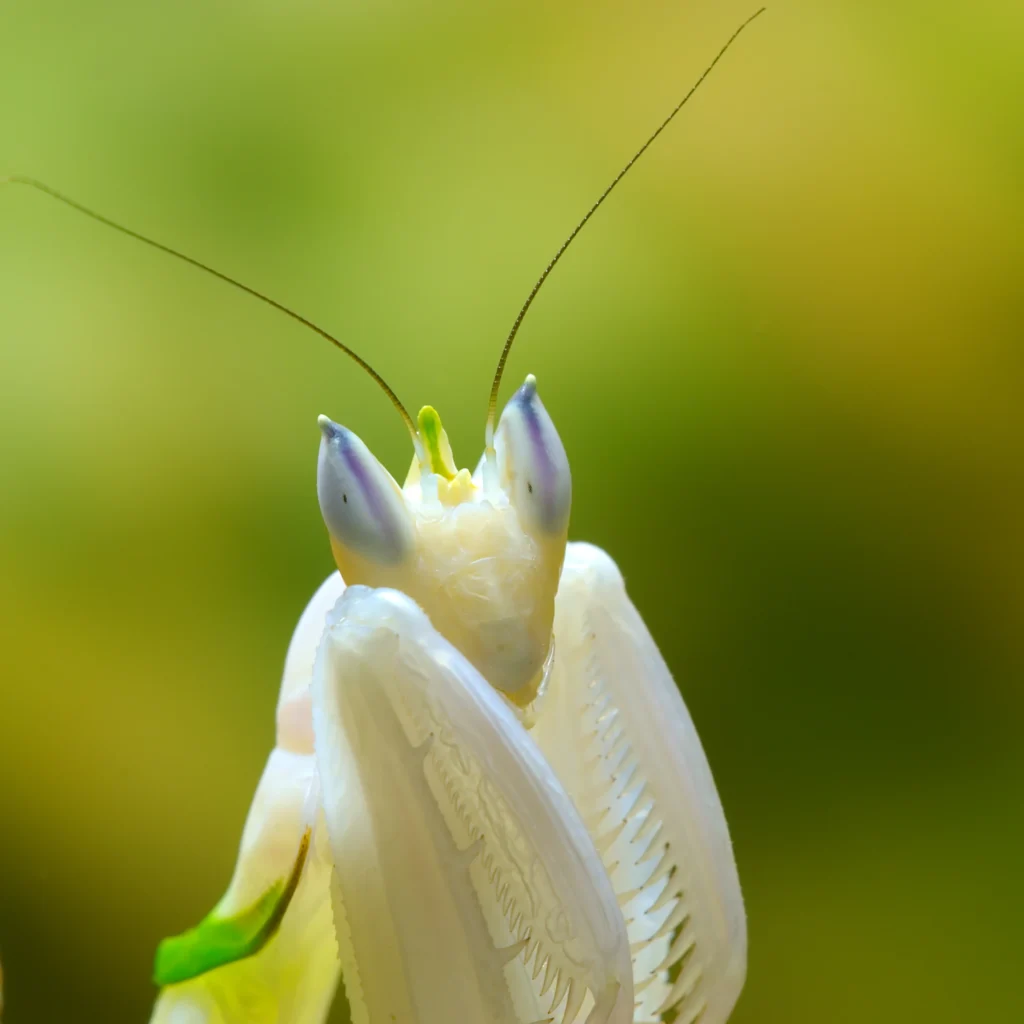
The orchid mantis is the textbook flower mimic. Its four walking legs carry wide, flat, rounded lobes that look like petals. Its body is predominantly white, often with pink or yellow hues, according to a 2013 study in the Journal of Orthoptera Research. Juvenile females look most flower-like. Adult females keep the coloring and gain wings that cover the back, while adult males are small and greenish brown.
It hunts in plain sight. Field research published in 2014 found that orchid mantises attracted pollinating insects at a higher rate than nearby flowers. Our orchid mantis camouflage guide covers those studies.
The ghost mantis
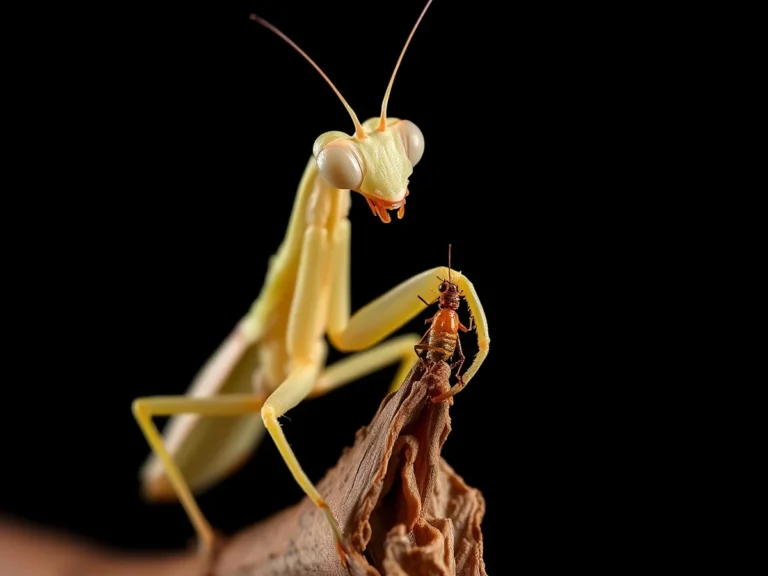
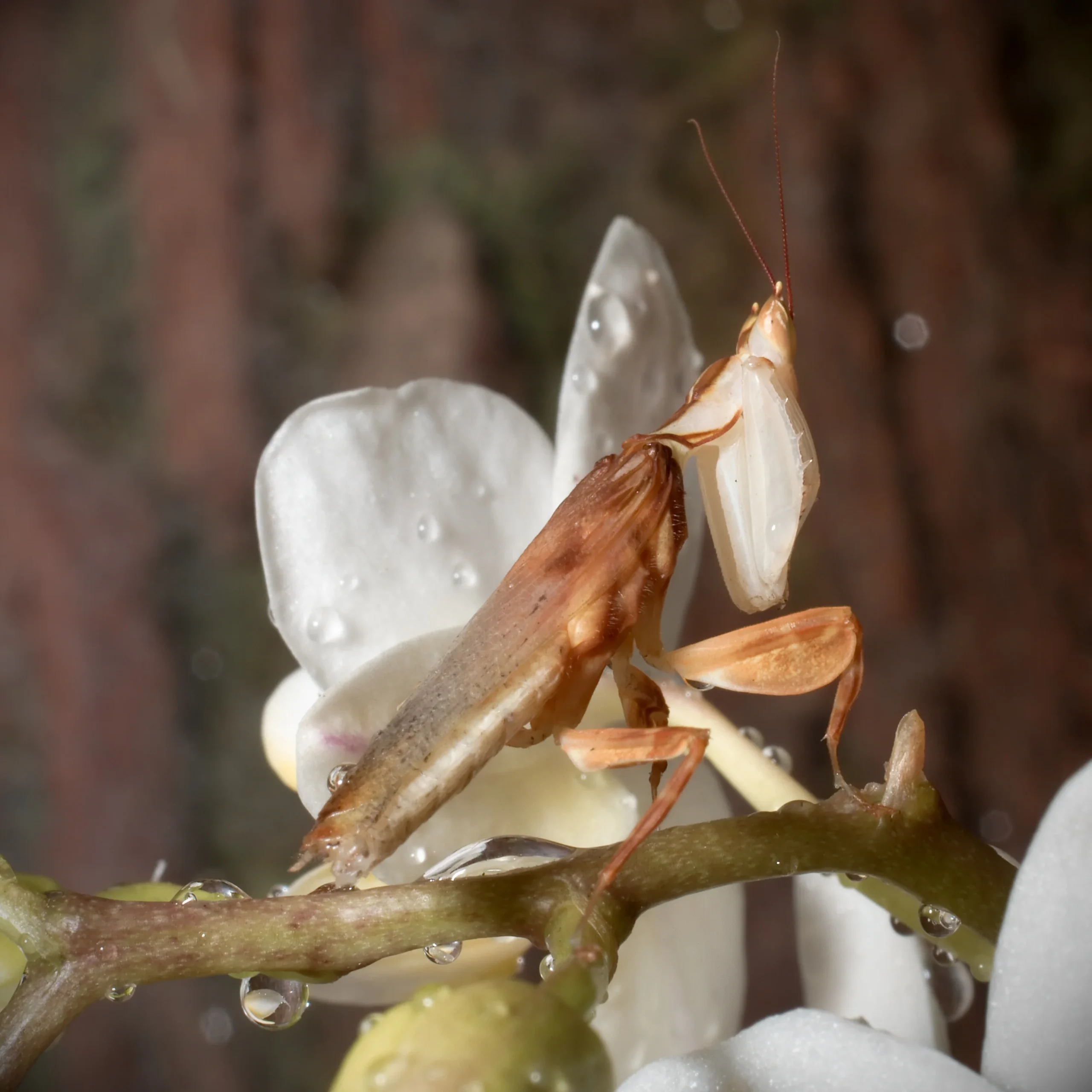
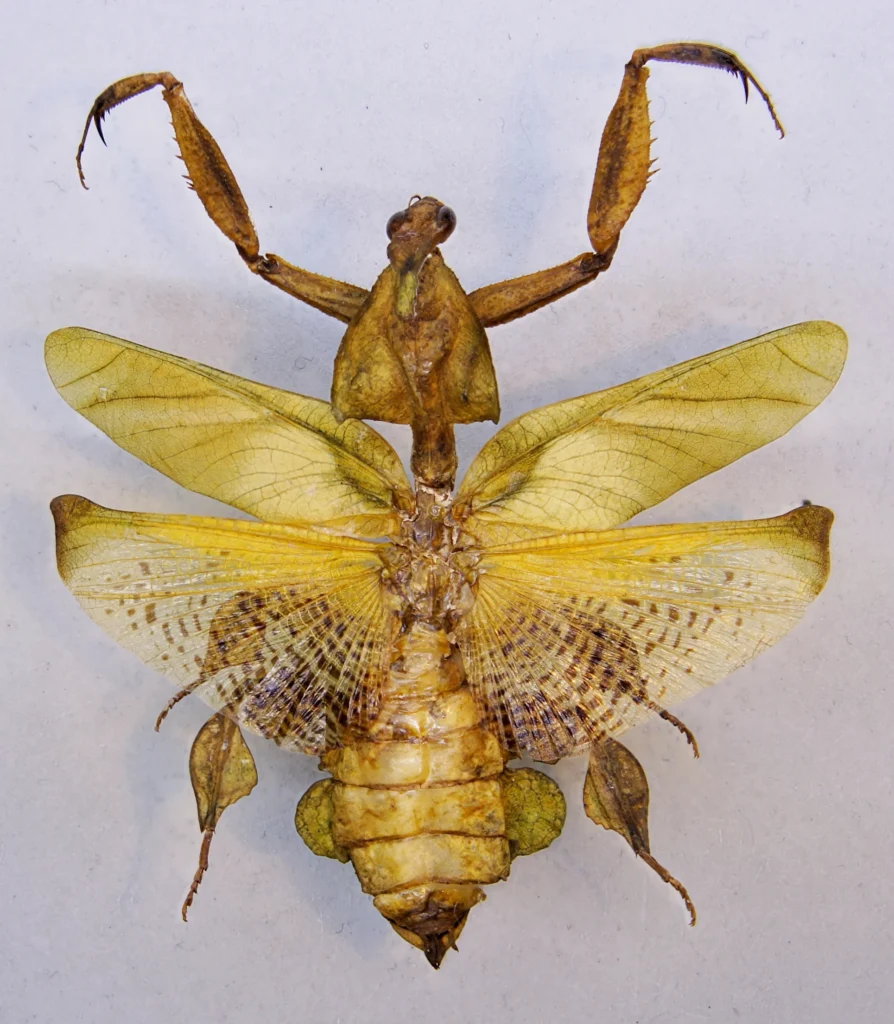
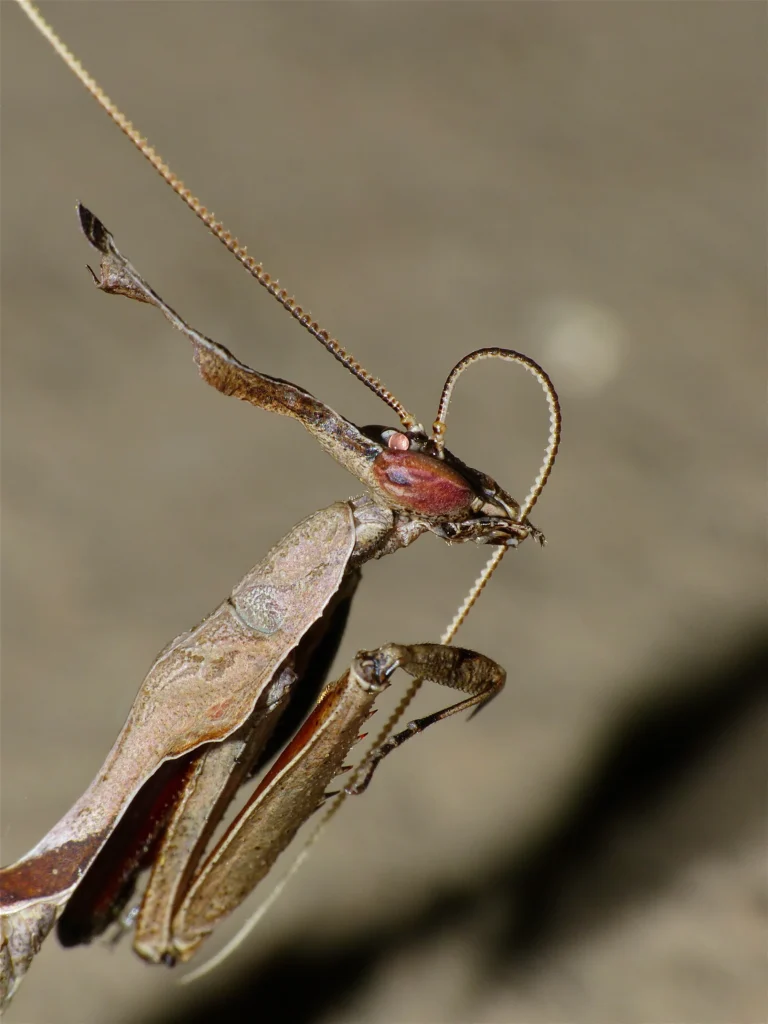
The ghost mantis takes the opposite approach. It imitates a dead leaf. Its forewings look like a dry, crinkled leaf, and Wikipedia notes that the apparent creases are actually shading in the pigment. It has a tall, leaf-shaped crest on its head, which gives the species its Latin name: Phyllocrania refers to the leaf-like head, and paradoxa means strange or contrary to expectation.
Colors range from dark brown to beige to green. It often hangs among twigs and dry foliage, and the Montreal Insectarium notes that it can even hang upside down beneath branches to perfect the illusion. Rather than luring prey, it relies on not being noticed.
Size
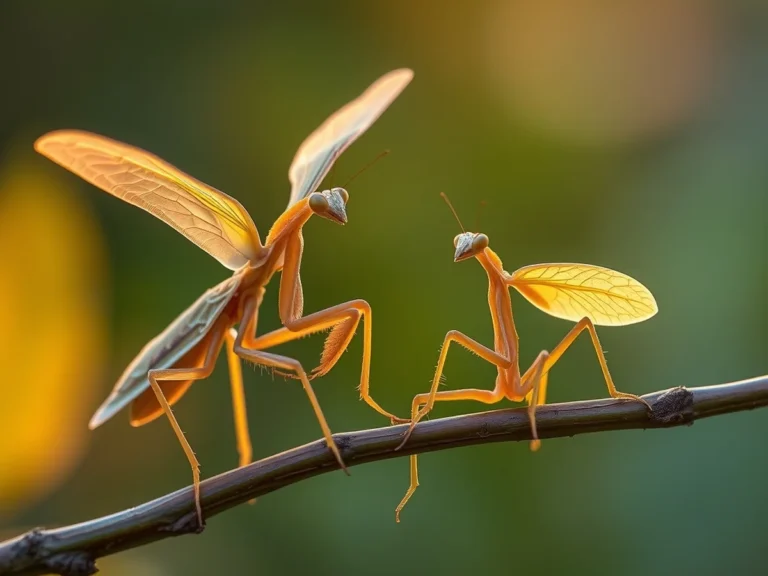
The orchid mantis shows one of the largest size gaps between the sexes of any mantis. Adult females reach about 6 to 7 cm, while males reach only about 2.5 to 3 cm. A US Mantis care sheet describes females as roughly 12 times heavier than males.
The ghost mantis is described as a miniature species compared with many mantises. Dimensions.com gives an overall body length of about 4.5 to 6 cm. Females are bulkier than males, but the size difference is far less dramatic than in the orchid mantis.
For detailed growth figures, see orchid mantis size and male vs female orchid mantis.
Where They Come From
The orchid mantis lives in the tropical forests of Southeast Asia. Wikipedia lists Cambodia, Indonesia, Laos, Malaysia, Myanmar, Singapore, Thailand and Vietnam. It has been recorded hunting on flowering shrubs such as the Straits rhododendron. See our orchid mantis habitat guide.
The ghost mantis is African. Care sources describe it as native to sub-Saharan Africa and Madagascar, where Wikipedia says it lives in dry areas, bushes, shrubs and trees in the open. This difference in habitat explains much of the difference in care.
Lifespan
Most keepers report that female orchid mantises live roughly 8 to 9 months and males about 5 to 6 months, counted from hatching. Temperature has a strong influence. See orchid mantis lifespan.
For the ghost mantis, Dubia Roaches and Reptile Supply both give a total lifespan of about 7 to 12 months, with females living longer, particularly at lower temperatures. Other sources give shorter ranges, such as 4 to 8 months on Dimensions.com, which shows how much lifespan depends on conditions.
In practice, the two species live for similar spans, with ghost mantis males often outliving orchid mantis males.
Life Cycle and Breeding
Both species follow the usual mantis pattern of egg case, nymph and adult, with no pupa. The details differ in ways that matter to keepers.
Orchid mantis. Newly hatched nymphs are red and black, a coloring that is thought to resemble foul-tasting assassin bugs. They turn white and pink after the early molts. A US Mantis care sheet reports molts roughly every three weeks, with the final molt taking about twice as long. Its keeper data puts egg case incubation at about 40 days at 80°F, with an average of around 40 nymphs per hatch, though numbers vary widely. Because males mature months before females, breeders have to slow the males down with cooler temperatures and less food so a pair is ready at the same time. Details are in orchid mantis eggs and breeding.
Ghost mantis. Ghost mantis nymphs already look like tiny dead leaves. Insektenliebe reports that, at 29°C, nymphs hatch after about four weeks and should be offered food straight away. Males and females mature on a closer timeline than in orchid mantises, which makes pairing simpler.
The practical result: breeding ghost mantises is a common first breeding project, while breeding orchid mantises is usually something keepers attempt after some experience.
Care Requirements
Humidity and ventilation
This is the biggest practical difference. Orchid mantises are generally kept at about 60 to 80% humidity, with misting and good airflow. A US Mantis care sheet warns that high humidity without adequate ventilation will kill specimens, so the goal is humid but moving air, not a damp, stagnant box.
Ghost mantises are more relaxed. Jack of All Inverts suggests 35 to 50% humidity, while noting they can tolerate higher. Spraying daily or every other day is usually enough.
Temperature
Orchid mantises are commonly kept around 75 to 85°F. Ghost mantises do well at about 72 to 80°F. Both benefit from a slight drop at night.
Enclosure
Both species need an enclosure at least three times as tall as the mantis is long, with a mesh or textured lid to hang from during molts. Ghost mantises are small enough for compact setups. A large female orchid mantis needs more height. Our orchid mantis enclosure guide gives exact sizes.
Feeding
Orchid mantises are adapted to catch flying pollinators. The Cincinnati Zoo, which raises them, says its orchid mantises will only eat flying prey, so keepers use fruit flies for small nymphs and larger flies for older ones. Ghost mantises also take flying insects readily and are generally less fussy. See what orchid mantises eat.
Housing together
Orchid mantises should be kept one per enclosure. Ghost mantises have a reputation for lower aggression; the German breeder Insektenliebe notes they can be kept in groups when food is plentiful. Even so, cannibalism remains possible, especially after a molt, and most keepers house adults separately.
Temperament and Behavior
Female orchid mantises are calm and slow-moving. They tend to sit in one spot and wait. Adult males are much more active and will fly.
Ghost mantises are also calm but more likely to flee than fight. When threatened, they may drop, freeze or spread their wings in a startle display. Green Matters reports that they may hiss and spread their wings to look intimidating rather than run.
Neither species is dangerous to people. Both may grip a finger with their forelegs, which is harmless.
Which One Should You Choose?
Choose the ghost mantis if:
- This is your first exotic mantis.
- You want a species that tolerates a range of humidity levels.
- You like the idea of a mantis that is a master of disguise rather than a showpiece.
- You want a lower price and easier access to captive-bred nymphs.
Choose the orchid mantis if:
- You have already kept a mantis successfully through its molts.
- You can maintain warm, humid air with good ventilation.
- You can supply a steady stream of live flying insects.
- You want one of the most striking insects in the hobby and accept a higher price.
Many keepers start with a ghost mantis and move to an orchid mantis later. That path lets you learn molting, feeding and humidity control on a more forgiving species. Read our honest guide to the orchid mantis as a pet and the orchid mantis care sheet before deciding.
Orchid Mantis vs Praying Mantis: Is It a Different Insect?
A common question is whether the orchid mantis is a praying mantis at all. It is. “Praying mantis” is the everyday name for the whole order Mantodea, which includes more than 2,400 species. The orchid mantis is one of them.
When people compare “orchid mantis vs praying mantis,” they usually mean the common green or brown mantises found in gardens, such as the European mantis (Mantis religiosa) or the Chinese mantis. Here is how the orchid mantis stands out:
| Feature | Orchid mantis | Typical garden praying mantis |
|---|---|---|
| Color | White to pink | Green or brown |
| Leg shape | Petal-like lobes on walking legs | Plain, slender legs |
| Hunting style | Lures pollinators by looking like a flower | Hides among leaves and stems |
| Climate | Tropical, cannot survive cold winters | Many species survive temperate winters as eggs |
| Size difference between sexes | Extreme | Usually moderate |
Like all praying mantises, the orchid mantis has raptorial forelegs, large compound eyes, three small simple eyes, and a flexible neck. Wikipedia notes that some mantises can rotate their heads nearly 180 degrees. More on body structure is in our orchid mantis anatomy guide.
Legal Note
Both species are exotic in the United States and many other countries. USDA APHIS advises contacting its Plant Protection and Quarantine program before buying any land-dwelling invertebrate, because many non-native species need a permit or are illegal to keep. See can you own an orchid mantis?
Related Guides
If you want to go deeper, these guides pick up where this page leaves off:
- Orchid mantis care sheet: temperature, humidity, feeding and molting.
- Orchid mantis as a pet: pros, cons and who it suits.
- Flower mantis species: every major flower-mimicking mantis compared.
- Orchid mantis: the complete guide: everything about the species in one place.
Frequently Asked Questions
Is the ghost mantis related to the orchid mantis?
Yes. Both belong to the family Hymenopodidae. Researchers have noted that the ghost mantis is more closely related to orchid mantises than to some dead-leaf mantises that look like it.
Which is easier to keep, a ghost mantis or an orchid mantis?
The ghost mantis is generally easier. It tolerates lower humidity and a wider range of conditions. The orchid mantis needs more careful humidity, ventilation and feeding.
Is there a “ghost orchid mantis”?
No species goes by that name. The phrase usually comes from people searching for both mantises at once. A ghost orchid is a plant, not an insect.
Which lives longer?
They are broadly similar. Ghost mantises are often given 7 to 12 months; female orchid mantises around 8 to 9 months in captivity. Males of the orchid mantis are usually the shortest-lived.
Can a ghost mantis and an orchid mantis live together?
No. Different mantis species should never share an enclosure. They may eat each other, and their humidity needs differ.
Is the orchid mantis a praying mantis?
Yes. Every species in the order Mantodea is a praying mantis, including the orchid mantis.
Sources
- American Museum of Natural History, “How Mantises Became Nature’s Strangest Assassins”: https://www.amnh.org/explore/videos/biodiversity/mantises-predators
- Wikipedia, Phyllocrania paradoxa: https://en.wikipedia.org/wiki/Phyllocrania_paradoxa
- Jack of All Inverts, Ghost Mantis care sheet: https://jackofallinverts.github.io/caresheets/ghost.html
- Dubia Roaches, Ghost mantis care sheet: https://dubiaroaches.com/blogs/invert-care/ghost-mantis-care-sheet
- Reptile Supply, How to care for your ghost mantis: https://reptilesupply.com/blogs/misc-invertebrate-care-sheets/how-to-care-for-your-ghost-mantis
- Dimensions.com, Ghost Mantis: https://www.dimensions.com/element/ghost-mantis-phyllocrania-paradoxa
- Montreal Insectarium (Espace pour la vie), Ghost mantis: https://espacepourlavie.ca/en/insects-arthropods/ghost-mantis?mode=76
- Insektenliebe, Phyllocrania paradoxa: https://insektenliebe.com/en/?p=150053
- Green Matters, What Is a Ghost Mantis?: https://www.greenmatters.com/community/ghost-mantis
- O’Hanlon, J.C., Li, D. and Norma-Rashid, Y. (2013). Coloration and morphology of the orchid mantis. https://hdl.handle.net/1959.11/27641
- US Mantis, orchid mantis care sheet (PDF): https://cdn.shopify.com/s/files/1/1296/7335/files/Orchid_Mantis_care_sheet.pdf
- Cincinnati Zoo and Botanical Garden: https://cincinnatizoo.org/?p=252752
- Wikipedia, Mantis: https://Www.Wikipedia.org/wiki/Mantis
- USDA APHIS, Invertebrate Pets: https://www.aphis.usda.gov/organism-soil-imports/invertebrate-pets